

284
Chapter 16 · Nature’s Pharmacy - Natural Pharmaceuticals
16
chona seedlings in the Dutch colony of Java. For
this “meritorious” deed, he was knighted by the
Dutch king as the “Knight of the Lion Order”.
In other Asian countries, such as India and
Ceylon, plantations of the cinchona tree were
also installed. Since the production increased
strongly, of course the price fell and many plantation owners had to declare bankruptcy. Today
the main growing areas are in Indonesia, Malaysia and Congo.
For a long time, the structure of quinine
remained unknown. It was not until 1908 that
the German chemist Paul Rabe was able to
establish the exact constitutional formula of quinine (. Fig. 16.10). Since quinine has four stereo centers, 16 stereoisomers are theoretically
possible. In 1950, Prelog and Häflinger could
finally determine the configuration for quinine
shown in . Fig. 16.10. Nowadays, several multistage total syntheses for quinine do exist, but all
of them are very complex and therefore uneconomical. The 300–500 tons of quinine per year
required today are therefore still obtained by
bark extraction.
For centuries, quinine was the only known
anti-malaria drug. In the meantime, it has been
replaced by much better remedies. Today, quinine is still used in small quantities in beverages, e.g. in tonic water. The idea for this drink
dates back to colonial times: All British soldiers
and officials should take a daily dose of quinine
to prevent malaria. Since quinine tastes very bitter, however, it was dissolved in soda water and
mixed with lemon juice. The tonic mixed in this
way was often drunk well chilled in a mixture
with gin: It was the invention of the gin tonic
(BOX: Shaken or stirred?).
16.4 Quinine
Quinine is extracted from the bark of the cinchona tree. This tree originates from the high
forests of the Andes. The Peruvian Indians, who
called this tree quinaquina (“bark of the bark”),
already knew the antipyretic properties of these
bark extracts. In the course of the sixteenth
century, the powder of the ground cinchona
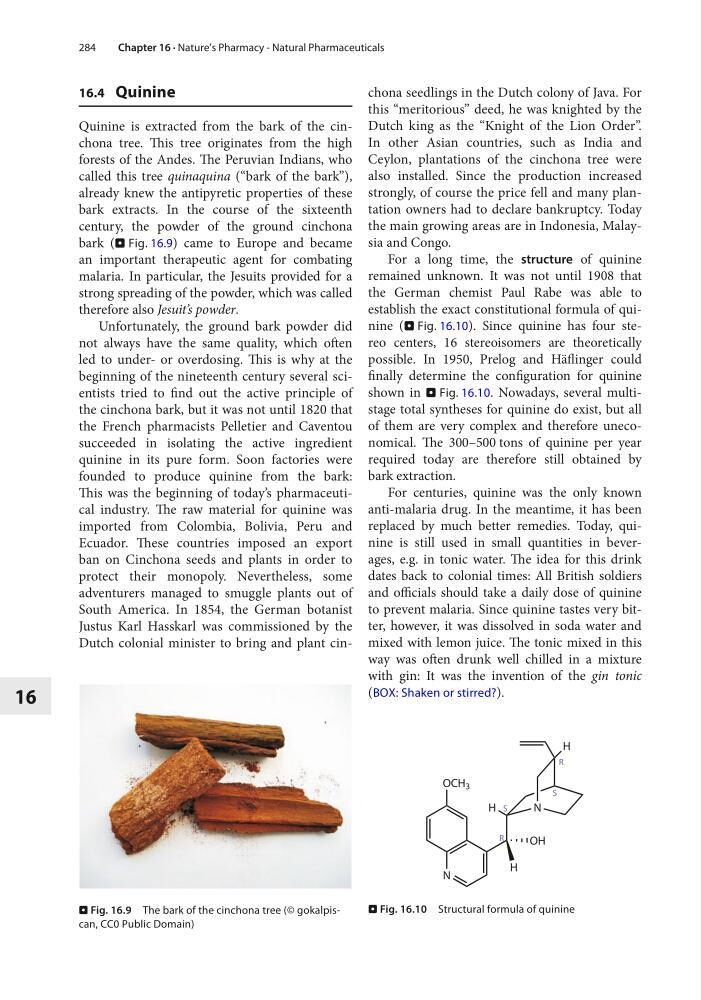
bark (. Fig. 16.9) came to Europe and became
an important therapeutic agent for combating
malaria. In particular, the Jesuits provided for a
strong spreading of the powder, which was called
therefore also Jesuit’s powder.
Unfortunately, the ground bark powder did
not always have the same quality, which often
led to under- or overdosing. This is why at the
beginning of the nineteenth century several scientists tried to find out the active principle of
the cinchona bark, but it was not until 1820 that
the French pharmacists Pelletier and Caventou
succeeded in isolating the active ingredient
quinine in its pure form. Soon factories were
founded to produce quinine from the bark:
This was the beginning of today’s pharmaceutical industry. The raw material for quinine was
imported from Colombia, Bolivia, Peru and
Ecuador. These countries imposed an export
ban on Cinchona seeds and plants in order to
protect their monopoly. Nevertheless, some
adventurers managed to smuggle plants out of
South America. In 1854, the German botanist
Justus Karl Hasskarl was commissioned by the
Dutch colonial minister to bring and plant cinN
OCH 3
H
OH
N
H
H
R
S
R
S
. Fig. 16.10 Structural formula of quinine
. Fig. 16.9 The bark of the cinchona tree (© gokalpiscan, CC0 Public Domain)
Chapter 16 · Nature’s Pharmacy - Natural Pharmaceuticals
16
chona seedlings in the Dutch colony of Java. For
this “meritorious” deed, he was knighted by the
Dutch king as the “Knight of the Lion Order”.
In other Asian countries, such as India and
Ceylon, plantations of the cinchona tree were
also installed. Since the production increased
strongly, of course the price fell and many plantation owners had to declare bankruptcy. Today
the main growing areas are in Indonesia, Malaysia and Congo.
For a long time, the structure of quinine
remained unknown. It was not until 1908 that
the German chemist Paul Rabe was able to
establish the exact constitutional formula of quinine (. Fig. 16.10). Since quinine has four stereo centers, 16 stereoisomers are theoretically
possible. In 1950, Prelog and Häflinger could
finally determine the configuration for quinine
shown in . Fig. 16.10. Nowadays, several multistage total syntheses for quinine do exist, but all
of them are very complex and therefore uneconomical. The 300–500 tons of quinine per year
required today are therefore still obtained by
bark extraction.
For centuries, quinine was the only known
anti-malaria drug. In the meantime, it has been
replaced by much better remedies. Today, quinine is still used in small quantities in beverages, e.g. in tonic water. The idea for this drink
dates back to colonial times: All British soldiers
and officials should take a daily dose of quinine
to prevent malaria. Since quinine tastes very bitter, however, it was dissolved in soda water and
mixed with lemon juice. The tonic mixed in this
way was often drunk well chilled in a mixture
with gin: It was the invention of the gin tonic
(BOX: Shaken or stirred?).
16.4 Quinine
Quinine is extracted from the bark of the cinchona tree. This tree originates from the high
forests of the Andes. The Peruvian Indians, who
called this tree quinaquina (“bark of the bark”),
already knew the antipyretic properties of these
bark extracts. In the course of the sixteenth
century, the powder of the ground cinchona
bark (. Fig. 16.9) came to Europe and became
an important therapeutic agent for combating
malaria. In particular, the Jesuits provided for a
strong spreading of the powder, which was called
therefore also Jesuit’s powder.
Unfortunately, the ground bark powder did
not always have the same quality, which often
led to under- or overdosing. This is why at the
beginning of the nineteenth century several scientists tried to find out the active principle of
the cinchona bark, but it was not until 1820 that
the French pharmacists Pelletier and Caventou
succeeded in isolating the active ingredient
quinine in its pure form. Soon factories were
founded to produce quinine from the bark:
This was the beginning of today’s pharmaceutical industry. The raw material for quinine was
imported from Colombia, Bolivia, Peru and
Ecuador. These countries imposed an export
ban on Cinchona seeds and plants in order to
protect their monopoly. Nevertheless, some
adventurers managed to smuggle plants out of
South America. In 1854, the German botanist
Justus Karl Hasskarl was commissioned by the
Dutch colonial minister to bring and plant cinN
OCH 3
H
OH
N
H
H
R
S
R
S
. Fig. 16.10 Structural formula of quinine
. Fig. 16.9 The bark of the cinchona tree (© gokalpiscan, CC0 Public Domain)