

283
16
distillation and extraction, leads to particularly
pure caffeine. The remaining 15,000 tons of caffeine are produced synthetically via a five-stage
synthesis process based on dimethylurea and
cyanoacetic acid.
developed by Kurt Zosel at the Max Planck Institute for Coal Research in Mülheim, Germany,
green coffee is decaffeinated with supercritical
carbon dioxide (see BOX: “Decaffeination: The Impotent Coffee”). This distraction, a combination of
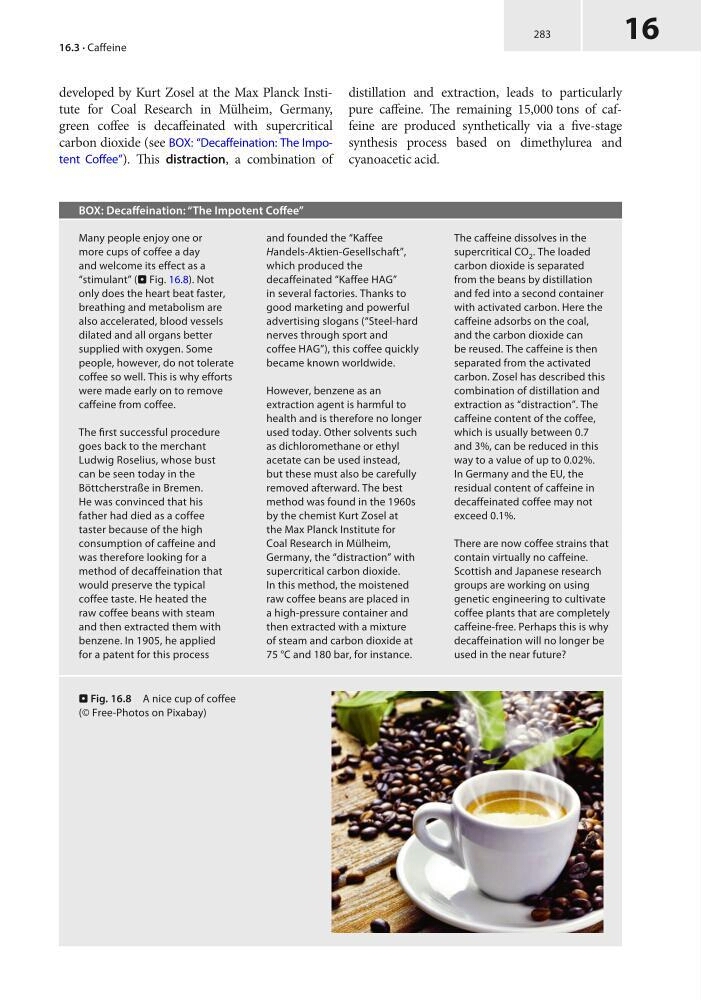
. Fig. 16.8 A nice cup of coffee
(© Free-Photos on Pixabay)
16.3 · Caffeine
BOX: Decaffeination: “The Impotent Coffee”
Many people enjoy one or
more cups of coffee a day
and welcome its effect as a
“stimulant” (. Fig. 16.8). Not
only does the heart beat faster,
breathing and metabolism are
also accelerated, blood vessels
dilated and all organs better
supplied with oxygen. Some
people, however, do not tolerate
coffee so well. This is why efforts
were made early on to remove
caffeine from coffee.
The first successful procedure
goes back to the merchant
Ludwig Roselius, whose bust
can be seen today in the
Böttcherstraße in Bremen.
He was convinced that his
father had died as a coffee
taster because of the high
consumption of caffeine and
was therefore looking for a
method of decaffeination that
would preserve the typical
coffee taste. He heated the
raw coffee beans with steam
and then extracted them with
benzene. In 1905, he applied
for a patent for this process
and founded the “Kaffee
Handels-Aktien-Gesellschaft”,
which produced the
decaffeinated “Kaffee HAG”
in several factories. Thanks to
good marketing and powerful
advertising slogans (“Steel-hard
nerves through sport and
coffee HAG”), this coffee quickly
became known worldwide.
However, benzene as an
extraction agent is harmful to
health and is therefore no longer
used today. Other solvents such
as dichloromethane or ethyl
acetate can be used instead,
but these must also be carefully
removed afterward. The best
method was found in the 1960s
by the chemist Kurt Zosel at
the Max Planck Institute for
Coal Research in Mülheim,
Germany, the “distraction” with
supercritical carbon dioxide.
In this method, the moistened
raw coffee beans are placed in
a high-pressure container and
then extracted with a mixture
of steam and carbon dioxide at
75 °C and 180 bar, for instance.
The caffeine dissolves in the
supercritical CO 2 . The loaded
carbon dioxide is separated
from the beans by distillation
and fed into a second container
with activated carbon. Here the
caffeine adsorbs on the coal,
and the carbon dioxide can
be reused. The caffeine is then
separated from the activated
carbon. Zosel has described this
combination of distillation and
extraction as “distraction”. The
caffeine content of the coffee,
which is usually between 0.7
and 3%, can be reduced in this
way to a value of up to 0.02%.
In Germany and the EU, the
residual content of caffeine in
decaffeinated coffee may not
exceed 0.1%.
There are now coffee strains that
contain virtually no caffeine.
Scottish and Japanese research
groups are working on using
genetic engineering to cultivate
coffee plants that are completely
caffeine-free. Perhaps this is why
decaffeination will no longer be
used in the near future?
16
distillation and extraction, leads to particularly
pure caffeine. The remaining 15,000 tons of caffeine are produced synthetically via a five-stage
synthesis process based on dimethylurea and
cyanoacetic acid.
developed by Kurt Zosel at the Max Planck Institute for Coal Research in Mülheim, Germany,
green coffee is decaffeinated with supercritical
carbon dioxide (see BOX: “Decaffeination: The Impotent Coffee”). This distraction, a combination of
. Fig. 16.8 A nice cup of coffee
(© Free-Photos on Pixabay)
16.3 · Caffeine
BOX: Decaffeination: “The Impotent Coffee”
Many people enjoy one or
more cups of coffee a day
and welcome its effect as a
“stimulant” (. Fig. 16.8). Not
only does the heart beat faster,
breathing and metabolism are
also accelerated, blood vessels
dilated and all organs better
supplied with oxygen. Some
people, however, do not tolerate
coffee so well. This is why efforts
were made early on to remove
caffeine from coffee.
The first successful procedure
goes back to the merchant
Ludwig Roselius, whose bust
can be seen today in the
Böttcherstraße in Bremen.
He was convinced that his
father had died as a coffee
taster because of the high
consumption of caffeine and
was therefore looking for a
method of decaffeination that
would preserve the typical
coffee taste. He heated the
raw coffee beans with steam
and then extracted them with
benzene. In 1905, he applied
for a patent for this process
and founded the “Kaffee
Handels-Aktien-Gesellschaft”,
which produced the
decaffeinated “Kaffee HAG”
in several factories. Thanks to
good marketing and powerful
advertising slogans (“Steel-hard
nerves through sport and
coffee HAG”), this coffee quickly
became known worldwide.
However, benzene as an
extraction agent is harmful to
health and is therefore no longer
used today. Other solvents such
as dichloromethane or ethyl
acetate can be used instead,
but these must also be carefully
removed afterward. The best
method was found in the 1960s
by the chemist Kurt Zosel at
the Max Planck Institute for
Coal Research in Mülheim,
Germany, the “distraction” with
supercritical carbon dioxide.
In this method, the moistened
raw coffee beans are placed in
a high-pressure container and
then extracted with a mixture
of steam and carbon dioxide at
75 °C and 180 bar, for instance.
The caffeine dissolves in the
supercritical CO 2 . The loaded
carbon dioxide is separated
from the beans by distillation
and fed into a second container
with activated carbon. Here the
caffeine adsorbs on the coal,
and the carbon dioxide can
be reused. The caffeine is then
separated from the activated
carbon. Zosel has described this
combination of distillation and
extraction as “distraction”. The
caffeine content of the coffee,
which is usually between 0.7
and 3%, can be reduced in this
way to a value of up to 0.02%.
In Germany and the EU, the
residual content of caffeine in
decaffeinated coffee may not
exceed 0.1%.
There are now coffee strains that
contain virtually no caffeine.
Scottish and Japanese research
groups are working on using
genetic engineering to cultivate
coffee plants that are completely
caffeine-free. Perhaps this is why
decaffeination will no longer be
used in the near future?