

280
Chapter 16 · Nature’s Pharmacy - Natural Pharmaceuticals
16
sharply, von Heyden decided to build a factory in
neighboring Radebeul, which began production
in 1875. Today, it is one of the “Historical Sites of
Chemistry” of the Society of German Chemists
(GDCh).
Because of the bitter taste and especially
because of the strong stomach-irritating effect
of sodium salicylate, an alternative was sought
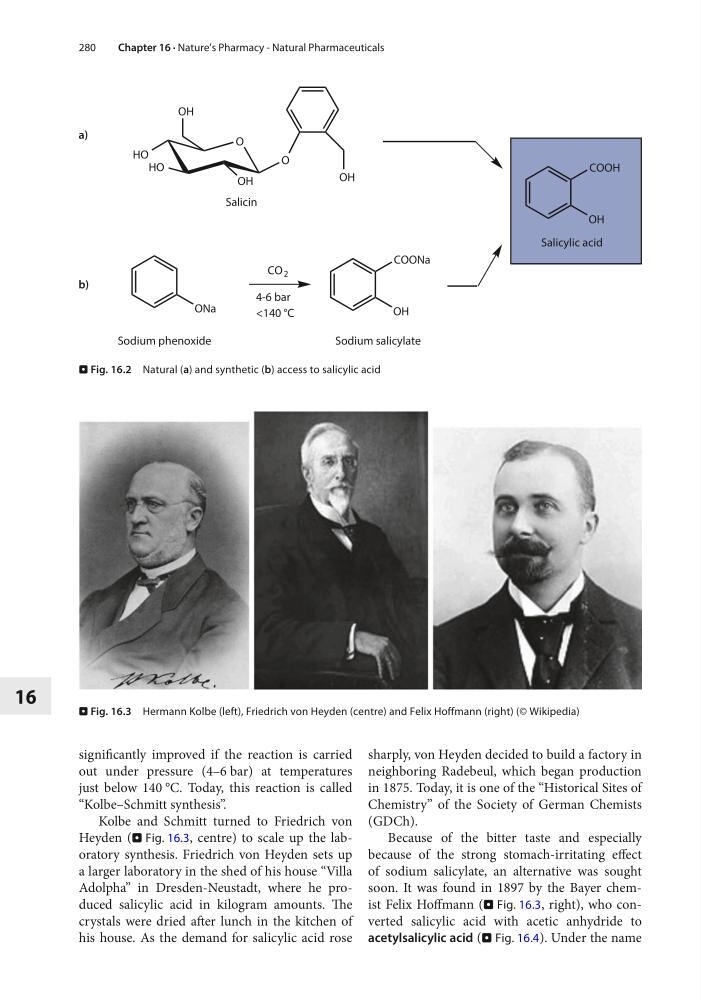
soon. It was found in 1897 by the Bayer chemist Felix Hoffmann (. Fig. 16.3, right), who converted salicylic acid with acetic anhydride to
acetylsalicylic acid (. Fig. 16.4). Under the name
significantly improved if the reaction is carried
out under pressure (4–6 bar) at temperatures
just below 140 °C. Today, this reaction is called
“Kolbe–Schmitt synthesis”.
Kolbe and Schmitt turned to Friedrich von
Heyden (. Fig. 16.3, centre) to scale up the laboratory synthesis. Friedrich von Heyden sets up
a larger laboratory in the shed of his house “Villa
Adolpha” in Dresden-Neustadt, where he produced salicylic acid in kilogram amounts. The
crystals were dried after lunch in the kitchen of
his house. As the demand for salicylic acid rose
O
HO
HO
O
OH
OH
OH
ONa
COONa
OH
a)
b)
COOH
OH
Salicin
Sodium phenoxide
CO 2
4-6 bar
<140 °C
Sodium salicylate
Salicylic acid
. Fig. 16.2 Natural (a) and synthetic (b) access to salicylic acid
. Fig. 16.3 Hermann Kolbe (left), Friedrich von Heyden (centre) and Felix Hoffmann (right) (© Wikipedia)
Chapter 16 · Nature’s Pharmacy - Natural Pharmaceuticals
16
sharply, von Heyden decided to build a factory in
neighboring Radebeul, which began production
in 1875. Today, it is one of the “Historical Sites of
Chemistry” of the Society of German Chemists
(GDCh).
Because of the bitter taste and especially
because of the strong stomach-irritating effect
of sodium salicylate, an alternative was sought
soon. It was found in 1897 by the Bayer chemist Felix Hoffmann (. Fig. 16.3, right), who converted salicylic acid with acetic anhydride to
acetylsalicylic acid (. Fig. 16.4). Under the name
significantly improved if the reaction is carried
out under pressure (4–6 bar) at temperatures
just below 140 °C. Today, this reaction is called
“Kolbe–Schmitt synthesis”.
Kolbe and Schmitt turned to Friedrich von
Heyden (. Fig. 16.3, centre) to scale up the laboratory synthesis. Friedrich von Heyden sets up
a larger laboratory in the shed of his house “Villa
Adolpha” in Dresden-Neustadt, where he produced salicylic acid in kilogram amounts. The
crystals were dried after lunch in the kitchen of
his house. As the demand for salicylic acid rose
O
HO
HO
O
OH
OH
OH
ONa
COONa
OH
a)
b)
COOH
OH
Salicin
Sodium phenoxide
CO 2
4-6 bar
<140 °C
Sodium salicylate
Salicylic acid
. Fig. 16.2 Natural (a) and synthetic (b) access to salicylic acid
. Fig. 16.3 Hermann Kolbe (left), Friedrich von Heyden (centre) and Felix Hoffmann (right) (© Wikipedia)