

279
16
liver to form the true active ingredient, salicylic
acid. Salicin was first isolated in 1828 by the
Munich pharmacist Johann Andreas Buchner.
The name Salicin was derived from the botanical
name for the willow (Salix). Ten years later, the
Italian Raffaele Piria was able to produce salicylic
acid for the first time by oxidizing salicin
(. Fig. 16.2a).
However, the exact chemical structure of salicylic acid (ortho-hydroxybenzoic acid) remained
unknown for a long time. Here started the work
of Hermann Kolbe (. Fig. 16.3, left), a chemistry professor in Marburg in the 1850s. He could
show that the reaction of sodium phenolate
with carbon dioxide produces sodium salicylate
from which salicylic acid can then be released
(. Fig. 16.2b). Kolbe’s pupil, Rudolf Schmitt,
found that the low yield of this reaction can be
pharmaceutical ingredients (API) have been isolated from plants and further developed into
pharmaceuticals. In the following, we will briefly
deal with the active ingredients acetylsalicylic
acid (brand name: Aspirin®), caffeine, quinine
and morphine as well as some information about
penicillin’s and steroids.
16.2 Aspirin
In ancient times, both the Egyptians and later the
Greeks were well aware that willow bark extract
could be used as a remedy for pain and fever.
Today, it is known that willow bark contains the
β-glucoside salicin, a compound of glucose and
salicyl alcohol. In the intestine, the glucoside is
split and the salicyl alcohol is metabolized in the
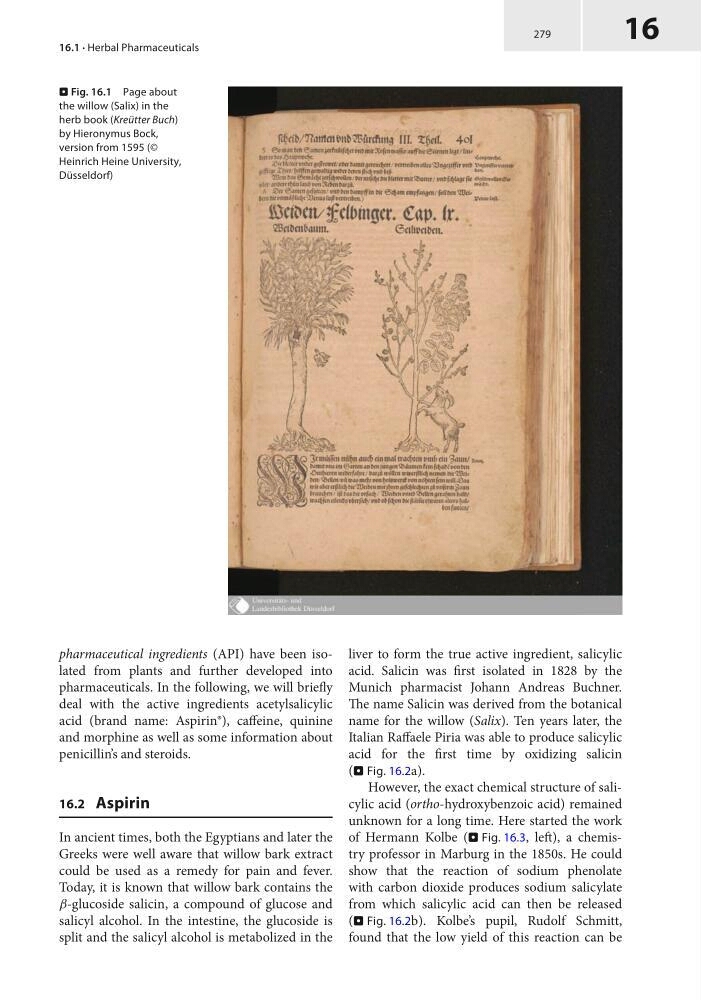
. Fig. 16.1 Page about
the willow (Salix) in the
herb book (Kreütter Buch)
by Hieronymus Bock,
version from 1595 (©
Heinrich Heine University,
Düsseldorf)
16.1 · Herbal Pharmaceuticals
16
liver to form the true active ingredient, salicylic
acid. Salicin was first isolated in 1828 by the
Munich pharmacist Johann Andreas Buchner.
The name Salicin was derived from the botanical
name for the willow (Salix). Ten years later, the
Italian Raffaele Piria was able to produce salicylic
acid for the first time by oxidizing salicin
(. Fig. 16.2a).
However, the exact chemical structure of salicylic acid (ortho-hydroxybenzoic acid) remained
unknown for a long time. Here started the work
of Hermann Kolbe (. Fig. 16.3, left), a chemistry professor in Marburg in the 1850s. He could
show that the reaction of sodium phenolate
with carbon dioxide produces sodium salicylate
from which salicylic acid can then be released
(. Fig. 16.2b). Kolbe’s pupil, Rudolf Schmitt,
found that the low yield of this reaction can be
pharmaceutical ingredients (API) have been isolated from plants and further developed into
pharmaceuticals. In the following, we will briefly
deal with the active ingredients acetylsalicylic
acid (brand name: Aspirin®), caffeine, quinine
and morphine as well as some information about
penicillin’s and steroids.
16.2 Aspirin
In ancient times, both the Egyptians and later the
Greeks were well aware that willow bark extract
could be used as a remedy for pain and fever.
Today, it is known that willow bark contains the
β-glucoside salicin, a compound of glucose and
salicyl alcohol. In the intestine, the glucoside is
split and the salicyl alcohol is metabolized in the
. Fig. 16.1 Page about
the willow (Salix) in the
herb book (Kreütter Buch)
by Hieronymus Bock,
version from 1595 (©
Heinrich Heine University,
Düsseldorf)
16.1 · Herbal Pharmaceuticals