

281
16
transported from the port of Al Mukha (Mokka)
on the Red Sea to Cairo and Damascus. A first
coffee house was opened in 1554 in Constantinople; numerous others followed in all major European cities.
The tea bush (Camellia sinensis) thrives in the
subtropical monsoon climate and is widespread
in southern Japan, Korea and China as well as in
India, Thailand and Vietnam. In 1610, the Dutch
East India Company brought the first green
tea from Japan and black tea from China to the
Netherlands. In 1657, a first tea bar was established in London. At the same time, tea came via
the Netherlands to East Frisia, which developed a
special tea culture.
The discoverer of caffeine is the German
chemist Friedlieb Ferdinand Runge (1794–1867,
. Fig. 16.6). In 1819, Johann Wolfgang von
Goethe presented him a box of coffee beans from
which he isolated the caffeine.
In 1875, the German chemist Ludwig Medicus assumed the chemical structure of caffeine to
be 1,3,7-trimethylxanthine. It was only 20 years
later that this assumption was confirmed by
Aspirin®, the powder was offered in small bottles
from 1899 and later sold in tablet form. It developed into one of the world’s best-known drugs. It
has analgesic, antipyretic, anti-inflammatory and
antirheumatic properties. World annual production is currently around 50,000 tons and is still
based on the reaction developed by Kolbe and
Schmitt in the middle of the nineteenth century.
16.3 Caffeine
Caffeine is found in the seeds of the coffee bush
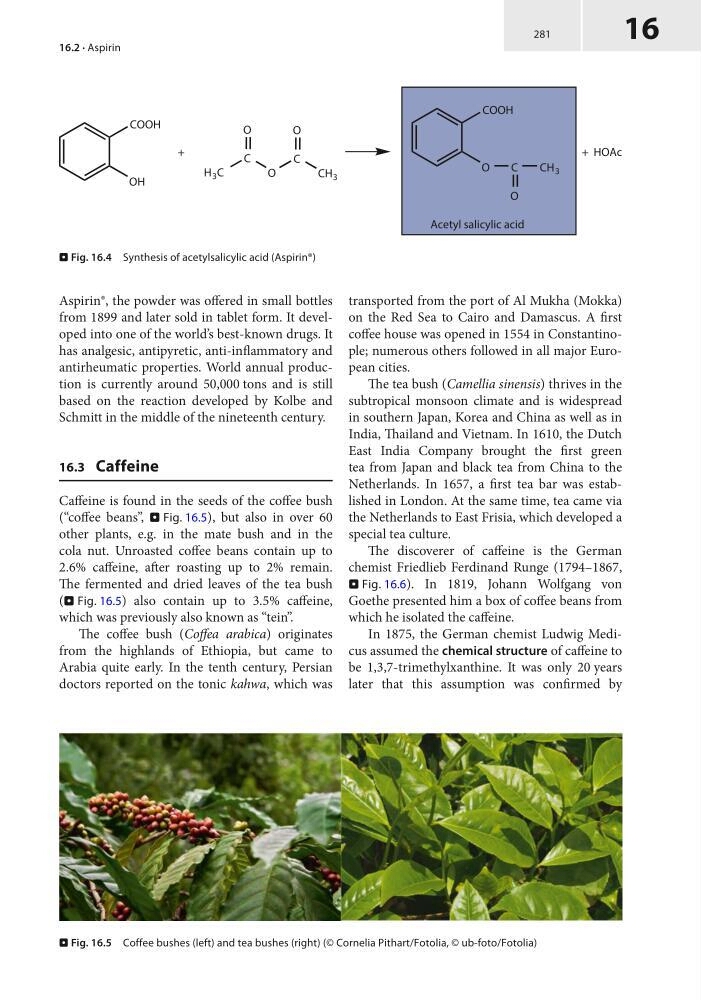
(“coffee beans”, . Fig. 16.5), but also in over 60
other plants, e.g. in the mate bush and in the
cola nut. Unroasted coffee beans contain up to
2.6% caffeine, after roasting up to 2% remain.
The fermented and dried leaves of the tea bush
(. Fig. 16.5) also contain up to 3.5% caffeine,
which was previously also known as “tein”.
The coffee bush (Coffea arabica) originates
from the highlands of Ethiopia, but came to
Arabia quite early. In the tenth century, Persian
doctors reported on the tonic kahwa, which was
COOH
OH
H 3 C
C
O
C
CH 3
O
O
+
COOH
O
C
CH 3
O
+ HOAc
Acetyl salicylic acid
. Fig. 16.4 Synthesis of acetylsalicylic acid (Aspirin®)
. Fig. 16.5 Coffee bushes (left) and tea bushes (right) (© Cornelia Pithart/Fotolia, © ub-foto/Fotolia)
16.2 · Aspirin
16
transported from the port of Al Mukha (Mokka)
on the Red Sea to Cairo and Damascus. A first
coffee house was opened in 1554 in Constantinople; numerous others followed in all major European cities.
The tea bush (Camellia sinensis) thrives in the
subtropical monsoon climate and is widespread
in southern Japan, Korea and China as well as in
India, Thailand and Vietnam. In 1610, the Dutch
East India Company brought the first green
tea from Japan and black tea from China to the
Netherlands. In 1657, a first tea bar was established in London. At the same time, tea came via
the Netherlands to East Frisia, which developed a
special tea culture.
The discoverer of caffeine is the German
chemist Friedlieb Ferdinand Runge (1794–1867,
. Fig. 16.6). In 1819, Johann Wolfgang von
Goethe presented him a box of coffee beans from
which he isolated the caffeine.
In 1875, the German chemist Ludwig Medicus assumed the chemical structure of caffeine to
be 1,3,7-trimethylxanthine. It was only 20 years
later that this assumption was confirmed by
Aspirin®, the powder was offered in small bottles
from 1899 and later sold in tablet form. It developed into one of the world’s best-known drugs. It
has analgesic, antipyretic, anti-inflammatory and
antirheumatic properties. World annual production is currently around 50,000 tons and is still
based on the reaction developed by Kolbe and
Schmitt in the middle of the nineteenth century.
16.3 Caffeine
Caffeine is found in the seeds of the coffee bush
(“coffee beans”, . Fig. 16.5), but also in over 60
other plants, e.g. in the mate bush and in the
cola nut. Unroasted coffee beans contain up to
2.6% caffeine, after roasting up to 2% remain.
The fermented and dried leaves of the tea bush
(. Fig. 16.5) also contain up to 3.5% caffeine,
which was previously also known as “tein”.
The coffee bush (Coffea arabica) originates
from the highlands of Ethiopia, but came to
Arabia quite early. In the tenth century, Persian
doctors reported on the tonic kahwa, which was
COOH
OH
H 3 C
C
O
C
CH 3
O
O
+
COOH
O
C
CH 3
O
+ HOAc
Acetyl salicylic acid
. Fig. 16.4 Synthesis of acetylsalicylic acid (Aspirin®)
. Fig. 16.5 Coffee bushes (left) and tea bushes (right) (© Cornelia Pithart/Fotolia, © ub-foto/Fotolia)
16.2 · Aspirin