

268
Chapter 15 · Showing Your Colors Sustainably! - Natural Dyes
15
lent metal ions such as aluminum, iron or chromium. If the impregnated fiber is immersed in
a solution of alizarin, insoluble complexes of the
trivalent metal with the dye are formed on the
fiber surface. Because of this special bonding,
the mordant dye is characterized by high light
fastness and wash resistance. The staining technique was already known in historical times.
With a stain of alum, potassium aluminum
sulfate (KAl(SO 4 ) 2 –12 H 2 O), deep red colors
were achieved, whereas with an iron stain black
colors were achieved. Numerous uniforms were
dyed in this way; in the Ottoman Empire, the
“Turkish Red” was used to color their headgear,
the fez.
In addition to dyeing textiles, alizarin can
also be used as a dye for other applications. The
metal–alizarin complexes are also referred to
as “madder varnishes” and are used for dyeing
paper in letterpress printing or wallpaper production, as well as for artists’ colors, e.g. in pastel
and oil painting (“Van Dyck Red”).
15.3 Alizarin
The name alizarin derives from the Spanish word
alizari, the name for madder (lat. rubia tinctorum, . Fig. 15.4). The red dye alizarin has been
extracted from the roots of this plant for centuries. The roots contain about 5–7% alizarin,
which is glycosidically bound to glucose and
xylose.
The madder plant originates from the Near
East and the Eastern Mediterranean, and from
there, it also reached western Europe. Charlemagne had the plant cultivated on his estates.
In the middle of the nineteenth century, large
quantities of madder were cultivated in France.
To obtain alizarin, the roots are harvested, dried
in furnaces and then crushed. The color quality
depends strongly on the plant species and the
further processing.
Alizarin belongs to the so-called mordant
dyes: To dye a textile fiber, it must first be
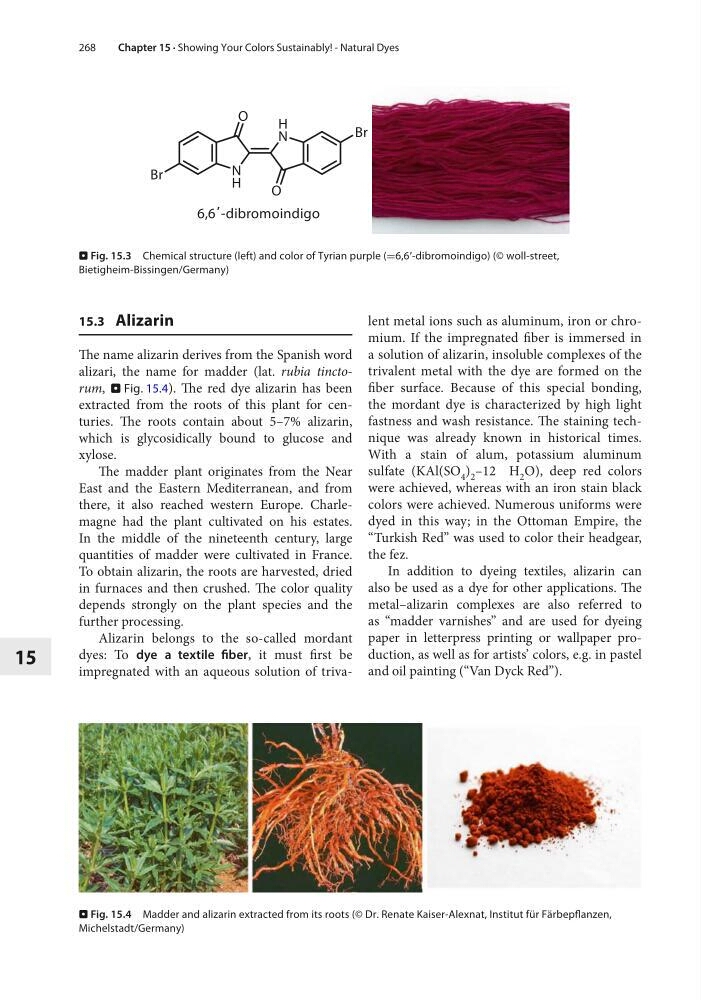
impregnated with an aqueous solution of triva. Fig. 15.3 Chemical structure (left) and color of Tyrian purple (=6,6′-dibromoindigo) (© woll-street,
Bietigheim-Bissingen/Germany)
. Fig. 15.4 Madder and alizarin extracted from its roots (© Dr. Renate Kaiser-Alexnat, Institut für Färbepflanzen,
Michelstadt/Germany)
Chapter 15 · Showing Your Colors Sustainably! - Natural Dyes
15
lent metal ions such as aluminum, iron or chromium. If the impregnated fiber is immersed in
a solution of alizarin, insoluble complexes of the
trivalent metal with the dye are formed on the
fiber surface. Because of this special bonding,
the mordant dye is characterized by high light
fastness and wash resistance. The staining technique was already known in historical times.
With a stain of alum, potassium aluminum
sulfate (KAl(SO 4 ) 2 –12 H 2 O), deep red colors
were achieved, whereas with an iron stain black
colors were achieved. Numerous uniforms were
dyed in this way; in the Ottoman Empire, the
“Turkish Red” was used to color their headgear,
the fez.
In addition to dyeing textiles, alizarin can
also be used as a dye for other applications. The
metal–alizarin complexes are also referred to
as “madder varnishes” and are used for dyeing
paper in letterpress printing or wallpaper production, as well as for artists’ colors, e.g. in pastel
and oil painting (“Van Dyck Red”).
15.3 Alizarin
The name alizarin derives from the Spanish word
alizari, the name for madder (lat. rubia tinctorum, . Fig. 15.4). The red dye alizarin has been
extracted from the roots of this plant for centuries. The roots contain about 5–7% alizarin,
which is glycosidically bound to glucose and
xylose.
The madder plant originates from the Near
East and the Eastern Mediterranean, and from
there, it also reached western Europe. Charlemagne had the plant cultivated on his estates.
In the middle of the nineteenth century, large
quantities of madder were cultivated in France.
To obtain alizarin, the roots are harvested, dried
in furnaces and then crushed. The color quality
depends strongly on the plant species and the
further processing.
Alizarin belongs to the so-called mordant
dyes: To dye a textile fiber, it must first be
impregnated with an aqueous solution of triva. Fig. 15.3 Chemical structure (left) and color of Tyrian purple (=6,6′-dibromoindigo) (© woll-street,
Bietigheim-Bissingen/Germany)
. Fig. 15.4 Madder and alizarin extracted from its roots (© Dr. Renate Kaiser-Alexnat, Institut für Färbepflanzen,
Michelstadt/Germany)