

267
15
BOX: Colorful Easter Eggs in a Quite Natural Way
Easter eggs should only be colored with food
colors that are totally safe for health. These
can be bought or you can make them yourself
at low cost from natural plant material. In
. Table 15.1, you will find an overview of
which colors which can be achieved by using
natural substances.
. Table 15.1 Dyeing plants for painting Easter eggs
Coloring
Plant material
Yellow
Yellow wood, chamomile blossoms,
marigold blossoms
Green
Mate tea
Blue–violet
Blue wood
Red
Redwood (Brazil wood), madder
roots
Red–brown
Willow bark, onion skins
Light brown
Black tea, horse chestnut bark
Dark brown
Walnut leaves, coffee, alchemilla
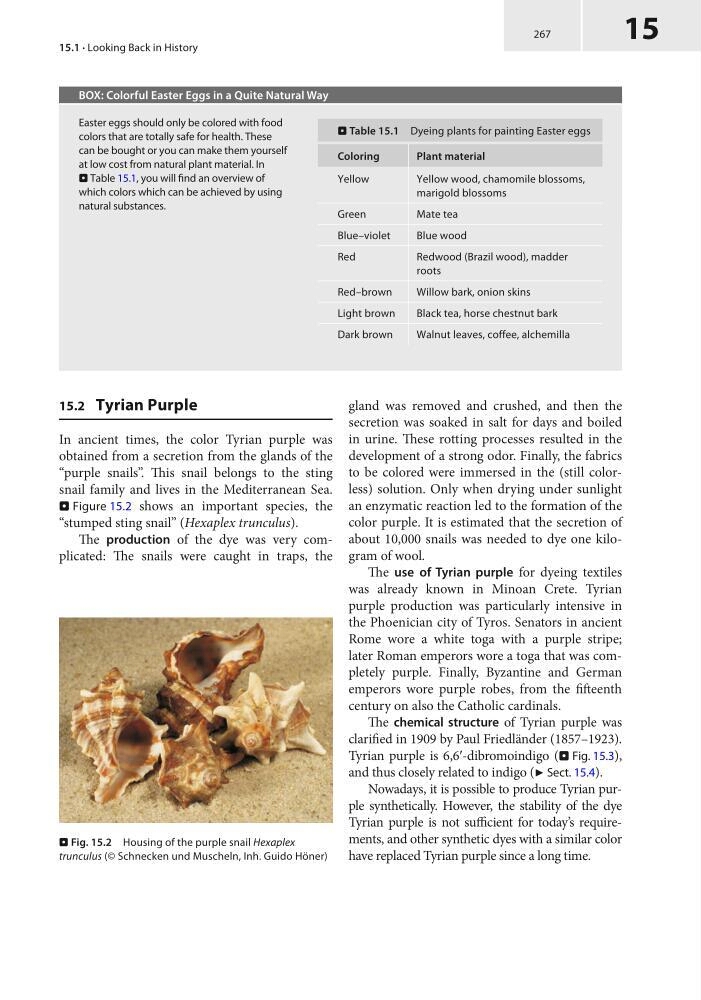
. Fig. 15.2 Housing of the purple snail Hexaplex
trunculus (© Schnecken und Muscheln, Inh. Guido Höner)
15.1 · Looking Back in History
15.2 Tyrian Purple
In ancient times, the color Tyrian purple was
obtained from a secretion from the glands of the
“purple snails”. This snail belongs to the sting
snail family and lives in the Mediterranean Sea.
. Figure 15.2 shows an important species, the
“stumped sting snail” (Hexaplex trunculus).
The production of the dye was very complicated: The snails were caught in traps, the
gland was removed and crushed, and then the
secretion was soaked in salt for days and boiled
in urine. These rotting processes resulted in the
development of a strong odor. Finally, the fabrics
to be colored were immersed in the (still colorless) solution. Only when drying under sunlight
an enzymatic reaction led to the formation of the
color purple. It is estimated that the secretion of
about 10,000 snails was needed to dye one kilogram of wool.
The use of Tyrian purple for dyeing textiles
was already known in Minoan Crete. Tyrian
purple production was particularly intensive in
the Phoenician city of Tyros. Senators in ancient
Rome wore a white toga with a purple stripe;
later Roman emperors wore a toga that was completely purple. Finally, Byzantine and German
emperors wore purple robes, from the fifteenth
century on also the Catholic cardinals.
The chemical structure of Tyrian purple was
clarified in 1909 by Paul Friedländer (1857–1923).
Tyrian purple is 6,6′-dibromoindigo (. Fig. 15.3),
and thus closely related to indigo (7 Sect. 15.4).
Nowadays, it is possible to produce Tyrian purple synthetically. However, the stability of the dye
Tyrian purple is not sufficient for today’s requirements, and other synthetic dyes with a similar color
have replaced Tyrian purple since a long time.
15
BOX: Colorful Easter Eggs in a Quite Natural Way
Easter eggs should only be colored with food
colors that are totally safe for health. These
can be bought or you can make them yourself
at low cost from natural plant material. In
. Table 15.1, you will find an overview of
which colors which can be achieved by using
natural substances.
. Table 15.1 Dyeing plants for painting Easter eggs
Coloring
Plant material
Yellow
Yellow wood, chamomile blossoms,
marigold blossoms
Green
Mate tea
Blue–violet
Blue wood
Red
Redwood (Brazil wood), madder
roots
Red–brown
Willow bark, onion skins
Light brown
Black tea, horse chestnut bark
Dark brown
Walnut leaves, coffee, alchemilla
. Fig. 15.2 Housing of the purple snail Hexaplex
trunculus (© Schnecken und Muscheln, Inh. Guido Höner)
15.1 · Looking Back in History
15.2 Tyrian Purple
In ancient times, the color Tyrian purple was
obtained from a secretion from the glands of the
“purple snails”. This snail belongs to the sting
snail family and lives in the Mediterranean Sea.
. Figure 15.2 shows an important species, the
“stumped sting snail” (Hexaplex trunculus).
The production of the dye was very complicated: The snails were caught in traps, the
gland was removed and crushed, and then the
secretion was soaked in salt for days and boiled
in urine. These rotting processes resulted in the
development of a strong odor. Finally, the fabrics
to be colored were immersed in the (still colorless) solution. Only when drying under sunlight
an enzymatic reaction led to the formation of the
color purple. It is estimated that the secretion of
about 10,000 snails was needed to dye one kilogram of wool.
The use of Tyrian purple for dyeing textiles
was already known in Minoan Crete. Tyrian
purple production was particularly intensive in
the Phoenician city of Tyros. Senators in ancient
Rome wore a white toga with a purple stripe;
later Roman emperors wore a toga that was completely purple. Finally, Byzantine and German
emperors wore purple robes, from the fifteenth
century on also the Catholic cardinals.
The chemical structure of Tyrian purple was
clarified in 1909 by Paul Friedländer (1857–1923).
Tyrian purple is 6,6′-dibromoindigo (. Fig. 15.3),
and thus closely related to indigo (7 Sect. 15.4).
Nowadays, it is possible to produce Tyrian purple synthetically. However, the stability of the dye
Tyrian purple is not sufficient for today’s requirements, and other synthetic dyes with a similar color
have replaced Tyrian purple since a long time.