

266
Chapter 15 · Showing Your Colors Sustainably! - Natural Dyes
15
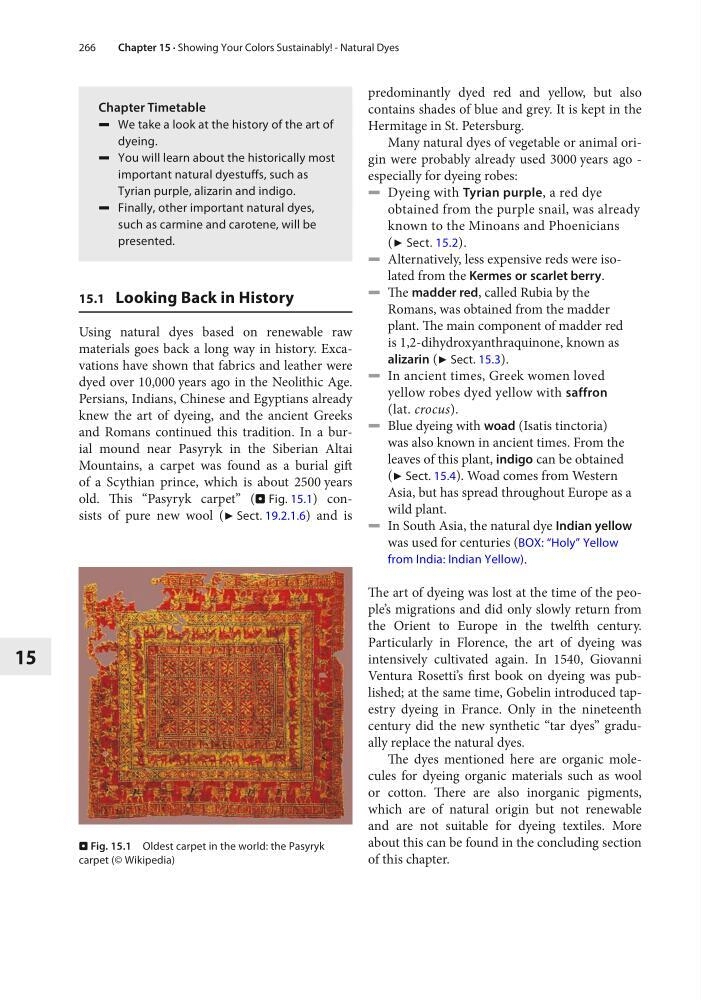
predominantly dyed red and yellow, but also
contains shades of blue and grey. It is kept in the
Hermitage in St. Petersburg.
Many natural dyes of vegetable or animal origin were probably already used 3000 years ago -
especially for dyeing robes:
5 Dyeing with Tyrian purple, a red dye
obtained from the purple snail, was already
known to the Minoans and Phoenicians
(7 Sect. 15.2).
5 Alternatively, less expensive reds were isolated from the Kermes or scarlet berry.
5 The madder red, called Rubia by the
Romans, was obtained from the madder
plant. The main component of madder red
is 1,2-dihydroxyanthraquinone, known as
alizarin (7 Sect. 15.3).
5 In ancient times, Greek women loved
yellow robes dyed yellow with saffron
(lat. crocus).
5 Blue dyeing with woad (Isatis tinctoria)
was also known in ancient times. From the
leaves of this plant, indigo can be obtained
(7 Sect. 15.4). Woad comes from Western
Asia, but has spread throughout Europe as a
wild plant.
5 In South Asia, the natural dye Indian yellow
was used for centuries (BOX: “Holy” Yellow
from India: Indian Yellow).
The art of dyeing was lost at the time of the people’s migrations and did only slowly return from
the Orient to Europe in the twelfth century.
Particularly in Florence, the art of dyeing was
intensively cultivated again. In 1540, Giovanni
Ventura Rosetti’s first book on dyeing was published; at the same time, Gobelin introduced tapestry dyeing in France. Only in the nineteenth
century did the new synthetic “tar dyes” gradually replace the natural dyes.
The dyes mentioned here are organic molecules for dyeing organic materials such as wool
or cotton. There are also inorganic pigments,
which are of natural origin but not renewable
and are not suitable for dyeing textiles. More
about this can be found in the concluding section
of this chapter.
Chapter Timetable
5 We take a look at the history of the art of
dyeing.
5 You will learn about the historically most
important natural dyestuffs, such as
Tyrian purple, alizarin and indigo.
5 Finally, other important natural dyes,
such as carmine and carotene, will be
presented.
15.1 Looking Back in History
Using natural dyes based on renewable raw
materials goes back a long way in history. Excavations have shown that fabrics and leather were
dyed over 10,000 years ago in the Neolithic Age.
Persians, Indians, Chinese and Egyptians already
knew the art of dyeing, and the ancient Greeks
and Romans continued this tradition. In a burial mound near Pasyryk in the Siberian Altai
Mountains, a carpet was found as a burial gift
of a Scythian prince, which is about 2500 years
old. This “Pasyryk carpet” (. Fig. 15.1) consists of pure new wool (7 Sect. 19.2.1.6) and is
. Fig. 15.1 Oldest carpet in the world: the Pasyryk
carpet (© Wikipedia)
Chapter 15 · Showing Your Colors Sustainably! - Natural Dyes
15
predominantly dyed red and yellow, but also
contains shades of blue and grey. It is kept in the
Hermitage in St. Petersburg.
Many natural dyes of vegetable or animal origin were probably already used 3000 years ago -
especially for dyeing robes:
5 Dyeing with Tyrian purple, a red dye
obtained from the purple snail, was already
known to the Minoans and Phoenicians
(7 Sect. 15.2).
5 Alternatively, less expensive reds were isolated from the Kermes or scarlet berry.
5 The madder red, called Rubia by the
Romans, was obtained from the madder
plant. The main component of madder red
is 1,2-dihydroxyanthraquinone, known as
alizarin (7 Sect. 15.3).
5 In ancient times, Greek women loved
yellow robes dyed yellow with saffron
(lat. crocus).
5 Blue dyeing with woad (Isatis tinctoria)
was also known in ancient times. From the
leaves of this plant, indigo can be obtained
(7 Sect. 15.4). Woad comes from Western
Asia, but has spread throughout Europe as a
wild plant.
5 In South Asia, the natural dye Indian yellow
was used for centuries (BOX: “Holy” Yellow
from India: Indian Yellow).
The art of dyeing was lost at the time of the people’s migrations and did only slowly return from
the Orient to Europe in the twelfth century.
Particularly in Florence, the art of dyeing was
intensively cultivated again. In 1540, Giovanni
Ventura Rosetti’s first book on dyeing was published; at the same time, Gobelin introduced tapestry dyeing in France. Only in the nineteenth
century did the new synthetic “tar dyes” gradually replace the natural dyes.
The dyes mentioned here are organic molecules for dyeing organic materials such as wool
or cotton. There are also inorganic pigments,
which are of natural origin but not renewable
and are not suitable for dyeing textiles. More
about this can be found in the concluding section
of this chapter.
Chapter Timetable
5 We take a look at the history of the art of
dyeing.
5 You will learn about the historically most
important natural dyestuffs, such as
Tyrian purple, alizarin and indigo.
5 Finally, other important natural dyes,
such as carmine and carotene, will be
presented.
15.1 Looking Back in History
Using natural dyes based on renewable raw
materials goes back a long way in history. Excavations have shown that fabrics and leather were
dyed over 10,000 years ago in the Neolithic Age.
Persians, Indians, Chinese and Egyptians already
knew the art of dyeing, and the ancient Greeks
and Romans continued this tradition. In a burial mound near Pasyryk in the Siberian Altai
Mountains, a carpet was found as a burial gift
of a Scythian prince, which is about 2500 years
old. This “Pasyryk carpet” (. Fig. 15.1) consists of pure new wool (7 Sect. 19.2.1.6) and is
. Fig. 15.1 Oldest carpet in the world: the Pasyryk
carpet (© Wikipedia)