

269
15
15.4 Indigo, the “King of Dyes”
The name Indigo derives from the river Indus. In
the Indus valley, there was the Harappa culture
in antiquity from 2800 to 1800 B.C., in which the
dyeing with indigo was proven for the first time.
Marco Polo was the first European to report on
indigo on his trip to China; from the end of the
fifteenth century, it was exported from India
to Europe. There was a great demand, because
apart from the inorganic mineral pigment ultramarine, no easily accessible blue colors were
known in the Mediterranean at that time. In
India, indigo was extracted from the leaves of
the indigo plant Indigofera tinctoria (. Fig. 15.6,
left), which is widespread in the tropics and subtropics. In northern Europe, there is also a plant
from which indigo can be extracted, albeit with
a much lower yield, the woad (. Fig. 15.6, right).
Indigo is not present as such in the plant
leaves, but must first be produced laboriously. In
India, the indigo plants were stomped together
with water to a pulp, which - filled in clay pits -
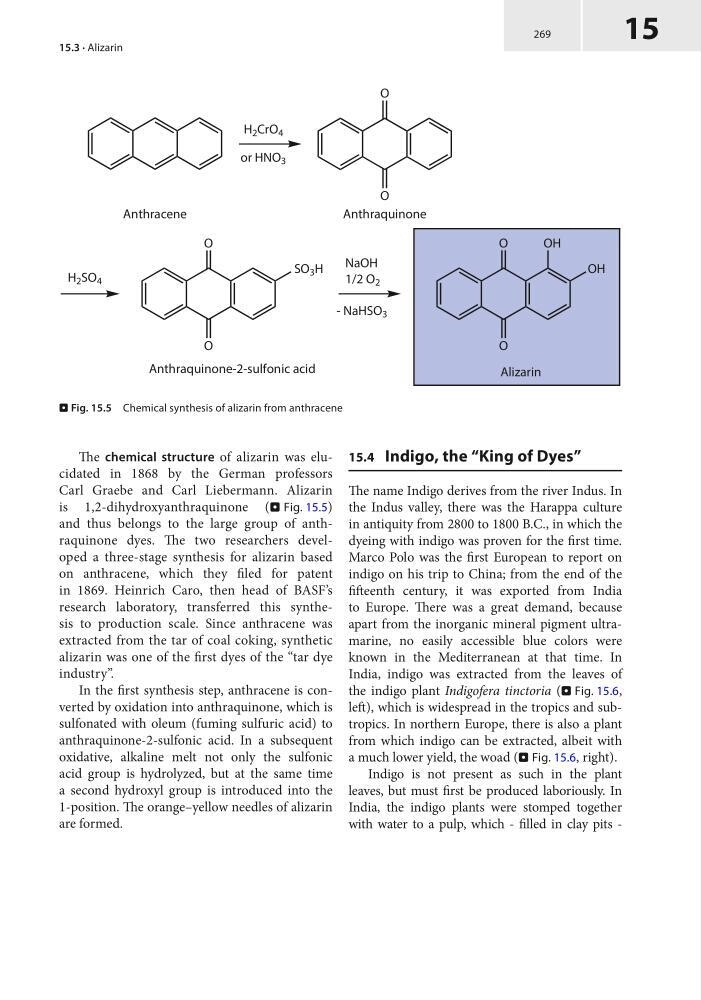
The chemical structure of alizarin was elucidated in 1868 by the German professors
Carl Graebe and Carl Liebermann. Alizarin
is 1,2-dihydroxyanthraquinone (. Fig. 15.5)
and thus belongs to the large group of anthraquinone dyes. The two researchers developed a three-stage synthesis for alizarin based
on anthracene, which they filed for patent
in 1869. Heinrich Caro, then head of BASF’s
research laboratory, transferred this synthesis to production scale. Since anthracene was
extracted from the tar of coal coking, synthetic
alizarin was one of the first dyes of the “tar dye
industry”.
In the first synthesis step, anthracene is converted by oxidation into anthraquinone, which is
sulfonated with oleum (fuming sulfuric acid) to
anthraquinone-2-sulfonic acid. In a subsequent
oxidative, alkaline melt not only the sulfonic
acid group is hydrolyzed, but at the same time
a second hydroxyl group is introduced into the
1-position. The orange–yellow needles of alizarin
are formed.
O
O
O
O
SO 3 H
O
O
OH
OH
Anthracene
Anthraquinone
Anthraquinone-2-sulfonic acid
Alizarin
H 2 CrO 4
or HNO 3
H 2 SO 4
NaOH
1/2 O 2
- NaHSO 3
. Fig. 15.5 Chemical synthesis of alizarin from anthracene
15.3 · Alizarin
15
15.4 Indigo, the “King of Dyes”
The name Indigo derives from the river Indus. In
the Indus valley, there was the Harappa culture
in antiquity from 2800 to 1800 B.C., in which the
dyeing with indigo was proven for the first time.
Marco Polo was the first European to report on
indigo on his trip to China; from the end of the
fifteenth century, it was exported from India
to Europe. There was a great demand, because
apart from the inorganic mineral pigment ultramarine, no easily accessible blue colors were
known in the Mediterranean at that time. In
India, indigo was extracted from the leaves of
the indigo plant Indigofera tinctoria (. Fig. 15.6,
left), which is widespread in the tropics and subtropics. In northern Europe, there is also a plant
from which indigo can be extracted, albeit with
a much lower yield, the woad (. Fig. 15.6, right).
Indigo is not present as such in the plant
leaves, but must first be produced laboriously. In
India, the indigo plants were stomped together
with water to a pulp, which - filled in clay pits -
The chemical structure of alizarin was elucidated in 1868 by the German professors
Carl Graebe and Carl Liebermann. Alizarin
is 1,2-dihydroxyanthraquinone (. Fig. 15.5)
and thus belongs to the large group of anthraquinone dyes. The two researchers developed a three-stage synthesis for alizarin based
on anthracene, which they filed for patent
in 1869. Heinrich Caro, then head of BASF’s
research laboratory, transferred this synthesis to production scale. Since anthracene was
extracted from the tar of coal coking, synthetic
alizarin was one of the first dyes of the “tar dye
industry”.
In the first synthesis step, anthracene is converted by oxidation into anthraquinone, which is
sulfonated with oleum (fuming sulfuric acid) to
anthraquinone-2-sulfonic acid. In a subsequent
oxidative, alkaline melt not only the sulfonic
acid group is hydrolyzed, but at the same time
a second hydroxyl group is introduced into the
1-position. The orange–yellow needles of alizarin
are formed.
O
O
O
O
SO 3 H
O
O
OH
OH
Anthracene
Anthraquinone
Anthraquinone-2-sulfonic acid
Alizarin
H 2 CrO 4
or HNO 3
H 2 SO 4
NaOH
1/2 O 2
- NaHSO 3
. Fig. 15.5 Chemical synthesis of alizarin from anthracene
15.3 · Alizarin