

258
Chapter 14 · Building Blocks of Life - Amino Acids
14
quantities. For example, l-glutamic acid is
produced industrially by fermentation of
glucose, preferably from relatively cheap
molasses. Fermentatively, l-lysine, l-cysteine,
l-phenylalanine, l-tyrosine, l-tryptophan,
l-isoleucine, l-threonine and l-valine are also
easily accessible.
A few important non-proteinogenic amino acids
should be mentioned briefly, which are predominantly found in the proteins of higher plants,
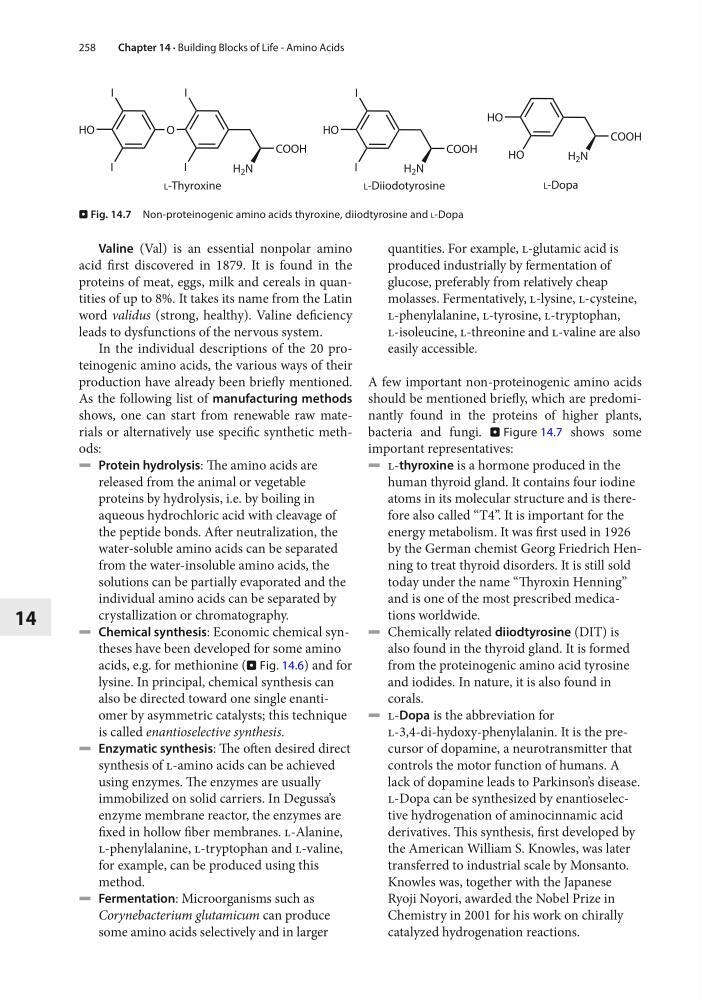
bacteria and fungi. . Figure 14.7 shows some
important representatives:
5 l-thyroxine is a hormone produced in the
human thyroid gland. It contains four iodine
atoms in its molecular structure and is therefore also called “T4”. It is important for the
energy metabolism. It was first used in 1926
by the German chemist Georg Friedrich Henning to treat thyroid disorders. It is still sold
today under the name “Thyroxin Henning”
and is one of the most prescribed medications worldwide.
5 Chemically related diiodtyrosine (DIT) is
also found in the thyroid gland. It is formed
from the proteinogenic amino acid tyrosine
and iodides. In nature, it is also found in
corals.
5 l-Dopa is the abbreviation for
l-3,4-di-hydoxy-phenylalanin. It is the precursor of dopamine, a neurotransmitter that
controls the motor function of humans. A
lack of dopamine leads to Parkinson’s disease.
l-Dopa can be synthesized by enantioselective hydrogenation of aminocinnamic acid
derivatives. This synthesis, first developed by
the American William S. Knowles, was later
transferred to industrial scale by Monsanto.
Knowles was, together with the Japanese
Ryoji Noyori, awarded the Nobel Prize in
Chemistry in 2001 for his work on chirally
catalyzed hydrogenation reactions.
Valine (Val) is an essential nonpolar amino
acid first discovered in 1879. It is found in the
proteins of meat, eggs, milk and cereals in quantities of up to 8%. It takes its name from the Latin
word validus (strong, healthy). Valine deficiency
leads to dysfunctions of the nervous system.
In the individual descriptions of the 20 proteinogenic amino acids, the various ways of their
production have already been briefly mentioned.
As the following list of manufacturing methods
shows, one can start from renewable raw materials or alternatively use specific synthetic methods:
5 Protein hydrolysis: The amino acids are
released from the animal or vegetable
proteins by hydrolysis, i.e. by boiling in
aqueous hydrochloric acid with cleavage of
the peptide bonds. After neutralization, the
water-soluble amino acids can be separated
from the water-insoluble amino acids, the
solutions can be partially evaporated and the
individual amino acids can be separated by
crystallization or chromatography.
5 Chemical synthesis: Economic chemical syntheses have been developed for some amino
acids, e.g. for methionine (. Fig. 14.6) and for
lysine. In principal, chemical synthesis can
also be directed toward one single enantiomer by asymmetric catalysts; this technique
is called enantioselective synthesis.
5 Enzymatic synthesis: The often desired direct
synthesis of l-amino acids can be achieved
using enzymes. The enzymes are usually
immobilized on solid carriers. In Degussa’s
enzyme membrane reactor, the enzymes are
fixed in hollow fiber membranes. l-Alanine,
l-phenylalanine, l-tryptophan and l-valine,
for example, can be produced using this
method.
5 Fermentation: Microorganisms such as
Corynebacterium glutamicum can produce
some amino acids selectively and in larger
O
I
HO
I
I
I
COOH
H 2 N
I
HO
I
H 2 N
COOH
HO
HO
H 2 N
COOH
L-Thyroxine
L-Diiodotyrosine
L-Dopa
. Fig. 14.7 Non-proteinogenic amino acids thyroxine, diiodtyrosine and l-Dopa
Chapter 14 · Building Blocks of Life - Amino Acids
14
quantities. For example, l-glutamic acid is
produced industrially by fermentation of
glucose, preferably from relatively cheap
molasses. Fermentatively, l-lysine, l-cysteine,
l-phenylalanine, l-tyrosine, l-tryptophan,
l-isoleucine, l-threonine and l-valine are also
easily accessible.
A few important non-proteinogenic amino acids
should be mentioned briefly, which are predominantly found in the proteins of higher plants,
bacteria and fungi. . Figure 14.7 shows some
important representatives:
5 l-thyroxine is a hormone produced in the
human thyroid gland. It contains four iodine
atoms in its molecular structure and is therefore also called “T4”. It is important for the
energy metabolism. It was first used in 1926
by the German chemist Georg Friedrich Henning to treat thyroid disorders. It is still sold
today under the name “Thyroxin Henning”
and is one of the most prescribed medications worldwide.
5 Chemically related diiodtyrosine (DIT) is
also found in the thyroid gland. It is formed
from the proteinogenic amino acid tyrosine
and iodides. In nature, it is also found in
corals.
5 l-Dopa is the abbreviation for
l-3,4-di-hydoxy-phenylalanin. It is the precursor of dopamine, a neurotransmitter that
controls the motor function of humans. A
lack of dopamine leads to Parkinson’s disease.
l-Dopa can be synthesized by enantioselective hydrogenation of aminocinnamic acid
derivatives. This synthesis, first developed by
the American William S. Knowles, was later
transferred to industrial scale by Monsanto.
Knowles was, together with the Japanese
Ryoji Noyori, awarded the Nobel Prize in
Chemistry in 2001 for his work on chirally
catalyzed hydrogenation reactions.
Valine (Val) is an essential nonpolar amino
acid first discovered in 1879. It is found in the
proteins of meat, eggs, milk and cereals in quantities of up to 8%. It takes its name from the Latin
word validus (strong, healthy). Valine deficiency
leads to dysfunctions of the nervous system.
In the individual descriptions of the 20 proteinogenic amino acids, the various ways of their
production have already been briefly mentioned.
As the following list of manufacturing methods
shows, one can start from renewable raw materials or alternatively use specific synthetic methods:
5 Protein hydrolysis: The amino acids are
released from the animal or vegetable
proteins by hydrolysis, i.e. by boiling in
aqueous hydrochloric acid with cleavage of
the peptide bonds. After neutralization, the
water-soluble amino acids can be separated
from the water-insoluble amino acids, the
solutions can be partially evaporated and the
individual amino acids can be separated by
crystallization or chromatography.
5 Chemical synthesis: Economic chemical syntheses have been developed for some amino
acids, e.g. for methionine (. Fig. 14.6) and for
lysine. In principal, chemical synthesis can
also be directed toward one single enantiomer by asymmetric catalysts; this technique
is called enantioselective synthesis.
5 Enzymatic synthesis: The often desired direct
synthesis of l-amino acids can be achieved
using enzymes. The enzymes are usually
immobilized on solid carriers. In Degussa’s
enzyme membrane reactor, the enzymes are
fixed in hollow fiber membranes. l-Alanine,
l-phenylalanine, l-tryptophan and l-valine,
for example, can be produced using this
method.
5 Fermentation: Microorganisms such as
Corynebacterium glutamicum can produce
some amino acids selectively and in larger
O
I
HO
I
I
I
COOH
H 2 N
I
HO
I
H 2 N
COOH
HO
HO
H 2 N
COOH
L-Thyroxine
L-Diiodotyrosine
L-Dopa
. Fig. 14.7 Non-proteinogenic amino acids thyroxine, diiodtyrosine and l-Dopa