

257
14
can be esterified with phosphoric acid via its
hydroxyl group, i.e. it can be “phosphorylated”.
When this serine phosphoric acid is found in
proteins, it is referred to as “phosphoproteins”,
which are widespread in the world of plants.
Threonine (Thr) - like serine - contains a
hydroxyl group in the side chain and can therefore also be phosphorylated. It occurs in meat,
eggs, milk and cereals in quantities of up to 5%.
Threonine was discovered in 1935 by the American biochemist William Cumming Rose, who
discovered that this essential amino acid is of
crucial importance for the digestion of the amino
acids present in food.
Tryptophan (Trp) is an essential amino
acid that contains an indole residue in the
side chain. It was discovered in 1902 in casein
hydrolyzate. In animal and vegetable proteins,
it is found only in 1–2%. Tryptophan is added
to mixed feeds. Its production (3000 t a −1 ) can
be conducted enzymatically from serine and
indole. Tryptophan deficiency leads to eye diseases or hair loss.
Tyrosine (Tyr) is a non-essential aromatic
amino acid contained in almost all proteins.
It takes its name from the Greek word tyros
(cheese), since it was first isolated from cheese
by Justus Liebig in 1845. Oxidation of tyrosine
produces melanins, which are important for the
brown coloring of human skin.
Phenylalanine (Phe) was isolated from
lupines in 1881. This essential amino acid is
found in almost all proteins in amounts of up
to 5%. In the human organism, phenylalanine
can change to tyrosine by hydroxylation in the
para-position of the phenyl ring. Phenylalanine
can therefore replace tyrosine in food. Phenylalanine deficiency can lead to disturbances in
the functions of the thyroid and the suprarenal
glands. The worldwide production of phenylalanine is 12,500 t a −1 .
Proline (Pro) is pyrrolidine-2-carboxylic acid,
thus belongs to the heterocyclic amino acids and
is the only secondary amino acid. Proline also
got its name from pyrrolidine. This non-essential
amino acid was discovered in 1901 by Emil
Fischer in casein. Proline is contained in most
proteins with up to 7%, but especially abundant
in gelatine (13%) and in casein (12%). In the
human body, it is important for the formation of
collagen, the protein that forms connective tissue
and bones.
Serine (Ser) contains a hydroxyl group in
the side chain and therefore belongs to the
uncharged, but polar amino acids. Most proteins contain up to 8% of this non-essential
amino acid. It was first isolated in 1865 from
silk bast (sericin), which covers the silk thread
and consists of one-third serine. The name serine derives from the Latin sericum (silk). Serine
H 3 C SH
O
+
H 3 C
S
O
+ HCN
H 3 C
S
OH
CN
+ [NH 4 ]HCO 3
H 3 C
S
HN
NH
O
O
+ 1/2 K 2 CO 3
+ 5/2 H 2 O
- [NH 4 ]HCO 3
H 3 C
S
NH 2
OK
O
+ CO 2
+ H 2 O
- KHCO 3
H 3 C
S
COOH
NH 2
: H 3 C SH
O
+
+ HCN
H 3 C
S
COOH
NH 2
+ H 2 O
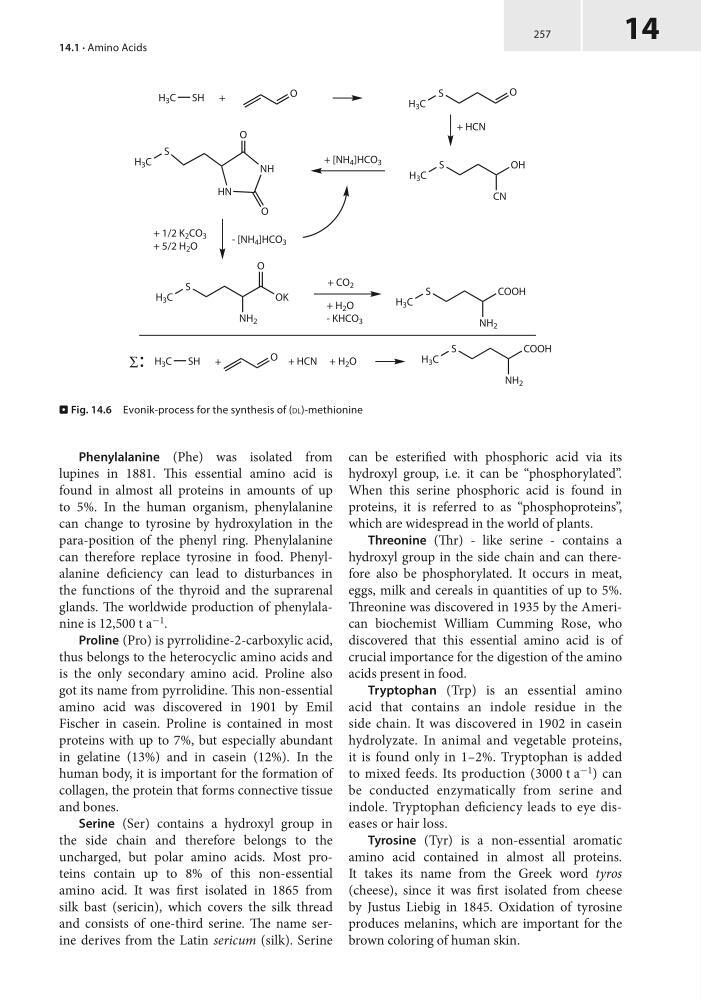
. Fig. 14.6 Evonik-process for the synthesis of (dl)-methionine
14.1 · Amino Acids
14
can be esterified with phosphoric acid via its
hydroxyl group, i.e. it can be “phosphorylated”.
When this serine phosphoric acid is found in
proteins, it is referred to as “phosphoproteins”,
which are widespread in the world of plants.
Threonine (Thr) - like serine - contains a
hydroxyl group in the side chain and can therefore also be phosphorylated. It occurs in meat,
eggs, milk and cereals in quantities of up to 5%.
Threonine was discovered in 1935 by the American biochemist William Cumming Rose, who
discovered that this essential amino acid is of
crucial importance for the digestion of the amino
acids present in food.
Tryptophan (Trp) is an essential amino
acid that contains an indole residue in the
side chain. It was discovered in 1902 in casein
hydrolyzate. In animal and vegetable proteins,
it is found only in 1–2%. Tryptophan is added
to mixed feeds. Its production (3000 t a −1 ) can
be conducted enzymatically from serine and
indole. Tryptophan deficiency leads to eye diseases or hair loss.
Tyrosine (Tyr) is a non-essential aromatic
amino acid contained in almost all proteins.
It takes its name from the Greek word tyros
(cheese), since it was first isolated from cheese
by Justus Liebig in 1845. Oxidation of tyrosine
produces melanins, which are important for the
brown coloring of human skin.
Phenylalanine (Phe) was isolated from
lupines in 1881. This essential amino acid is
found in almost all proteins in amounts of up
to 5%. In the human organism, phenylalanine
can change to tyrosine by hydroxylation in the
para-position of the phenyl ring. Phenylalanine
can therefore replace tyrosine in food. Phenylalanine deficiency can lead to disturbances in
the functions of the thyroid and the suprarenal
glands. The worldwide production of phenylalanine is 12,500 t a −1 .
Proline (Pro) is pyrrolidine-2-carboxylic acid,
thus belongs to the heterocyclic amino acids and
is the only secondary amino acid. Proline also
got its name from pyrrolidine. This non-essential
amino acid was discovered in 1901 by Emil
Fischer in casein. Proline is contained in most
proteins with up to 7%, but especially abundant
in gelatine (13%) and in casein (12%). In the
human body, it is important for the formation of
collagen, the protein that forms connective tissue
and bones.
Serine (Ser) contains a hydroxyl group in
the side chain and therefore belongs to the
uncharged, but polar amino acids. Most proteins contain up to 8% of this non-essential
amino acid. It was first isolated in 1865 from
silk bast (sericin), which covers the silk thread
and consists of one-third serine. The name serine derives from the Latin sericum (silk). Serine
H 3 C SH
O
+
H 3 C
S
O
+ HCN
H 3 C
S
OH
CN
+ [NH 4 ]HCO 3
H 3 C
S
HN
NH
O
O
+ 1/2 K 2 CO 3
+ 5/2 H 2 O
- [NH 4 ]HCO 3
H 3 C
S
NH 2
OK
O
+ CO 2
+ H 2 O
- KHCO 3
H 3 C
S
COOH
NH 2
: H 3 C SH
O
+
+ HCN
H 3 C
S
COOH
NH 2
+ H 2 O
. Fig. 14.6 Evonik-process for the synthesis of (dl)-methionine
14.1 · Amino Acids