

259
14
port of glucose through the cell membrane and
thus lowers the blood sugar level. At the same
time, the number of enzymes in the liver that
promote the conversion of glucose into the storage polysaccharide glycogen is increased. Insulin deficiency leads to diabetes mellitus. To treat
this disease, artificial insulin can be supplied to
the human body. The synthesis of this insulin can
be based on pig insulin, which is then enzymatically converted into human insulin. Alternatively,
human insulin is produced today with genetically modified Escherichia coli strains.
Important pharmaceuticals based on
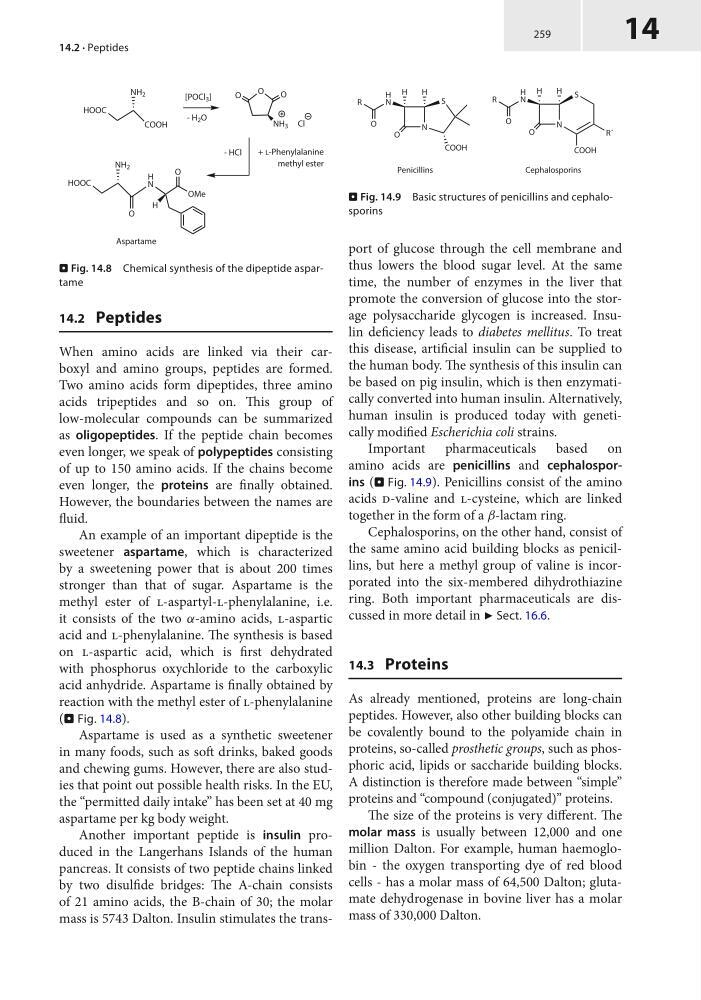
amino acids are penicillins and cephalosporins (. Fig. 14.9). Penicillins consist of the amino
acids d-valine and l-cysteine, which are linked
together in the form of a β-lactam ring.
Cephalosporins, on the other hand, consist of
the same amino acid building blocks as penicillins, but here a methyl group of valine is incorporated into the six-membered dihydrothiazine
ring. Both important pharmaceuticals are discussed in more detail in 7 Sect. 16.6.
14.3 Proteins
As already mentioned, proteins are long-chain
peptides. However, also other building blocks can
be covalently bound to the polyamide chain in
proteins, so-called prosthetic groups, such as phosphoric acid, lipids or saccharide building blocks.
A distinction is therefore made between “simple”
proteins and “compound (conjugated)” proteins.
The size of the proteins is very different. The
molar mass is usually between 12,000 and one
million Dalton. For example, human haemoglobin - the oxygen transporting dye of red blood
cells - has a molar mass of 64,500 Dalton; glutamate dehydrogenase in bovine liver has a molar
mass of 330,000 Dalton.
14.2 Peptides
When amino acids are linked via their carboxyl and amino groups, peptides are formed.
Two amino acids form dipeptides, three amino
acids tripeptides and so on. This group of
low-molecular compounds can be summarized
as oligopeptides. If the peptide chain becomes
even longer, we speak of polypeptides consisting
of up to 150 amino acids. If the chains become
even longer, the proteins are finally obtained.
However, the boundaries between the names are
fluid.
An example of an important dipeptide is the
sweetener aspartame, which is characterized
by a sweetening power that is about 200 times
stronger than that of sugar. Aspartame is the
methyl ester of l-aspartyl-l-phenylalanine, i.e.
it consists of the two α-amino acids, l-aspartic
acid and l-phenylalanine. The synthesis is based
on l-aspartic acid, which is first dehydrated
with phosphorus oxychloride to the carboxylic
acid anhydride. Aspartame is finally obtained by
reaction with the methyl ester of l-phenylalanine
(. Fig. 14.8).
Aspartame is used as a synthetic sweetener
in many foods, such as soft drinks, baked goods
and chewing gums. However, there are also studies that point out possible health risks. In the EU,
the “permitted daily intake” has been set at 40 mg
aspartame per kg body weight.
Another important peptide is insulin produced in the Langerhans Islands of the human
pancreas. It consists of two peptide chains linked
by two disulfide bridges: The A-chain consists
of 21 amino acids, the B-chain of 30; the molar
mass is 5743 Dalton. Insulin stimulates the transHOOC
COOH
NH 2
[POCl 3 ]
- H 2 O
O
O
O
NH 3 Cl
HOOC
NH 2
H
N
OMe
O
O
H
Aspartame
+ L-Phenylalanine
methyl ester
- HCl
. Fig. 14.8 Chemical synthesis of the dipeptide aspartame
R
H
N
O
N
H
H
O
Penicillins
R
H
N
O
N
H
H
O
S
R´
COOH
S
COOH
Cephalosporins
. Fig. 14.9 Basic structures of penicillins and cephalosporins
14.2 · Peptides
14
port of glucose through the cell membrane and
thus lowers the blood sugar level. At the same
time, the number of enzymes in the liver that
promote the conversion of glucose into the storage polysaccharide glycogen is increased. Insulin deficiency leads to diabetes mellitus. To treat
this disease, artificial insulin can be supplied to
the human body. The synthesis of this insulin can
be based on pig insulin, which is then enzymatically converted into human insulin. Alternatively,
human insulin is produced today with genetically modified Escherichia coli strains.
Important pharmaceuticals based on
amino acids are penicillins and cephalosporins (. Fig. 14.9). Penicillins consist of the amino
acids d-valine and l-cysteine, which are linked
together in the form of a β-lactam ring.
Cephalosporins, on the other hand, consist of
the same amino acid building blocks as penicillins, but here a methyl group of valine is incorporated into the six-membered dihydrothiazine
ring. Both important pharmaceuticals are discussed in more detail in 7 Sect. 16.6.
14.3 Proteins
As already mentioned, proteins are long-chain
peptides. However, also other building blocks can
be covalently bound to the polyamide chain in
proteins, so-called prosthetic groups, such as phosphoric acid, lipids or saccharide building blocks.
A distinction is therefore made between “simple”
proteins and “compound (conjugated)” proteins.
The size of the proteins is very different. The
molar mass is usually between 12,000 and one
million Dalton. For example, human haemoglobin - the oxygen transporting dye of red blood
cells - has a molar mass of 64,500 Dalton; glutamate dehydrogenase in bovine liver has a molar
mass of 330,000 Dalton.
14.2 Peptides
When amino acids are linked via their carboxyl and amino groups, peptides are formed.
Two amino acids form dipeptides, three amino
acids tripeptides and so on. This group of
low-molecular compounds can be summarized
as oligopeptides. If the peptide chain becomes
even longer, we speak of polypeptides consisting
of up to 150 amino acids. If the chains become
even longer, the proteins are finally obtained.
However, the boundaries between the names are
fluid.
An example of an important dipeptide is the
sweetener aspartame, which is characterized
by a sweetening power that is about 200 times
stronger than that of sugar. Aspartame is the
methyl ester of l-aspartyl-l-phenylalanine, i.e.
it consists of the two α-amino acids, l-aspartic
acid and l-phenylalanine. The synthesis is based
on l-aspartic acid, which is first dehydrated
with phosphorus oxychloride to the carboxylic
acid anhydride. Aspartame is finally obtained by
reaction with the methyl ester of l-phenylalanine
(. Fig. 14.8).
Aspartame is used as a synthetic sweetener
in many foods, such as soft drinks, baked goods
and chewing gums. However, there are also studies that point out possible health risks. In the EU,
the “permitted daily intake” has been set at 40 mg
aspartame per kg body weight.
Another important peptide is insulin produced in the Langerhans Islands of the human
pancreas. It consists of two peptide chains linked
by two disulfide bridges: The A-chain consists
of 21 amino acids, the B-chain of 30; the molar
mass is 5743 Dalton. Insulin stimulates the transHOOC
COOH
NH 2
[POCl 3 ]
- H 2 O
O
O
O
NH 3 Cl
HOOC
NH 2
H
N
OMe
O
O
H
Aspartame
+ L-Phenylalanine
methyl ester
- HCl
. Fig. 14.8 Chemical synthesis of the dipeptide aspartame
R
H
N
O
N
H
H
O
Penicillins
R
H
N
O
N
H
H
O
S
R´
COOH
S
COOH
Cephalosporins
. Fig. 14.9 Basic structures of penicillins and cephalosporins
14.2 · Peptides