

246
Chapter 13 · Elastomers from Nature! - Polyterpenes
13
South America as a wild plant. Large
rubber plantations exist today in
Thailand, Indonesia, Malaysia and India.
5 The aqueous rubber milk, the so-called
latex, is obtained by scratching the bark
of the tree. Approximately 5 kg of natural
rubber can be collected per tree each
year.
5 The aqueous latex is first concentrated.
This is usually done by centrifugation, less
often by creaming or evaporation.
5 A large part of the latex is further
processed into solid rubber. The two
most important types of solid rubber are
sheet rubber and crepe rubber.
5 In the case of sheet rubber, the
concentrated latex filled in tubs is
acidified. Coagulation produces soft
rubber plates known as “sheets”. When
the sheets are washed and pressed
out, they are given a ribbed surface in a
cylindrical roller.
5 The sheets are stabilized by smoking
(ribbed smoked sheets) or drying in warm
air (air dried sheets).
5 Crepe rubber is produced using a similar
process, but the latex is first treated with
sodium hydrogen sulfite. This results in
lighter rubber qualities, the pale crepe
and the white crepe.
5 In natural rubber, crystallization is
strongly inhibited due to the low glass
transition temperature of −73 °C.
When tensile stress is applied, however,
elongation crystallization occurs and the
natural rubber solidifies. Its molecular
weight distribution is bimodal. The
average molecular weight can be reduced
by mechanical or thermal-oxidative
mastication.
5 Since natural rubber contains one C=C
double bond per monomer unit, the
polymer chains can subsequently be
interconnected with elemental sulfur by
vulcanization, a process discovered by
Charles Goodyear. Plastic rubber thus
becomes an elastic rubber with high
tensile strength.
5 The properties of the rubber can be
greatly improved by additives. Fillers,
pigments, plasticizers, vulcanization
of carcass, steel belt, belt cover and tread are
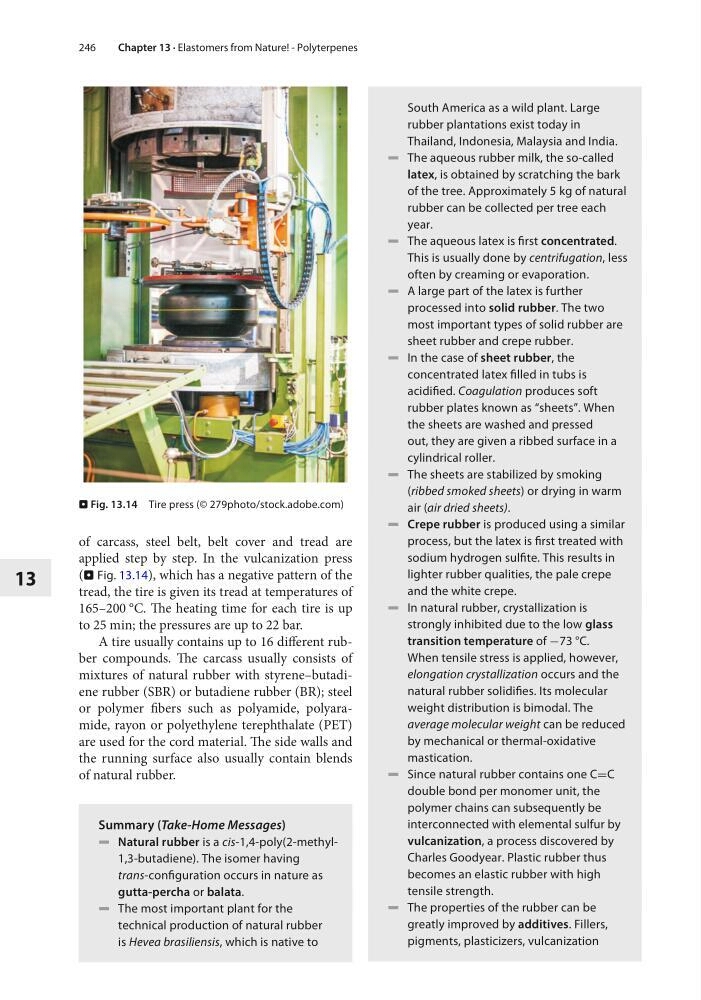
applied step by step. In the vulcanization press
(. Fig. 13.14), which has a negative pattern of the
tread, the tire is given its tread at temperatures of
165–200 °C. The heating time for each tire is up
to 25 min; the pressures are up to 22 bar.
A tire usually contains up to 16 different rubber compounds. The carcass usually consists of
mixtures of natural rubber with styrene–butadiene rubber (SBR) or butadiene rubber (BR); steel
or polymer fibers such as polyamide, polyaramide, rayon or polyethylene terephthalate (PET)
are used for the cord material. The side walls and
the running surface also usually contain blends
of natural rubber.
Summary (Take-Home Messages)
5 Natural rubber is a cis-1,4-poly(2-methyl1,3-butadiene). The isomer having
trans-configuration occurs in nature as
gutta-percha or balata.
5 The most important plant for the
technical production of natural rubber
is Hevea brasiliensis, which is native to
. Fig. 13.14 Tire press (© 279photo/stock.adobe.com)
Chapter 13 · Elastomers from Nature! - Polyterpenes
13
South America as a wild plant. Large
rubber plantations exist today in
Thailand, Indonesia, Malaysia and India.
5 The aqueous rubber milk, the so-called
latex, is obtained by scratching the bark
of the tree. Approximately 5 kg of natural
rubber can be collected per tree each
year.
5 The aqueous latex is first concentrated.
This is usually done by centrifugation, less
often by creaming or evaporation.
5 A large part of the latex is further
processed into solid rubber. The two
most important types of solid rubber are
sheet rubber and crepe rubber.
5 In the case of sheet rubber, the
concentrated latex filled in tubs is
acidified. Coagulation produces soft
rubber plates known as “sheets”. When
the sheets are washed and pressed
out, they are given a ribbed surface in a
cylindrical roller.
5 The sheets are stabilized by smoking
(ribbed smoked sheets) or drying in warm
air (air dried sheets).
5 Crepe rubber is produced using a similar
process, but the latex is first treated with
sodium hydrogen sulfite. This results in
lighter rubber qualities, the pale crepe
and the white crepe.
5 In natural rubber, crystallization is
strongly inhibited due to the low glass
transition temperature of −73 °C.
When tensile stress is applied, however,
elongation crystallization occurs and the
natural rubber solidifies. Its molecular
weight distribution is bimodal. The
average molecular weight can be reduced
by mechanical or thermal-oxidative
mastication.
5 Since natural rubber contains one C=C
double bond per monomer unit, the
polymer chains can subsequently be
interconnected with elemental sulfur by
vulcanization, a process discovered by
Charles Goodyear. Plastic rubber thus
becomes an elastic rubber with high
tensile strength.
5 The properties of the rubber can be
greatly improved by additives. Fillers,
pigments, plasticizers, vulcanization
of carcass, steel belt, belt cover and tread are
applied step by step. In the vulcanization press
(. Fig. 13.14), which has a negative pattern of the
tread, the tire is given its tread at temperatures of
165–200 °C. The heating time for each tire is up
to 25 min; the pressures are up to 22 bar.
A tire usually contains up to 16 different rubber compounds. The carcass usually consists of
mixtures of natural rubber with styrene–butadiene rubber (SBR) or butadiene rubber (BR); steel
or polymer fibers such as polyamide, polyaramide, rayon or polyethylene terephthalate (PET)
are used for the cord material. The side walls and
the running surface also usually contain blends
of natural rubber.
Summary (Take-Home Messages)
5 Natural rubber is a cis-1,4-poly(2-methyl1,3-butadiene). The isomer having
trans-configuration occurs in nature as
gutta-percha or balata.
5 The most important plant for the
technical production of natural rubber
is Hevea brasiliensis, which is native to
. Fig. 13.14 Tire press (© 279photo/stock.adobe.com)