

245
13
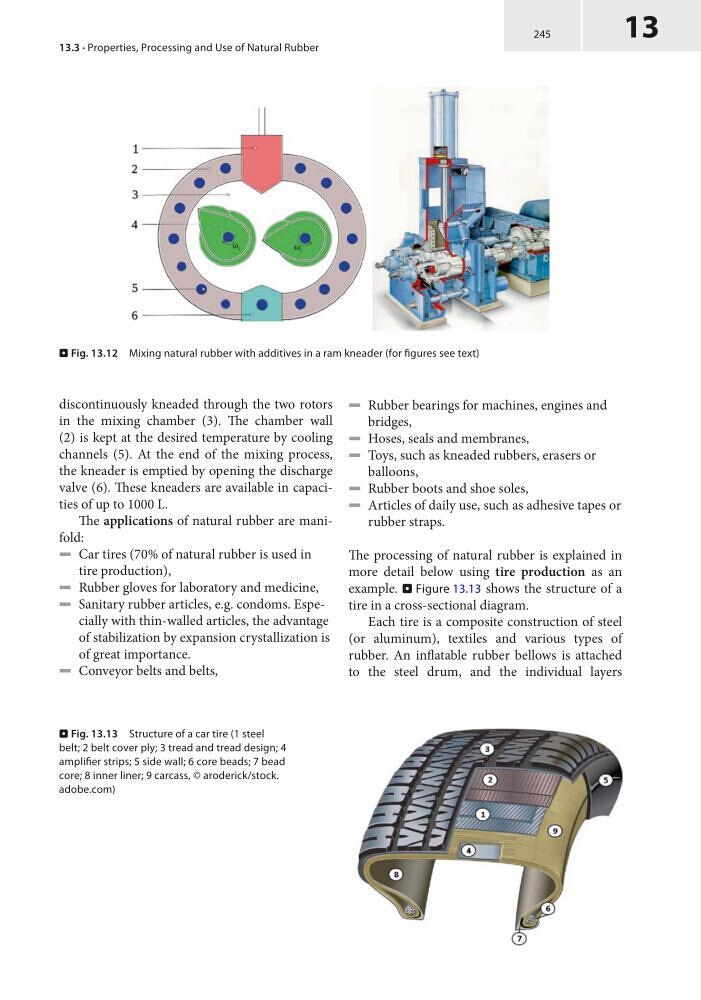
. Fig. 13.12 Mixing natural rubber with additives in a ram kneader (for figures see text)
5 Rubber bearings for machines, engines and
bridges,
5 Hoses, seals and membranes,
5 Toys, such as kneaded rubbers, erasers or
balloons,
5 Rubber boots and shoe soles,
5 Articles of daily use, such as adhesive tapes or
rubber straps.
The processing of natural rubber is explained in
more detail below using tire production as an
example. . Figure 13.13 shows the structure of a
tire in a cross-sectional diagram.
Each tire is a composite construction of steel
(or aluminum), textiles and various types of
rubber. An inflatable rubber bellows is attached
to the steel drum, and the individual layers
discontinuously kneaded through the two rotors
in the mixing chamber (3). The chamber wall
(2) is kept at the desired temperature by cooling
channels (5). At the end of the mixing process,
the kneader is emptied by opening the discharge
valve (6). These kneaders are available in capacities of up to 1000 L.
The applications of natural rubber are manifold:
5 Car tires (70% of natural rubber is used in
tire production),
5 Rubber gloves for laboratory and medicine,
5 Sanitary rubber articles, e.g. condoms. Especially with thin-walled articles, the advantage
of stabilization by expansion crystallization is
of great importance.
5 Conveyor belts and belts,
. Fig. 13.13 Structure of a car tire (1 steel
belt; 2 belt cover ply; 3 tread and tread design; 4
amplifier strips; 5 side wall; 6 core beads; 7 bead
core; 8 inner liner; 9 carcass, © aroderick/stock.
adobe.com)
13.3 · Properties, Processing and Use of Natural Rubber
13
. Fig. 13.12 Mixing natural rubber with additives in a ram kneader (for figures see text)
5 Rubber bearings for machines, engines and
bridges,
5 Hoses, seals and membranes,
5 Toys, such as kneaded rubbers, erasers or
balloons,
5 Rubber boots and shoe soles,
5 Articles of daily use, such as adhesive tapes or
rubber straps.
The processing of natural rubber is explained in
more detail below using tire production as an
example. . Figure 13.13 shows the structure of a
tire in a cross-sectional diagram.
Each tire is a composite construction of steel
(or aluminum), textiles and various types of
rubber. An inflatable rubber bellows is attached
to the steel drum, and the individual layers
discontinuously kneaded through the two rotors
in the mixing chamber (3). The chamber wall
(2) is kept at the desired temperature by cooling
channels (5). At the end of the mixing process,
the kneader is emptied by opening the discharge
valve (6). These kneaders are available in capacities of up to 1000 L.
The applications of natural rubber are manifold:
5 Car tires (70% of natural rubber is used in
tire production),
5 Rubber gloves for laboratory and medicine,
5 Sanitary rubber articles, e.g. condoms. Especially with thin-walled articles, the advantage
of stabilization by expansion crystallization is
of great importance.
5 Conveyor belts and belts,
. Fig. 13.13 Structure of a car tire (1 steel
belt; 2 belt cover ply; 3 tread and tread design; 4
amplifier strips; 5 side wall; 6 core beads; 7 bead
core; 8 inner liner; 9 carcass, © aroderick/stock.
adobe.com)
13.3 · Properties, Processing and Use of Natural Rubber