

244
Chapter 13 · Elastomers from Nature! - Polyterpenes
13
The production of special types of rubber has
meanwhile developed into a real science. Numerous properties can be tailored by mixing with
other types of rubber (blending) or adding additives (compounding):
5 Natural rubber can be covulcanized with
other polydienes made from fossil raw materials, such as polybutadiene or polychloroprene.
5 For faster vulcanization, accelerators are
added.
5 To reduce abrasion (which is important for
tires), fillers such as carbon black or silica can
be added.
5 Mineral oils serve as plasticizers.
5 Phosphoric acid esters improve flame retardancy.
BOX: How Caoutchouc Did Become Rubber?
Charles Nelson Goodyear
(1800–1860, . Fig. 13.11)
succeeded in converting
caoutchouc into rubber in 1839.
He heated caoutchouc together
with sulfur and obtained a
low-odor material that was both
stable and elastic in both heat
and cold. Goodyear patented
the process in 1841. A short
time later, it was given the name
vulcanization. This name goes
back to the Roman god of fire,
Vulcanus.
This invention was a
breakthrough and laid the
foundation for numerous further
developments:
5 In 1845, the Englishman
Thomas Hancock invented
the first solid rubber
tire for horse-drawn
carriages.
5 In the same year, the
Scotsman Robert William
Thomson developed the first
pneumatic tire. However,
his patent fell into oblivion.
In 1888, the pneumatic tire
was reinvented by John
Boyd Dunlop.
5 In 1846, the Englishman
Alexander Parkes invented
cold vulcanization with
sulfur monochloride.
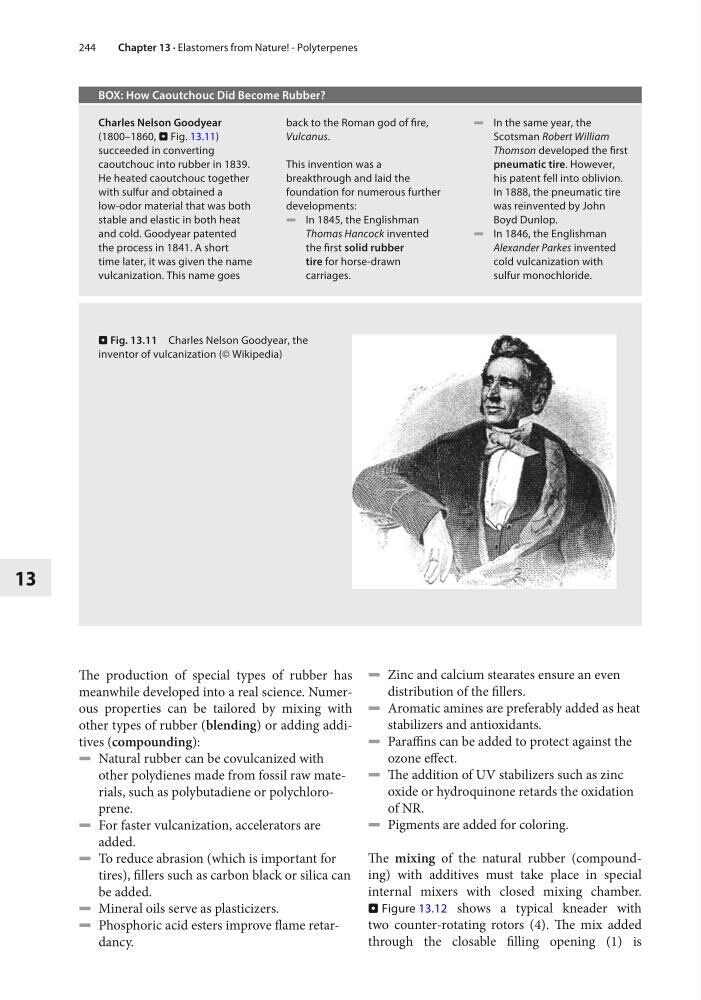
. Fig. 13.11 Charles Nelson Goodyear, the
inventor of vulcanization (© Wikipedia)
5 Zinc and calcium stearates ensure an even
distribution of the fillers.
5 Aromatic amines are preferably added as heat
stabilizers and antioxidants.
5 Paraffins can be added to protect against the
ozone effect.
5 The addition of UV stabilizers such as zinc
oxide or hydroquinone retards the oxidation
of NR.
5 Pigments are added for coloring.
The mixing of the natural rubber (compounding) with additives must take place in special
internal mixers with closed mixing chamber.
. Figure 13.12 shows a typical kneader with
two counter-rotating rotors (4). The mix added
through the closable filling opening (1) is
Chapter 13 · Elastomers from Nature! - Polyterpenes
13
The production of special types of rubber has
meanwhile developed into a real science. Numerous properties can be tailored by mixing with
other types of rubber (blending) or adding additives (compounding):
5 Natural rubber can be covulcanized with
other polydienes made from fossil raw materials, such as polybutadiene or polychloroprene.
5 For faster vulcanization, accelerators are
added.
5 To reduce abrasion (which is important for
tires), fillers such as carbon black or silica can
be added.
5 Mineral oils serve as plasticizers.
5 Phosphoric acid esters improve flame retardancy.
BOX: How Caoutchouc Did Become Rubber?
Charles Nelson Goodyear
(1800–1860, . Fig. 13.11)
succeeded in converting
caoutchouc into rubber in 1839.
He heated caoutchouc together
with sulfur and obtained a
low-odor material that was both
stable and elastic in both heat
and cold. Goodyear patented
the process in 1841. A short
time later, it was given the name
vulcanization. This name goes
back to the Roman god of fire,
Vulcanus.
This invention was a
breakthrough and laid the
foundation for numerous further
developments:
5 In 1845, the Englishman
Thomas Hancock invented
the first solid rubber
tire for horse-drawn
carriages.
5 In the same year, the
Scotsman Robert William
Thomson developed the first
pneumatic tire. However,
his patent fell into oblivion.
In 1888, the pneumatic tire
was reinvented by John
Boyd Dunlop.
5 In 1846, the Englishman
Alexander Parkes invented
cold vulcanization with
sulfur monochloride.
. Fig. 13.11 Charles Nelson Goodyear, the
inventor of vulcanization (© Wikipedia)
5 Zinc and calcium stearates ensure an even
distribution of the fillers.
5 Aromatic amines are preferably added as heat
stabilizers and antioxidants.
5 Paraffins can be added to protect against the
ozone effect.
5 The addition of UV stabilizers such as zinc
oxide or hydroquinone retards the oxidation
of NR.
5 Pigments are added for coloring.
The mixing of the natural rubber (compounding) with additives must take place in special
internal mixers with closed mixing chamber.
. Figure 13.12 shows a typical kneader with
two counter-rotating rotors (4). The mix added
through the closable filling opening (1) is