

243
13
and became sticky. The Scotsman Charles
Macintosh had already introduced a rubbercoated raincoat in 1823. When the sun was
shining, however, the coat became sticky, and
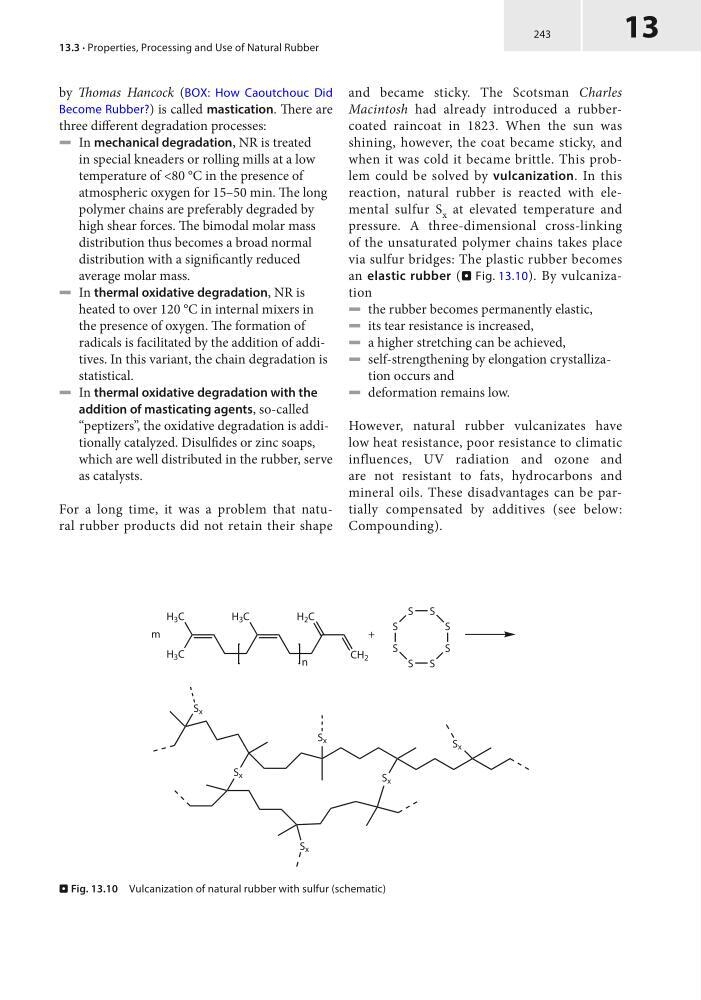
when it was cold it became brittle. This problem could be solved by vulcanization. In this
reaction, natural rubber is reacted with elemental sulfur S x at elevated temperature and
pressure. A three-dimensional cross-linking
of the unsaturated polymer chains takes place
via sulfur bridges: The plastic rubber becomes
an elastic rubber (. Fig. 13.10). By vulcanization
5 the rubber becomes permanently elastic,
5 its tear resistance is increased,
5 a higher stretching can be achieved,
5 self-strengthening by elongation crystallization occurs and
5 deformation remains low.
However, natural rubber vulcanizates have
low heat resistance, poor resistance to climatic
influences, UV radiation and ozone and
are not resistant to fats, hydrocarbons and
mineral oils. These disadvantages can be partially compensated by additives (see below:
Compounding).
by Thomas Hancock (BOX: How Caoutchouc Did
Become Rubber?) is called mastication. There are
three different degradation processes:
5 In mechanical degradation, NR is treated
in special kneaders or rolling mills at a low
temperature of <80 °C in the presence of
atmospheric oxygen for 15–50 min. The long
polymer chains are preferably degraded by
high shear forces. The bimodal molar mass
distribution thus becomes a broad normal
distribution with a significantly reduced
average molar mass.
5 In thermal oxidative degradation, NR is
heated to over 120 °C in internal mixers in
the presence of oxygen. The formation of
radicals is facilitated by the addition of additives. In this variant, the chain degradation is
statistical.
5 In thermal oxidative degradation with the
addition of masticating agents, so-called
“peptizers”, the oxidative degradation is additionally catalyzed. Disulfides or zinc soaps,
which are well distributed in the rubber, serve
as catalysts.
For a long time, it was a problem that natural rubber products did not retain their shape
S
S
S S
S
S
S
S
S x
S x
S x
S x
S x
S x
CH 2
H 3 C
H 2 C
H 3 C
H 3 C
n
. Fig. 13.10 Vulcanization of natural rubber with sulfur (schematic)
13.3 · Properties, Processing and Use of Natural Rubber
13
and became sticky. The Scotsman Charles
Macintosh had already introduced a rubbercoated raincoat in 1823. When the sun was
shining, however, the coat became sticky, and
when it was cold it became brittle. This problem could be solved by vulcanization. In this
reaction, natural rubber is reacted with elemental sulfur S x at elevated temperature and
pressure. A three-dimensional cross-linking
of the unsaturated polymer chains takes place
via sulfur bridges: The plastic rubber becomes
an elastic rubber (. Fig. 13.10). By vulcanization
5 the rubber becomes permanently elastic,
5 its tear resistance is increased,
5 a higher stretching can be achieved,
5 self-strengthening by elongation crystallization occurs and
5 deformation remains low.
However, natural rubber vulcanizates have
low heat resistance, poor resistance to climatic
influences, UV radiation and ozone and
are not resistant to fats, hydrocarbons and
mineral oils. These disadvantages can be partially compensated by additives (see below:
Compounding).
by Thomas Hancock (BOX: How Caoutchouc Did
Become Rubber?) is called mastication. There are
three different degradation processes:
5 In mechanical degradation, NR is treated
in special kneaders or rolling mills at a low
temperature of <80 °C in the presence of
atmospheric oxygen for 15–50 min. The long
polymer chains are preferably degraded by
high shear forces. The bimodal molar mass
distribution thus becomes a broad normal
distribution with a significantly reduced
average molar mass.
5 In thermal oxidative degradation, NR is
heated to over 120 °C in internal mixers in
the presence of oxygen. The formation of
radicals is facilitated by the addition of additives. In this variant, the chain degradation is
statistical.
5 In thermal oxidative degradation with the
addition of masticating agents, so-called
“peptizers”, the oxidative degradation is additionally catalyzed. Disulfides or zinc soaps,
which are well distributed in the rubber, serve
as catalysts.
For a long time, it was a problem that natural rubber products did not retain their shape
S
S
S S
S
S
S
S
S x
S x
S x
S x
S x
S x
CH 2
H 3 C
H 2 C
H 3 C
H 3 C
n
. Fig. 13.10 Vulcanization of natural rubber with sulfur (schematic)
13.3 · Properties, Processing and Use of Natural Rubber