

240
Chapter 13 · Elastomers from Nature! - Polyterpenes
13
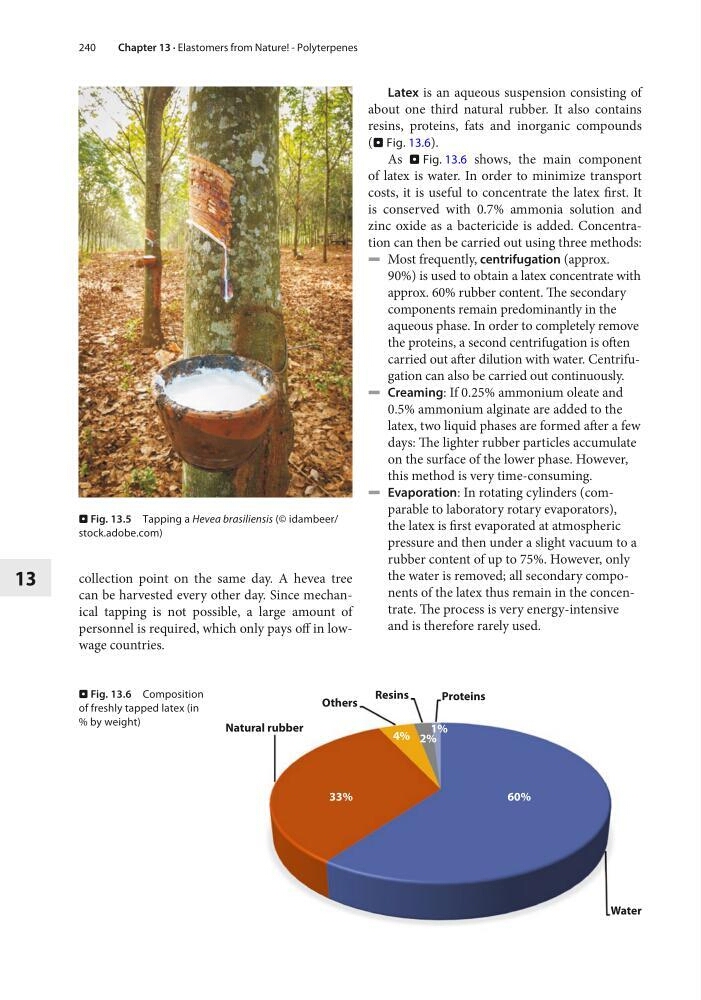
Latex is an aqueous suspension consisting of
about one third natural rubber. It also contains
resins, proteins, fats and inorganic compounds
(. Fig. 13.6).
As . Fig. 13.6 shows, the main component
of latex is water. In order to minimize transport
costs, it is useful to concentrate the latex first. It
is conserved with 0.7% ammonia solution and
zinc oxide as a bactericide is added. Concentration can then be carried out using three methods:
5 Most frequently, centrifugation (approx.
90%) is used to obtain a latex concentrate with
approx. 60% rubber content. The secondary
components remain predominantly in the
aqueous phase. In order to completely remove
the proteins, a second centrifugation is often
carried out after dilution with water. Centrifugation can also be carried out continuously.
5 Creaming: If 0.25% ammonium oleate and
0.5% ammonium alginate are added to the
latex, two liquid phases are formed after a few
days: The lighter rubber particles accumulate
on the surface of the lower phase. However,
this method is very time-consuming.
5 Evaporation: In rotating cylinders (comparable to laboratory rotary evaporators),
the latex is first evaporated at atmospheric
pressure and then under a slight vacuum to a
rubber content of up to 75%. However, only
the water is removed; all secondary components of the latex thus remain in the concentrate. The process is very energy-intensive
and is therefore rarely used.
collection point on the same day. A hevea tree
can be harvested every other day. Since mechanical tapping is not possible, a large amount of
personnel is required, which only pays off in lowwage countries.
. Fig. 13.6 Composition
of freshly tapped latex (in
% by weight)
Water
Natural rubber
Others
Resins
Proteins
60%
33%
4% 2%
1%
. Fig. 13.5 Tapping a Hevea brasiliensis (© idambeer/
stock.adobe.com)
Chapter 13 · Elastomers from Nature! - Polyterpenes
13
Latex is an aqueous suspension consisting of
about one third natural rubber. It also contains
resins, proteins, fats and inorganic compounds
(. Fig. 13.6).
As . Fig. 13.6 shows, the main component
of latex is water. In order to minimize transport
costs, it is useful to concentrate the latex first. It
is conserved with 0.7% ammonia solution and
zinc oxide as a bactericide is added. Concentration can then be carried out using three methods:
5 Most frequently, centrifugation (approx.
90%) is used to obtain a latex concentrate with
approx. 60% rubber content. The secondary
components remain predominantly in the
aqueous phase. In order to completely remove
the proteins, a second centrifugation is often
carried out after dilution with water. Centrifugation can also be carried out continuously.
5 Creaming: If 0.25% ammonium oleate and
0.5% ammonium alginate are added to the
latex, two liquid phases are formed after a few
days: The lighter rubber particles accumulate
on the surface of the lower phase. However,
this method is very time-consuming.
5 Evaporation: In rotating cylinders (comparable to laboratory rotary evaporators),
the latex is first evaporated at atmospheric
pressure and then under a slight vacuum to a
rubber content of up to 75%. However, only
the water is removed; all secondary components of the latex thus remain in the concentrate. The process is very energy-intensive
and is therefore rarely used.
collection point on the same day. A hevea tree
can be harvested every other day. Since mechanical tapping is not possible, a large amount of
personnel is required, which only pays off in lowwage countries.
. Fig. 13.6 Composition
of freshly tapped latex (in
% by weight)
Water
Natural rubber
Others
Resins
Proteins
60%
33%
4% 2%
1%
. Fig. 13.5 Tapping a Hevea brasiliensis (© idambeer/
stock.adobe.com)