

241
13
5 In the case of crepe rubber, the latex is first
treated with 0.5% sodium hydrogen sulfite.
This prevents the light yellow carotene present
in the rubber (7 Chap. 12) from turning
brown through an enzymatic reaction. Only
then coagulation with acid as well as rolling,
washing and drying takes place - as with sheet
rubber. The “pale crepe” is formed or, if very
fresh latex is used, the “white crepe”. Crepe
rubber is particularly manufactured in Indonesia. The crepes (just like the sheets) are sold
in bales of about 100 kg.
In 2018, more than 13.5 Mio t a −1 of natural rubber were produced worldwide. As . Table 13.1
shows, Thailand and Indonesia are by far the
most important producers.
13.3 Properties, Processing and Use
of Natural Rubber
The properties of natural rubber (NR) vary
greatly depending on the type of rubber, the age
of the trees, the season of the tapping and the
production method. The glass transition temperature T G , i.e. the temperature above which
the solid polymer changes into a rubber-like
material, is −73 °C. Natural rubber can be used
A large part of the latex is then further processed into solid natural rubber (“solid rubber”).
There are many different methods. The two most
important types of solid rubber are “sheet rubber” and “crepe rubber”:
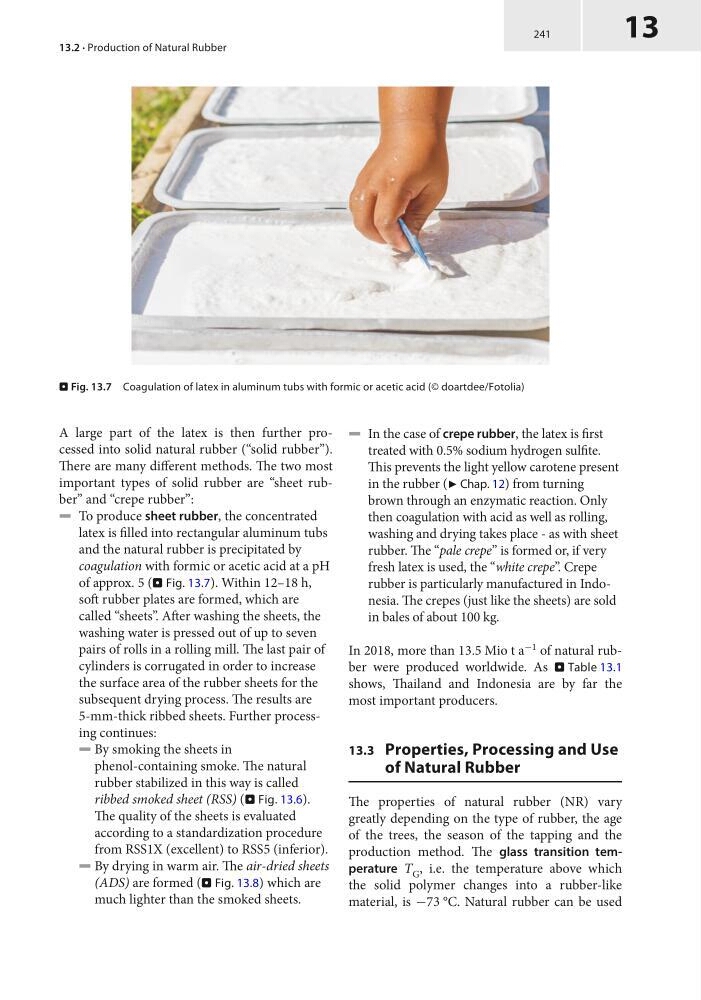
5 To produce sheet rubber, the concentrated
latex is filled into rectangular aluminum tubs
and the natural rubber is precipitated by
coagulation with formic or acetic acid at a pH
of approx. 5 (. Fig. 13.7). Within 12–18 h,
soft rubber plates are formed, which are
called “sheets”. After washing the sheets, the
washing water is pressed out of up to seven
pairs of rolls in a rolling mill. The last pair of
cylinders is corrugated in order to increase
the surface area of the rubber sheets for the
subsequent drying process. The results are
5-mm-thick ribbed sheets. Further processing continues:
5 By smoking the sheets in
phenol-containing smoke. The natural
rubber stabilized in this way is called
ribbed smoked sheet (RSS) (. Fig. 13.6).
The quality of the sheets is evaluated
according to a standardization procedure
from RSS1X (excellent) to RSS5 (inferior).
5 By drying in warm air. The air-dried sheets
(ADS) are formed (. Fig. 13.8) which are
much lighter than the smoked sheets.
. Fig. 13.7 Coagulation of latex in aluminum tubs with formic or acetic acid (© doartdee/Fotolia)
13.2 · Production of Natural Rubber
13
5 In the case of crepe rubber, the latex is first
treated with 0.5% sodium hydrogen sulfite.
This prevents the light yellow carotene present
in the rubber (7 Chap. 12) from turning
brown through an enzymatic reaction. Only
then coagulation with acid as well as rolling,
washing and drying takes place - as with sheet
rubber. The “pale crepe” is formed or, if very
fresh latex is used, the “white crepe”. Crepe
rubber is particularly manufactured in Indonesia. The crepes (just like the sheets) are sold
in bales of about 100 kg.
In 2018, more than 13.5 Mio t a −1 of natural rubber were produced worldwide. As . Table 13.1
shows, Thailand and Indonesia are by far the
most important producers.
13.3 Properties, Processing and Use
of Natural Rubber
The properties of natural rubber (NR) vary
greatly depending on the type of rubber, the age
of the trees, the season of the tapping and the
production method. The glass transition temperature T G , i.e. the temperature above which
the solid polymer changes into a rubber-like
material, is −73 °C. Natural rubber can be used
A large part of the latex is then further processed into solid natural rubber (“solid rubber”).
There are many different methods. The two most
important types of solid rubber are “sheet rubber” and “crepe rubber”:
5 To produce sheet rubber, the concentrated
latex is filled into rectangular aluminum tubs
and the natural rubber is precipitated by
coagulation with formic or acetic acid at a pH
of approx. 5 (. Fig. 13.7). Within 12–18 h,
soft rubber plates are formed, which are
called “sheets”. After washing the sheets, the
washing water is pressed out of up to seven
pairs of rolls in a rolling mill. The last pair of
cylinders is corrugated in order to increase
the surface area of the rubber sheets for the
subsequent drying process. The results are
5-mm-thick ribbed sheets. Further processing continues:
5 By smoking the sheets in
phenol-containing smoke. The natural
rubber stabilized in this way is called
ribbed smoked sheet (RSS) (. Fig. 13.6).
The quality of the sheets is evaluated
according to a standardization procedure
from RSS1X (excellent) to RSS5 (inferior).
5 By drying in warm air. The air-dried sheets
(ADS) are formed (. Fig. 13.8) which are
much lighter than the smoked sheets.
. Fig. 13.7 Coagulation of latex in aluminum tubs with formic or acetic acid (© doartdee/Fotolia)
13.2 · Production of Natural Rubber