

239
13
In these plantations about 300–400 trees
grow per hectare, which can be first harvested
starting from the sixth year. The yield of a hevea
tree is currently around 5 kg a −1 ; this means
that around 2 tons of rubber can be harvested
per hectare per year. Tapping is done by cutting
the bark with a special knife. The cut is made at
an angle of approx. 30°; a cup is attached to the
lower end of the cut, and the latex is collected
(. Fig. 13.5). This latex is then brought to a
13.2 Production of Natural Rubber
The most important rubber plant, Hevea brasiliensis, grows best in the equatorial zone (in the
“rubber belt”) with year-round temperatures
around 30 °C and a rainfall of 2000 mm per
year. The originally Brazilian plant (as the name
indicates) was also planted in Asia at the end of
the nineteenth century: The Englishman Henry
Wickham shipped about 70,000 seeds to London
in 1876. In the literature, this seed shipment is
often referred to as “smuggling”; other sources,
however, point out that at that time there was no
export restriction for Hevea seeds. Young plants
were bred in the greenhouses of the Kew Gardens in London and shipped to Singapore. From
here the seedlings found their way to Burma,
Ceylon and Java. Today, Thailand, Indonesia,
Malaysia and India are the main producers of
natural rubber (. Table 13.1). Large plantations
were successively established there, either by
small planters (cultivation area <40 ha) or in the
shape of large plantations with an average area of
approx. 700 ha. Wild rubber in Brazil no longer
has any industrial significance.
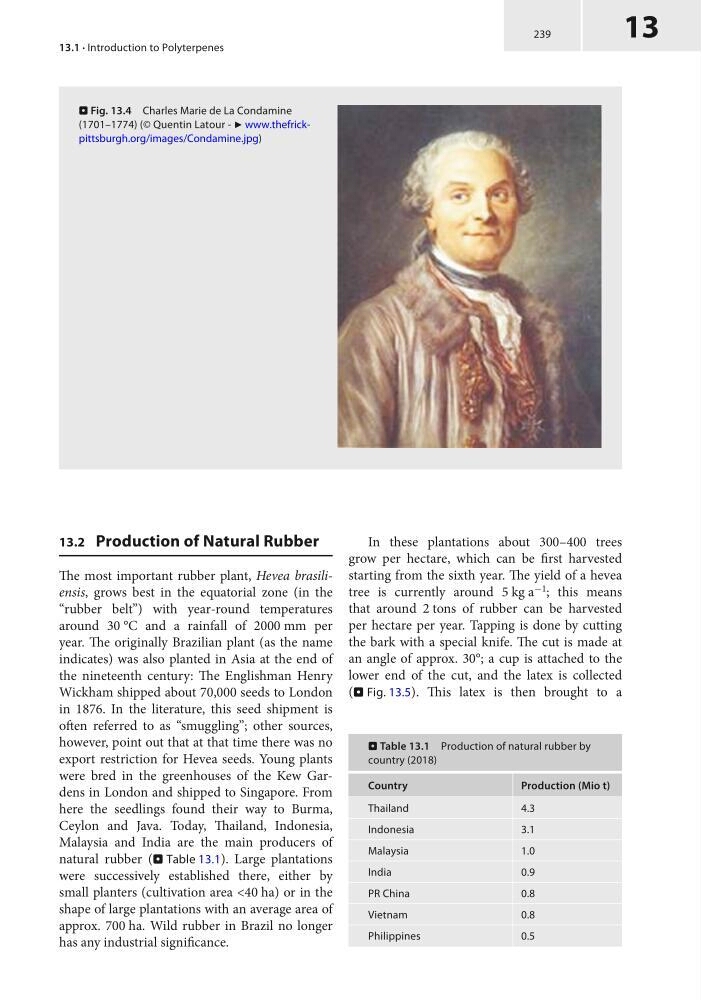
. Fig. 13.4 Charles Marie de La Condamine
(1701–1774) (© Quentin Latour - 7 www.thefrickpittsburgh.org/images/Condamine.jpg)
. Table 13.1 Production of natural rubber by
country (2018)
Country
Production (Mio t)
Thailand
4.3
Indonesia
3.1
Malaysia
1.0
India
0.9
PR China
0.8
Vietnam
0.8
Philippines
0.5
13.1 · Introduction to Polyterpenes
13
In these plantations about 300–400 trees
grow per hectare, which can be first harvested
starting from the sixth year. The yield of a hevea
tree is currently around 5 kg a −1 ; this means
that around 2 tons of rubber can be harvested
per hectare per year. Tapping is done by cutting
the bark with a special knife. The cut is made at
an angle of approx. 30°; a cup is attached to the
lower end of the cut, and the latex is collected
(. Fig. 13.5). This latex is then brought to a
13.2 Production of Natural Rubber
The most important rubber plant, Hevea brasiliensis, grows best in the equatorial zone (in the
“rubber belt”) with year-round temperatures
around 30 °C and a rainfall of 2000 mm per
year. The originally Brazilian plant (as the name
indicates) was also planted in Asia at the end of
the nineteenth century: The Englishman Henry
Wickham shipped about 70,000 seeds to London
in 1876. In the literature, this seed shipment is
often referred to as “smuggling”; other sources,
however, point out that at that time there was no
export restriction for Hevea seeds. Young plants
were bred in the greenhouses of the Kew Gardens in London and shipped to Singapore. From
here the seedlings found their way to Burma,
Ceylon and Java. Today, Thailand, Indonesia,
Malaysia and India are the main producers of
natural rubber (. Table 13.1). Large plantations
were successively established there, either by
small planters (cultivation area <40 ha) or in the
shape of large plantations with an average area of
approx. 700 ha. Wild rubber in Brazil no longer
has any industrial significance.
. Fig. 13.4 Charles Marie de La Condamine
(1701–1774) (© Quentin Latour - 7 www.thefrickpittsburgh.org/images/Condamine.jpg)
. Table 13.1 Production of natural rubber by
country (2018)
Country
Production (Mio t)
Thailand
4.3
Indonesia
3.1
Malaysia
1.0
India
0.9
PR China
0.8
Vietnam
0.8
Philippines
0.5
13.1 · Introduction to Polyterpenes