

230
Chapter 12 · The Balm of the Trees - Terpenes
12
BOX: A Sesquiterpene for Malaria Control
Malaria, also known as swamp
or tropical fever, is one of the
worst infectious diseases. This
plague occurs particularly in the
tropics and subtropics, where
it is transmitted by bites of the
female Anopheles mosquito.
Typical symptoms of malaria are
high, periodic fever, chills and
gastrointestinal complaints. The
number of malaria infections
per year is estimated at 200
million; about half a million
people die each year, many of
them as babies or small children.
Traditionally, the disease has
been treated with quinine
(7 Sect. 16.4) or the related
compound chloroquine, but
resistance to these drugs has
increased.
At the end of the 1960s, the
Chinese pharmacologist Youyou
Tu investigated the properties
of the leaves and flowers of the
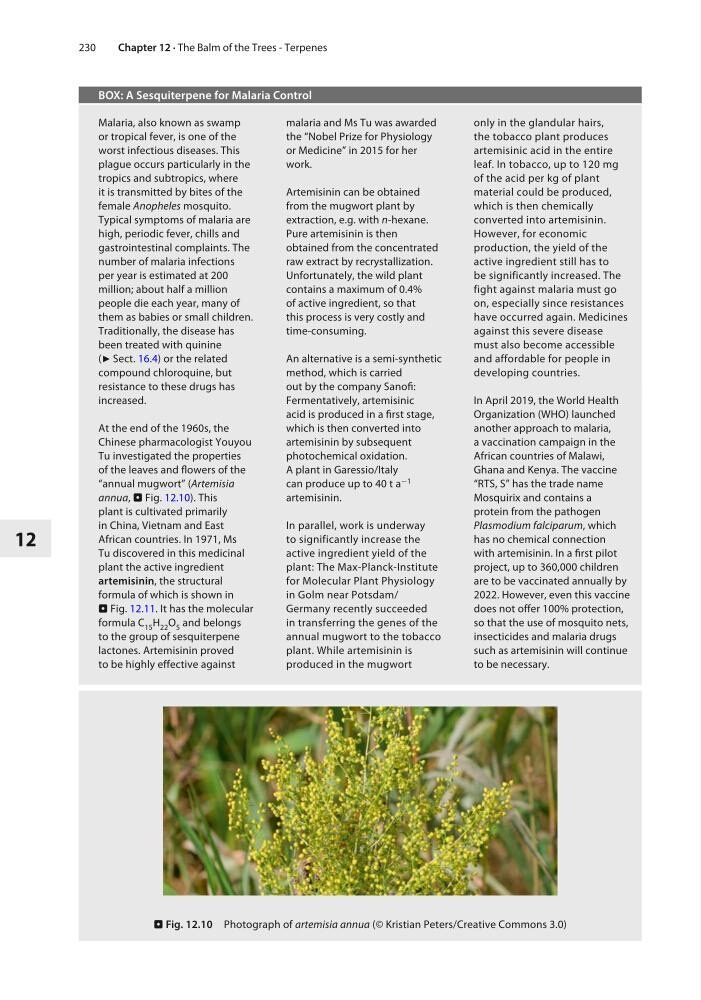
“annual mugwort” (Artemisia
annua, . Fig. 12.10). This
plant is cultivated primarily
in China, Vietnam and East
African countries. In 1971, Ms
Tu discovered in this medicinal
plant the active ingredient
artemisinin, the structural
formula of which is shown in
. Fig. 12.11. It has the molecular
formula C 15 H 22 O 5 and belongs
to the group of sesquiterpene
lactones. Artemisinin proved
to be highly effective against
malaria and Ms Tu was awarded
the “Nobel Prize for Physiology
or Medicine” in 2015 for her
work.
Artemisinin can be obtained
from the mugwort plant by
extraction, e.g. with n-hexane.
Pure artemisinin is then
obtained from the concentrated
raw extract by recrystallization.
Unfortunately, the wild plant
contains a maximum of 0.4%
of active ingredient, so that
this process is very costly and
time-consuming.
An alternative is a semi-synthetic
method, which is carried
out by the company Sanofi:
Fermentatively, artemisinic
acid is produced in a first stage,
which is then converted into
artemisinin by subsequent
photochemical oxidation.
A plant in Garessio/Italy
can produce up to 40 t a −1
artemisinin.
In parallel, work is underway
to significantly increase the
active ingredient yield of the
plant: The Max-Planck-Institute
for Molecular Plant Physiology
in Golm near Potsdam/
Germany recently succeeded
in transferring the genes of the
annual mugwort to the tobacco
plant. While artemisinin is
produced in the mugwort
only in the glandular hairs,
the tobacco plant produces
artemisinic acid in the entire
leaf. In tobacco, up to 120 mg
of the acid per kg of plant
material could be produced,
which is then chemically
converted into artemisinin.
However, for economic
production, the yield of the
active ingredient still has to
be significantly increased. The
fight against malaria must go
on, especially since resistances
have occurred again. Medicines
against this severe disease
must also become accessible
and affordable for people in
developing countries.
In April 2019, the World Health
Organization (WHO) launched
another approach to malaria,
a vaccination campaign in the
African countries of Malawi,
Ghana and Kenya. The vaccine
“RTS, S” has the trade name
Mosquirix and contains a
protein from the pathogen
Plasmodium falciparum, which
has no chemical connection
with artemisinin. In a first pilot
project, up to 360,000 children
are to be vaccinated annually by
2022. However, even this vaccine
does not offer 100% protection,
so that the use of mosquito nets,
insecticides and malaria drugs
such as artemisinin will continue
to be necessary.
. Fig. 12.10 Photograph of artemisia annua (© Kristian Peters/Creative Commons 3.0)
Chapter 12 · The Balm of the Trees - Terpenes
12
BOX: A Sesquiterpene for Malaria Control
Malaria, also known as swamp
or tropical fever, is one of the
worst infectious diseases. This
plague occurs particularly in the
tropics and subtropics, where
it is transmitted by bites of the
female Anopheles mosquito.
Typical symptoms of malaria are
high, periodic fever, chills and
gastrointestinal complaints. The
number of malaria infections
per year is estimated at 200
million; about half a million
people die each year, many of
them as babies or small children.
Traditionally, the disease has
been treated with quinine
(7 Sect. 16.4) or the related
compound chloroquine, but
resistance to these drugs has
increased.
At the end of the 1960s, the
Chinese pharmacologist Youyou
Tu investigated the properties
of the leaves and flowers of the
“annual mugwort” (Artemisia
annua, . Fig. 12.10). This
plant is cultivated primarily
in China, Vietnam and East
African countries. In 1971, Ms
Tu discovered in this medicinal
plant the active ingredient
artemisinin, the structural
formula of which is shown in
. Fig. 12.11. It has the molecular
formula C 15 H 22 O 5 and belongs
to the group of sesquiterpene
lactones. Artemisinin proved
to be highly effective against
malaria and Ms Tu was awarded
the “Nobel Prize for Physiology
or Medicine” in 2015 for her
work.
Artemisinin can be obtained
from the mugwort plant by
extraction, e.g. with n-hexane.
Pure artemisinin is then
obtained from the concentrated
raw extract by recrystallization.
Unfortunately, the wild plant
contains a maximum of 0.4%
of active ingredient, so that
this process is very costly and
time-consuming.
An alternative is a semi-synthetic
method, which is carried
out by the company Sanofi:
Fermentatively, artemisinic
acid is produced in a first stage,
which is then converted into
artemisinin by subsequent
photochemical oxidation.
A plant in Garessio/Italy
can produce up to 40 t a −1
artemisinin.
In parallel, work is underway
to significantly increase the
active ingredient yield of the
plant: The Max-Planck-Institute
for Molecular Plant Physiology
in Golm near Potsdam/
Germany recently succeeded
in transferring the genes of the
annual mugwort to the tobacco
plant. While artemisinin is
produced in the mugwort
only in the glandular hairs,
the tobacco plant produces
artemisinic acid in the entire
leaf. In tobacco, up to 120 mg
of the acid per kg of plant
material could be produced,
which is then chemically
converted into artemisinin.
However, for economic
production, the yield of the
active ingredient still has to
be significantly increased. The
fight against malaria must go
on, especially since resistances
have occurred again. Medicines
against this severe disease
must also become accessible
and affordable for people in
developing countries.
In April 2019, the World Health
Organization (WHO) launched
another approach to malaria,
a vaccination campaign in the
African countries of Malawi,
Ghana and Kenya. The vaccine
“RTS, S” has the trade name
Mosquirix and contains a
protein from the pathogen
Plasmodium falciparum, which
has no chemical connection
with artemisinin. In a first pilot
project, up to 360,000 children
are to be vaccinated annually by
2022. However, even this vaccine
does not offer 100% protection,
so that the use of mosquito nets,
insecticides and malaria drugs
such as artemisinin will continue
to be necessary.
. Fig. 12.10 Photograph of artemisia annua (© Kristian Peters/Creative Commons 3.0)