

229
12
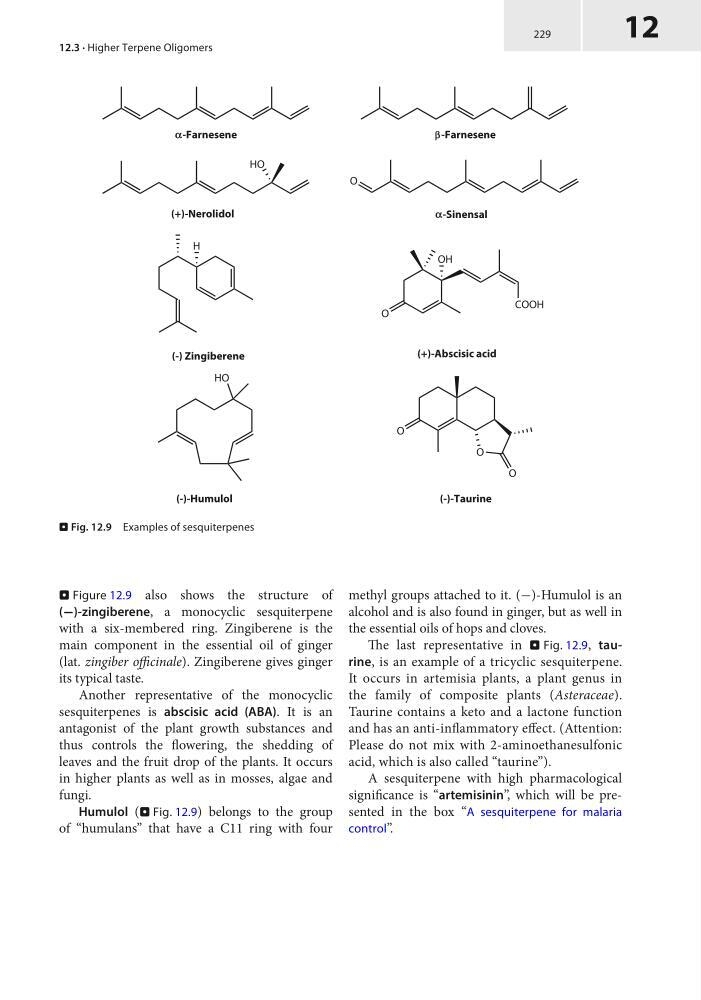
methyl groups attached to it. (−)-Humulol is an
alcohol and is also found in ginger, but as well in
the essential oils of hops and cloves.
The last representative in . Fig. 12.9, taurine, is an example of a tricyclic sesquiterpene.
It occurs in artemisia plants, a plant genus in
the family of composite plants (Asteraceae).
Taurine contains a keto and a lactone function
and has an anti-inflammatory effect. (Attention:
Please do not mix with 2-aminoethanesulfonic
acid, which is also called “taurine”).
A sesquiterpene with high pharmacological
significance is “artemisinin”, which will be presented in the box “A sesquiterpene for malaria
control”.
. Figure 12.9 also shows the structure of
(−)-zingiberene, a monocyclic sesquiterpene
with a six-membered ring. Zingiberene is the
main component in the essential oil of ginger
(lat. zingiber officinale). Zingiberene gives ginger
its typical taste.
Another representative of the monocyclic
sesquiterpenes is abscisic acid (ABA). It is an
antagonist of the plant growth substances and
thus controls the flowering, the shedding of
leaves and the fruit drop of the plants. It occurs
in higher plants as well as in mosses, algae and
fungi.
Humulol (. Fig. 12.9) belongs to the group
of “humulans” that have a C11 ring with four
O
HO
H
O
OH
COOH
HO
O
O
O
-Farnesene
-Farnesene
(+)-Nerolidol
-Sinensal
(-) Zingiberene
(+)-Abscisic acid
(-)-Humulol
(-)-Taurine
. Fig. 12.9 Examples of sesquiterpenes
12.3 · Higher Terpene Oligomers
12
methyl groups attached to it. (−)-Humulol is an
alcohol and is also found in ginger, but as well in
the essential oils of hops and cloves.
The last representative in . Fig. 12.9, taurine, is an example of a tricyclic sesquiterpene.
It occurs in artemisia plants, a plant genus in
the family of composite plants (Asteraceae).
Taurine contains a keto and a lactone function
and has an anti-inflammatory effect. (Attention:
Please do not mix with 2-aminoethanesulfonic
acid, which is also called “taurine”).
A sesquiterpene with high pharmacological
significance is “artemisinin”, which will be presented in the box “A sesquiterpene for malaria
control”.
. Figure 12.9 also shows the structure of
(−)-zingiberene, a monocyclic sesquiterpene
with a six-membered ring. Zingiberene is the
main component in the essential oil of ginger
(lat. zingiber officinale). Zingiberene gives ginger
its typical taste.
Another representative of the monocyclic
sesquiterpenes is abscisic acid (ABA). It is an
antagonist of the plant growth substances and
thus controls the flowering, the shedding of
leaves and the fruit drop of the plants. It occurs
in higher plants as well as in mosses, algae and
fungi.
Humulol (. Fig. 12.9) belongs to the group
of “humulans” that have a C11 ring with four
O
HO
H
O
OH
COOH
HO
O
O
O
-Farnesene
-Farnesene
(+)-Nerolidol
-Sinensal
(-) Zingiberene
(+)-Abscisic acid
(-)-Humulol
(-)-Taurine
. Fig. 12.9 Examples of sesquiterpenes
12.3 · Higher Terpene Oligomers