

228
Chapter 12 · The Balm of the Trees - Terpenes
12
use farnesene to repel insects. Since 2015,
the company Amyris has been offering a
trans-β-farnesene on the market, which is
obtained from sugars by fermentation with
the aid of yeasts and can therefore be produced very cheaply.
The alcohol nerolidol and the aldehyde
α-sinensal are derived from farnesenes:
5 Nerolidol is isolated from orange blossom oil,
the “neroli oil”, and is an important component in perfumery because of its mild flowery
aroma. It is also an intermediate in the synthesis of vitamins E and K1. Nerolidol
can also be produced synthetically from
linalool.
5 β-Sinensal characterizes the aroma of orange
and mandarin oils. It is used preferentially in
food industry.
12.3 Higher Terpene Oligomers
As already mentioned in 7 Sect. 12.1, the next
higher group of terpenes is the class of sesquiterpenes, which are composed of three isoprene
units and thus contain 15 carbon atoms. From
the more than 8000 sesquiterpenes known so far,
eight acyclic and cyclic structures are listed as
examples in . Fig. 12.9.
Two representatives of the acyclic farnesane
series are α-farnesene and β-farnesene with different positions of the 1,3 diene unit:
5 α-Farnesene is found in the skin of apples
and pears and has the typical smell of “green
apples”. It can be obtained from the essential
oil of the perilla plant growing in Asia. It is
also the main component of gardenia oil.
5 β-Farnesene is found in citrus, chamomile
and hop oils. Some plants, such as potatoes,
O
-Pinene
-Pinene
Camphor
Isomerization
Isomerization
Isomerization
Isomerization
Camphene
OH
Isomerization
+
Hydration
Borneol
Oxidation
Limonene
-Myrcene
OH
Geraniol/Nerol
OH
O
Citronellol
Citral
Oxidation
+H 2 O
Hydrogenation
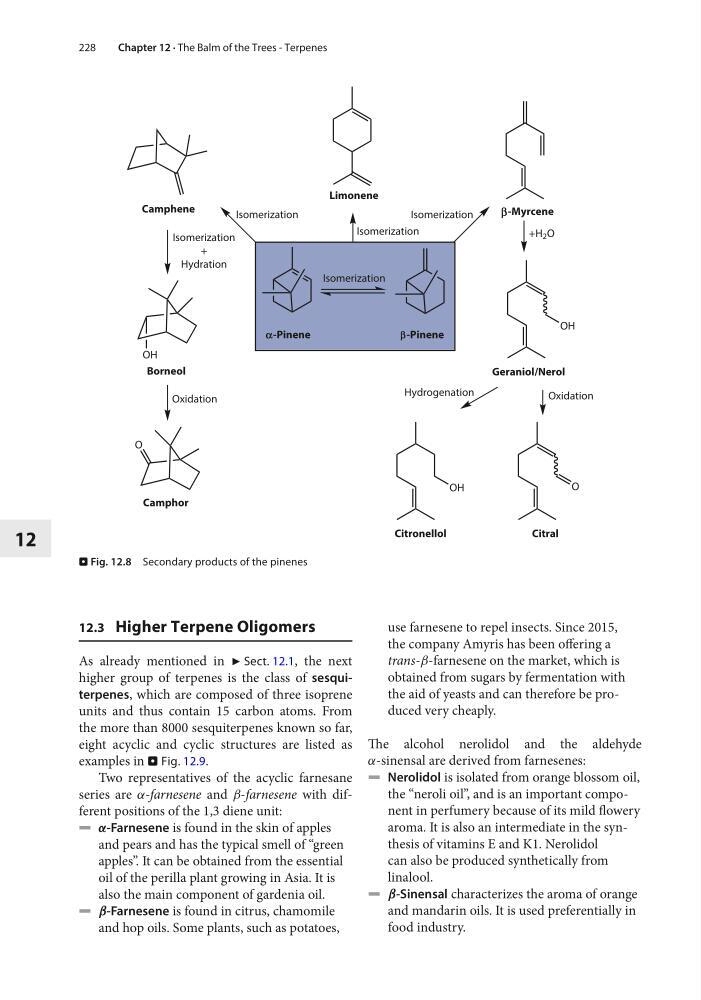
. Fig. 12.8 Secondary products of the pinenes
Chapter 12 · The Balm of the Trees - Terpenes
12
use farnesene to repel insects. Since 2015,
the company Amyris has been offering a
trans-β-farnesene on the market, which is
obtained from sugars by fermentation with
the aid of yeasts and can therefore be produced very cheaply.
The alcohol nerolidol and the aldehyde
α-sinensal are derived from farnesenes:
5 Nerolidol is isolated from orange blossom oil,
the “neroli oil”, and is an important component in perfumery because of its mild flowery
aroma. It is also an intermediate in the synthesis of vitamins E and K1. Nerolidol
can also be produced synthetically from
linalool.
5 β-Sinensal characterizes the aroma of orange
and mandarin oils. It is used preferentially in
food industry.
12.3 Higher Terpene Oligomers
As already mentioned in 7 Sect. 12.1, the next
higher group of terpenes is the class of sesquiterpenes, which are composed of three isoprene
units and thus contain 15 carbon atoms. From
the more than 8000 sesquiterpenes known so far,
eight acyclic and cyclic structures are listed as
examples in . Fig. 12.9.
Two representatives of the acyclic farnesane
series are α-farnesene and β-farnesene with different positions of the 1,3 diene unit:
5 α-Farnesene is found in the skin of apples
and pears and has the typical smell of “green
apples”. It can be obtained from the essential
oil of the perilla plant growing in Asia. It is
also the main component of gardenia oil.
5 β-Farnesene is found in citrus, chamomile
and hop oils. Some plants, such as potatoes,
O
-Pinene
-Pinene
Camphor
Isomerization
Isomerization
Isomerization
Isomerization
Camphene
OH
Isomerization
+
Hydration
Borneol
Oxidation
Limonene
-Myrcene
OH
Geraniol/Nerol
OH
O
Citronellol
Citral
Oxidation
+H 2 O
Hydrogenation
. Fig. 12.8 Secondary products of the pinenes