

227
12
by isomerization and subsequent hydration.
Further oxidation finally results in camphor,
which also occurs in nature, e.g. in the resin
of the camphor tree or in essential oils of laurel plants. Camphor is a white, crumbly powder with a eucalyptus-like odor. It can be used
for the production of celluloid (7 Sect. 7.3.2),
as a plasticizer for cellulose esters and as an
anti-moth agent.
5 We have already discussed the β-myrcene
produced from the pinenes during the
presentation of the acyclic monoterpenes.
It is offered on the market in two qualities:
As technical commodity with approx. 75%
purity and a price of 2–4 € kg −1 as well as
a pure commodity (>90%) with prices of
6–8 € kg −1 . Since β-myrcene contains both
an internal C=C double bond and a 1,3
diene unit, it can enter numerous downstream reactions. In . Fig. 12.8, the hydration to the geraniol/nerol mixture and the
further conversions to citronellol and citral
(. Fig. 12.4) are exemplarily shown.
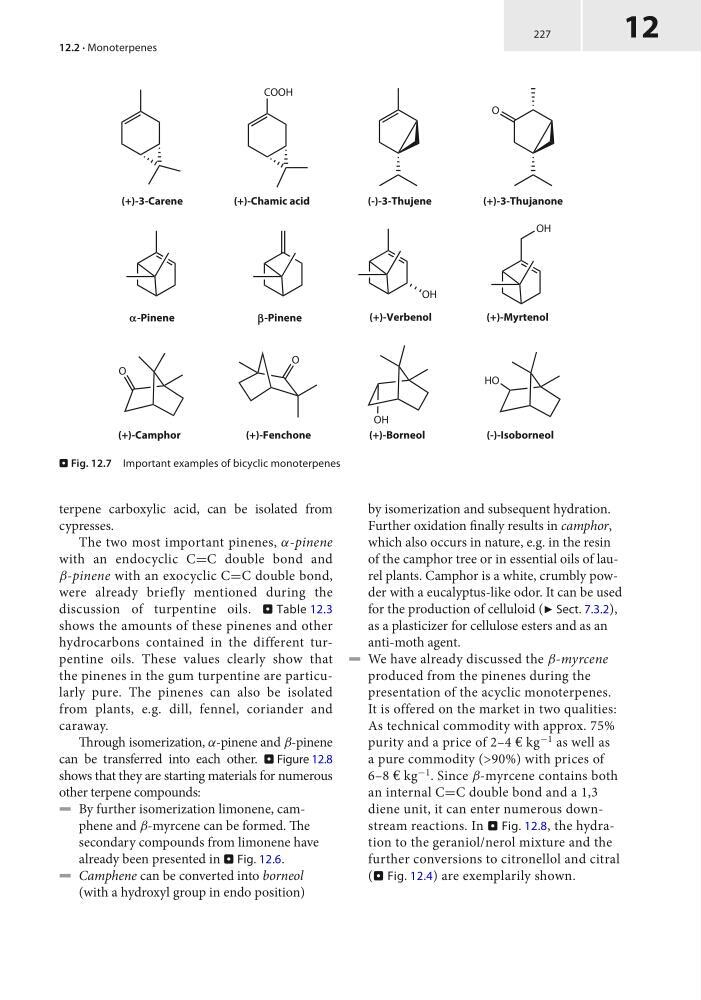
terpene carboxylic acid, can be isolated from
cypresses.
The two most important pinenes, α-pinene
with an endocyclic C=C double bond and
β-pinene with an exocyclic C=C double bond,
were already briefly mentioned during the
discussion of turpentine oils. . Table 12.3
shows the amounts of these pinenes and other
hydrocarbons contained in the different turpentine oils. These values clearly show that
the pinenes in the gum turpentine are particularly pure. The pinenes can also be isolated
from plants, e.g. dill, fennel, coriander and
caraway.
Through isomerization, α-pinene and β-pinene
can be transferred into each other. . Figure 12.8
shows that they are starting materials for numerous
other terpene compounds:
5 By further isomerization limonene, camphene and β-myrcene can be formed. The
secondary compounds from limonene have
already been presented in . Fig. 12.6.
5 Camphene can be converted into borneol
(with a hydroxyl group in endo position)
COOH
O
OH
OH
O
O
OH
HO
(+)-3-Carene
(+)-Chamic acid
(-)-3-Thujene
(+)-3-Thujanone
-Pinene
-Pinene
(+)-Verbenol
(+)-Myrtenol
(+)-Camphor
(+)-Fenchone
(+)-Borneol
(-)-Isoborneol
. Fig. 12.7 Important examples of bicyclic monoterpenes
12.2 · Monoterpenes
12
by isomerization and subsequent hydration.
Further oxidation finally results in camphor,
which also occurs in nature, e.g. in the resin
of the camphor tree or in essential oils of laurel plants. Camphor is a white, crumbly powder with a eucalyptus-like odor. It can be used
for the production of celluloid (7 Sect. 7.3.2),
as a plasticizer for cellulose esters and as an
anti-moth agent.
5 We have already discussed the β-myrcene
produced from the pinenes during the
presentation of the acyclic monoterpenes.
It is offered on the market in two qualities:
As technical commodity with approx. 75%
purity and a price of 2–4 € kg −1 as well as
a pure commodity (>90%) with prices of
6–8 € kg −1 . Since β-myrcene contains both
an internal C=C double bond and a 1,3
diene unit, it can enter numerous downstream reactions. In . Fig. 12.8, the hydration to the geraniol/nerol mixture and the
further conversions to citronellol and citral
(. Fig. 12.4) are exemplarily shown.
terpene carboxylic acid, can be isolated from
cypresses.
The two most important pinenes, α-pinene
with an endocyclic C=C double bond and
β-pinene with an exocyclic C=C double bond,
were already briefly mentioned during the
discussion of turpentine oils. . Table 12.3
shows the amounts of these pinenes and other
hydrocarbons contained in the different turpentine oils. These values clearly show that
the pinenes in the gum turpentine are particularly pure. The pinenes can also be isolated
from plants, e.g. dill, fennel, coriander and
caraway.
Through isomerization, α-pinene and β-pinene
can be transferred into each other. . Figure 12.8
shows that they are starting materials for numerous
other terpene compounds:
5 By further isomerization limonene, camphene and β-myrcene can be formed. The
secondary compounds from limonene have
already been presented in . Fig. 12.6.
5 Camphene can be converted into borneol
(with a hydroxyl group in endo position)
COOH
O
OH
OH
O
O
OH
HO
(+)-3-Carene
(+)-Chamic acid
(-)-3-Thujene
(+)-3-Thujanone
-Pinene
-Pinene
(+)-Verbenol
(+)-Myrtenol
(+)-Camphor
(+)-Fenchone
(+)-Borneol
(-)-Isoborneol
. Fig. 12.7 Important examples of bicyclic monoterpenes
12.2 · Monoterpenes