

231
12
O
O
O
CH 3
H
H
CH 3
H
H 3 C
O O
. Fig. 12.11 Structural formula of artemisinin
OH
HOOC
all-trans-Retinol
Abietic acid
Squalene
β,β-Carotene
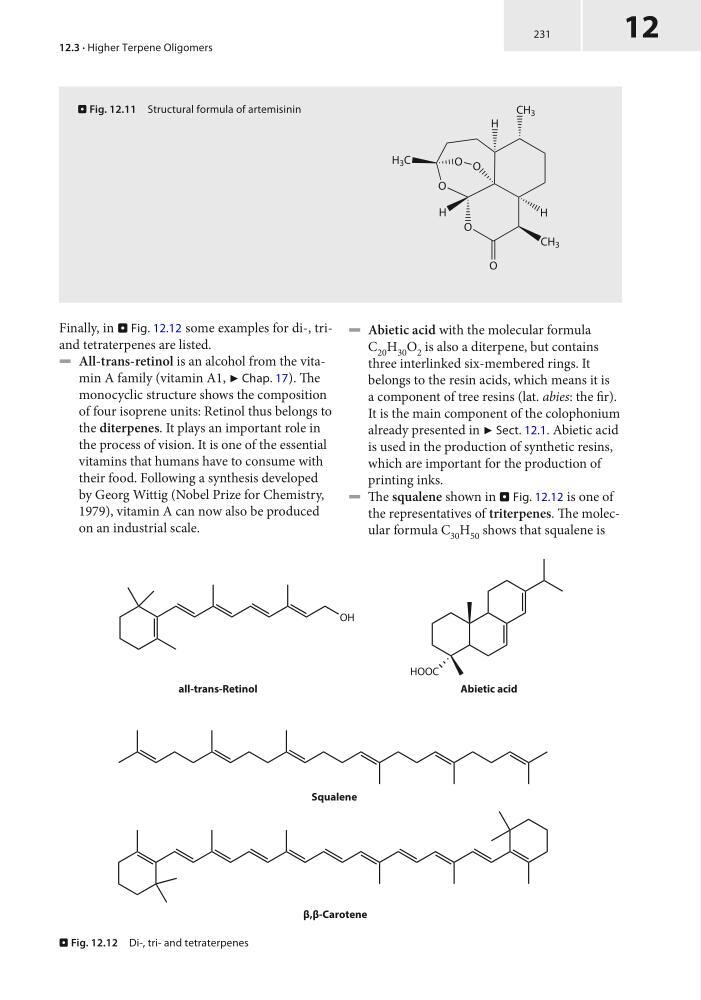
. Fig. 12.12 Di-, tri- and tetraterpenes
Finally, in . Fig. 12.12 some examples for di-, triand tetraterpenes are listed.
5 All-trans-retinol is an alcohol from the vitamin A family (vitamin A1, 7 Chap. 17). The
monocyclic structure shows the composition
of four isoprene units: Retinol thus belongs to
the diterpenes. It plays an important role in
the process of vision. It is one of the essential
vitamins that humans have to consume with
their food. Following a synthesis developed
by Georg Wittig (Nobel Prize for Chemistry,
1979), vitamin A can now also be produced
on an industrial scale.
5 Abietic acid with the molecular formula
C 20 H 30 O 2 is also a diterpene, but contains
three interlinked six-membered rings. It
belongs to the resin acids, which means it is
a component of tree resins (lat. abies: the fir).
It is the main component of the colophonium
already presented in 7 Sect. 12.1. Abietic acid
is used in the production of synthetic resins,
which are important for the production of
printing inks.
5 The squalene shown in . Fig. 12.12 is one of
the representatives of triterpenes. The molecular formula C 30 H 50 shows that squalene is
12.3 · Higher Terpene Oligomers
12
O
O
O
CH 3
H
H
CH 3
H
H 3 C
O O
. Fig. 12.11 Structural formula of artemisinin
OH
HOOC
all-trans-Retinol
Abietic acid
Squalene
β,β-Carotene
. Fig. 12.12 Di-, tri- and tetraterpenes
Finally, in . Fig. 12.12 some examples for di-, triand tetraterpenes are listed.
5 All-trans-retinol is an alcohol from the vitamin A family (vitamin A1, 7 Chap. 17). The
monocyclic structure shows the composition
of four isoprene units: Retinol thus belongs to
the diterpenes. It plays an important role in
the process of vision. It is one of the essential
vitamins that humans have to consume with
their food. Following a synthesis developed
by Georg Wittig (Nobel Prize for Chemistry,
1979), vitamin A can now also be produced
on an industrial scale.
5 Abietic acid with the molecular formula
C 20 H 30 O 2 is also a diterpene, but contains
three interlinked six-membered rings. It
belongs to the resin acids, which means it is
a component of tree resins (lat. abies: the fir).
It is the main component of the colophonium
already presented in 7 Sect. 12.1. Abietic acid
is used in the production of synthetic resins,
which are important for the production of
printing inks.
5 The squalene shown in . Fig. 12.12 is one of
the representatives of triterpenes. The molecular formula C 30 H 50 shows that squalene is
12.3 · Higher Terpene Oligomers