

222
Chapter 12 · The Balm of the Trees - Terpenes
12
Larger quantities of terpenes, on the other
hand, are isolated from the turpentine oil already
mentioned in the BOX: How were the complex
structures of the terpenes identified? The two
main components of turpentine oil are α-pinene
and β-pinene, presented in . Table 12.3.
Depending on the starting material and isolation
procedure, a distinction is made between three
different types of turpentine:
5 In the case of wood turpentine, old tree roots
are excavated from the soil and, after the
roots have been crushed, the oil is obtained
either by steam distillation or by extraction
with hydrocarbons or chlorinated hydrocarbons. The main reason for this procedure
is that the terpenes are located especially in
the lower areas of the trees, i.e. also in the
roots. However, the effort involved in this
extraction method is very high; therefore, this
method is of decreasing importance.
5 The gum turpentine is extracted from living
trees. For this purpose, cuts are made in the
tree bark of conifers, especially pines (lat.
pinus), and more rarely also of spruces or firs,
and the raw balsam formed is absorbed into
bottles, pots or bags. In this way, for example, a black pine (lat. pinus nigra), which is
Terpenes often have characteristic, pleasant
scents (violet, eucalyptus, citrus) or a special
taste (rosemary, sage, coriander). Accordingly,
they are often used as fragrances in perfumes or
as flavorings in food and beverages (7 Chap. 18).
Some terpenes also have a pharmacological effect
and are therefore used in herbal medicinal products (“phytopharmaceuticals”) (7 Chap. 16). The
biological function of terpenes has not been clarified in all cases. They often function as
5 Attractants to attract insects for pollination
5 Defensive substances to protect against enemies.
The industrial recovery of terpenes from plants is
accomplished via three methods:
5 Steam distillation,
5 Extraction,
5 Mechanical pressing.
These three methods are preferably used to isolate essential oils from plants as fragrances for
the perfume industry. Separation of these oils
into individual components, e.g. for the production of individual terpenes, is rather rare. For this
reason, the three processes are discussed in more
detail in 7 Chap. 18 (Fragrances).
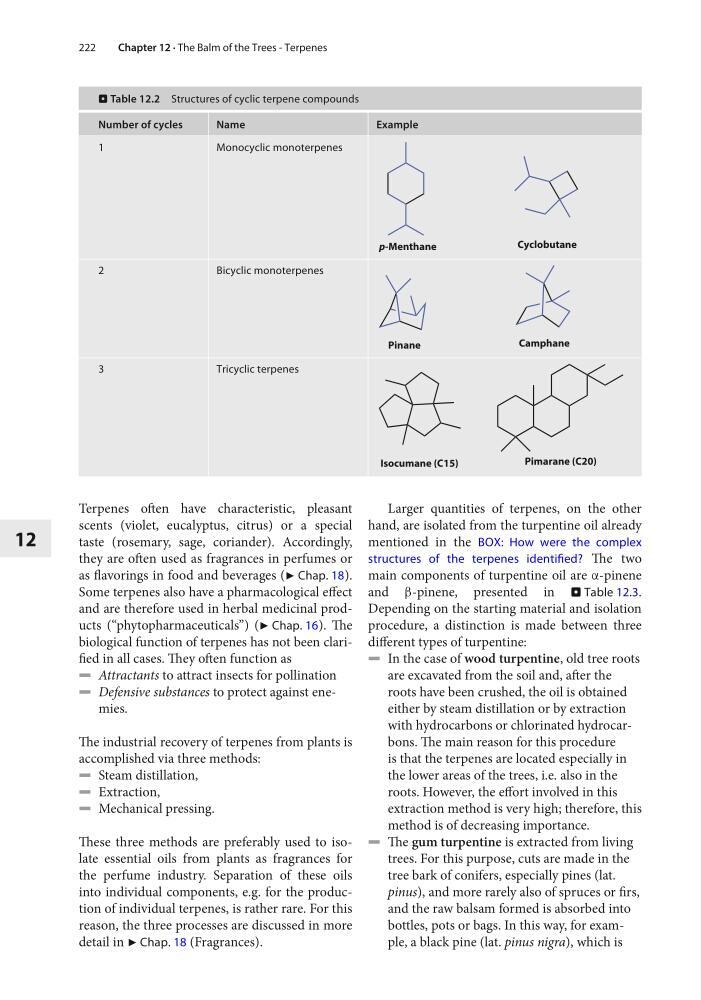
. Table 12.2 Structures of cyclic terpene compounds
Number of cycles
Name
Example
1
Monocyclic monoterpenes
p-Menthane
Cyclobutane
2
Bicyclic monoterpenes
Pinane
Camphane
3
Tricyclic terpenes
Isocumane (C15)
Pimarane (C20)
Chapter 12 · The Balm of the Trees - Terpenes
12
Larger quantities of terpenes, on the other
hand, are isolated from the turpentine oil already
mentioned in the BOX: How were the complex
structures of the terpenes identified? The two
main components of turpentine oil are α-pinene
and β-pinene, presented in . Table 12.3.
Depending on the starting material and isolation
procedure, a distinction is made between three
different types of turpentine:
5 In the case of wood turpentine, old tree roots
are excavated from the soil and, after the
roots have been crushed, the oil is obtained
either by steam distillation or by extraction
with hydrocarbons or chlorinated hydrocarbons. The main reason for this procedure
is that the terpenes are located especially in
the lower areas of the trees, i.e. also in the
roots. However, the effort involved in this
extraction method is very high; therefore, this
method is of decreasing importance.
5 The gum turpentine is extracted from living
trees. For this purpose, cuts are made in the
tree bark of conifers, especially pines (lat.
pinus), and more rarely also of spruces or firs,
and the raw balsam formed is absorbed into
bottles, pots or bags. In this way, for example, a black pine (lat. pinus nigra), which is
Terpenes often have characteristic, pleasant
scents (violet, eucalyptus, citrus) or a special
taste (rosemary, sage, coriander). Accordingly,
they are often used as fragrances in perfumes or
as flavorings in food and beverages (7 Chap. 18).
Some terpenes also have a pharmacological effect
and are therefore used in herbal medicinal products (“phytopharmaceuticals”) (7 Chap. 16). The
biological function of terpenes has not been clarified in all cases. They often function as
5 Attractants to attract insects for pollination
5 Defensive substances to protect against enemies.
The industrial recovery of terpenes from plants is
accomplished via three methods:
5 Steam distillation,
5 Extraction,
5 Mechanical pressing.
These three methods are preferably used to isolate essential oils from plants as fragrances for
the perfume industry. Separation of these oils
into individual components, e.g. for the production of individual terpenes, is rather rare. For this
reason, the three processes are discussed in more
detail in 7 Chap. 18 (Fragrances).
. Table 12.2 Structures of cyclic terpene compounds
Number of cycles
Name
Example
1
Monocyclic monoterpenes
p-Menthane
Cyclobutane
2
Bicyclic monoterpenes
Pinane
Camphane
3
Tricyclic terpenes
Isocumane (C15)
Pimarane (C20)