

221
12
In . Table 12.1, the isoprene units are highlighted in color to illustrate the respective linkage. Functional groups and the C=C double
bonds in the C5–C30 terpenes have also been
omitted.
In addition to the acyclic terpenes, there are
a large number of cyclic terpenoids. . Table 12.2
shows some typical representatives of mono-,
bi- and tricyclic terpenes including four, five and
six-membered rings.
5 More than 4000 triterpenes consist of six
isoprene units and are therefore C30 compounds. . Table 12.1 shows an example of the
squalane skeleton, which has a tt-linkage in
the centre of the molecule.
5 Polyterpenes are macromolecules and
therefore consist of n isoprene building
blocks. Among these are natural rubber and
gutta-percha, which are presented separately
in 7 Chap. 13.
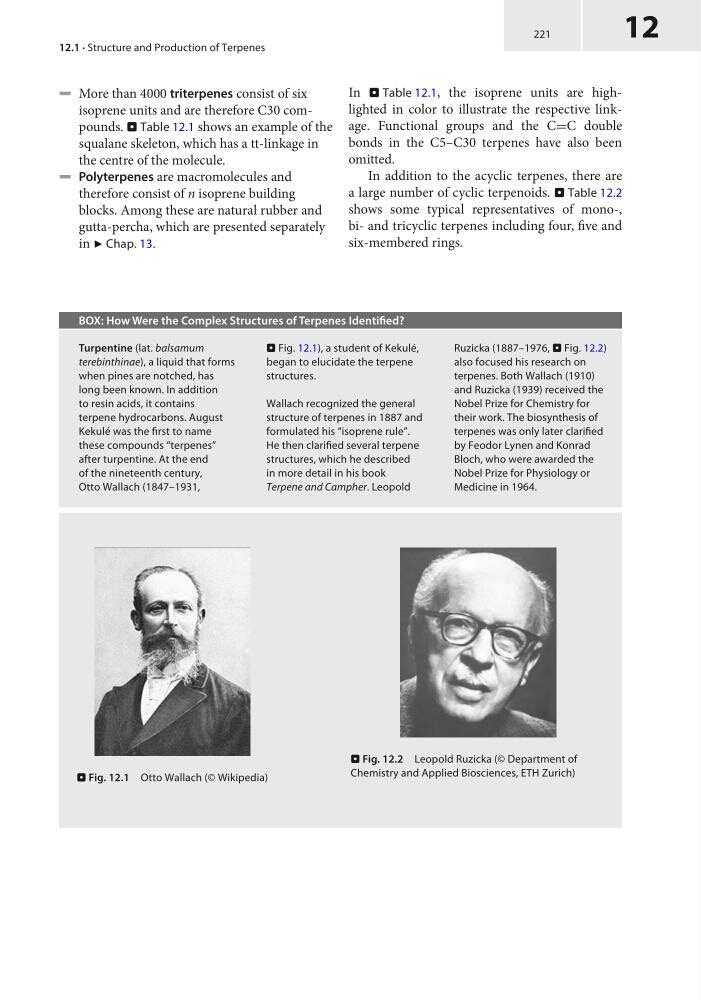
. Fig. 12.1 Otto Wallach (© Wikipedia)
. Fig. 12.2 Leopold Ruzicka (© Department of
Chemistry and Applied Biosciences, ETH Zurich)
BOX: How Were the Complex Structures of Terpenes Identified?
Turpentine (lat. balsamum
terebinthinae), a liquid that forms
when pines are notched, has
long been known. In addition
to resin acids, it contains
terpene hydrocarbons. August
Kekulé was the first to name
these compounds “terpenes”
after turpentine. At the end
of the nineteenth century,
Otto Wallach (1847–1931,
. Fig. 12.1), a student of Kekulé,
began to elucidate the terpene
structures.
Wallach recognized the general
structure of terpenes in 1887 and
formulated his “isoprene rule”.
He then clarified several terpene
structures, which he described
in more detail in his book
Terpene and Campher. Leopold
Ruzicka (1887–1976, . Fig. 12.2)
also focused his research on
terpenes. Both Wallach (1910)
and Ruzicka (1939) received the
Nobel Prize for Chemistry for
their work. The biosynthesis of
terpenes was only later clarified
by Feodor Lynen and Konrad
Bloch, who were awarded the
Nobel Prize for Physiology or
Medicine in 1964.
12.1 · Structure and Production of Terpenes
12
In . Table 12.1, the isoprene units are highlighted in color to illustrate the respective linkage. Functional groups and the C=C double
bonds in the C5–C30 terpenes have also been
omitted.
In addition to the acyclic terpenes, there are
a large number of cyclic terpenoids. . Table 12.2
shows some typical representatives of mono-,
bi- and tricyclic terpenes including four, five and
six-membered rings.
5 More than 4000 triterpenes consist of six
isoprene units and are therefore C30 compounds. . Table 12.1 shows an example of the
squalane skeleton, which has a tt-linkage in
the centre of the molecule.
5 Polyterpenes are macromolecules and
therefore consist of n isoprene building
blocks. Among these are natural rubber and
gutta-percha, which are presented separately
in 7 Chap. 13.
. Fig. 12.1 Otto Wallach (© Wikipedia)
. Fig. 12.2 Leopold Ruzicka (© Department of
Chemistry and Applied Biosciences, ETH Zurich)
BOX: How Were the Complex Structures of Terpenes Identified?
Turpentine (lat. balsamum
terebinthinae), a liquid that forms
when pines are notched, has
long been known. In addition
to resin acids, it contains
terpene hydrocarbons. August
Kekulé was the first to name
these compounds “terpenes”
after turpentine. At the end
of the nineteenth century,
Otto Wallach (1847–1931,
. Fig. 12.1), a student of Kekulé,
began to elucidate the terpene
structures.
Wallach recognized the general
structure of terpenes in 1887 and
formulated his “isoprene rule”.
He then clarified several terpene
structures, which he described
in more detail in his book
Terpene and Campher. Leopold
Ruzicka (1887–1976, . Fig. 12.2)
also focused his research on
terpenes. Both Wallach (1910)
and Ruzicka (1939) received the
Nobel Prize for Chemistry for
their work. The biosynthesis of
terpenes was only later clarified
by Feodor Lynen and Konrad
Bloch, who were awarded the
Nobel Prize for Physiology or
Medicine in 1964.
12.1 · Structure and Production of Terpenes