

223
12
12.2 Monoterpenes
Monoterpenes are found both in the essential
oils of plants and in turpentine oils. They are
either acyclic, monocyclic or bicyclic.
Acyclic monoterpenes (. Fig. 12.3) consist of
a basic structure of ten carbon atoms. They occur
as hydrocarbons (with three C=C double bonds)
or as alcohols, aldehydes or ketones (with two
remaining C=C double bonds).
5 β-Myrcene occurs in numerous essential oils,
e.g. in verbena, hop or laurel oil. Industrially,
it is easily accessible from the pinenes of
turpentine oil by pyrolysis. By brief heating
to temperatures of 400–700 °C, myrcene is
obtained in selectivities of up to 95%.
In the group of alcohols, linalool, geraniol, nerol
and citronellol are of particular importance:
5 Linalool is isolated from lavender, rose and
neroli oil, but can also be produced synthetically from β-myrcene. Annual production
is estimated at 12,000 t a −1 tons per year.
Because of its fresh, flowery smell, it is often
used to perfume detergents.
5 Geraniol and nerol differ only in the configuration of a double bond and are therefore cis/trans isomers. Geraniol is found
in coriander, nutmeg and laurel and is an
important ingredient in many perfumes
due to its rose-like odor. Nerol can be found
in “real lavender” and in rose oil, it has a
citrus-like smell. Both can be produced from
β-myrcene, the worldwide production is 4000
tons per year.
particularly widespread in Austria, produces
5 kg of raw gum turpentine per year. The
world’s largest producer of gum turpentine
is China; in Europe, Portugal is the largest
producer.
5 Further processing is carried out by vacuum
distillation. This results in two fractions:
5 At the top of the column, pure terpentine
oil is isolated, which is used as a solvent
for lacquers, paints, shoe care products
and floor polish as well as a raw material source for pinenes, carene and other
terpenes. The pure gum turpentine oil
is an ideal starting material for chemical
syntheses.
5 The colophonium, a yellow to brown-black
tree resin, remains at the bottom of the
column. The amorphous colophonium
consists mainly of resin acids, such as
abietin and pimaric acid (7 Sect. 12.3).
It is a solid that softens at approx. 100 °C
depending on its composition. Colophonium is used for the production of newspaper inks and adhesive solutions.
5 Sulfate turpentine is a coproduct of the
sulfate process already described (7 Sect. 7.1).
In this wood pulping in basic environment
using Na 2 S, Na 2 SO 4 and Na 2 CO 3 , sulfate turpentine is isolated from the condensate of the
volatile exhaust gases. Despite cleaning steps
and oxidations, sulfur impurities still remain
in this turpentine, so that it is not as clean
as gum turpentine. The USA is the world’s
largest producer, in Europe the most important producing countries are Scandinavia and
Russia.
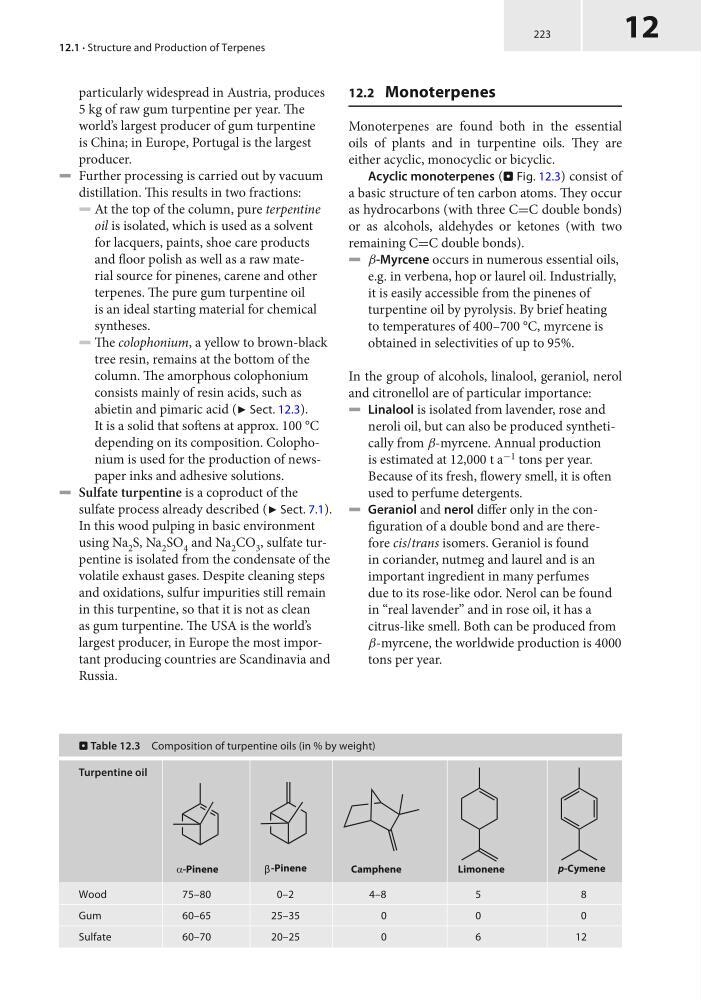
. Table 12.3 Composition of turpentine oils (in % by weight)
Turpentine oil
D-Pinene
-Pinene
β
Camphene
Limonene
p-Cymene
Wood
75–80
0–2
4–8
5
8
Gum
60–65
25–35
0
0
0
Sulfate
60–70
20–25
0
6
12
12.1 · Structure and Production of Terpenes
12
12.2 Monoterpenes
Monoterpenes are found both in the essential
oils of plants and in turpentine oils. They are
either acyclic, monocyclic or bicyclic.
Acyclic monoterpenes (. Fig. 12.3) consist of
a basic structure of ten carbon atoms. They occur
as hydrocarbons (with three C=C double bonds)
or as alcohols, aldehydes or ketones (with two
remaining C=C double bonds).
5 β-Myrcene occurs in numerous essential oils,
e.g. in verbena, hop or laurel oil. Industrially,
it is easily accessible from the pinenes of
turpentine oil by pyrolysis. By brief heating
to temperatures of 400–700 °C, myrcene is
obtained in selectivities of up to 95%.
In the group of alcohols, linalool, geraniol, nerol
and citronellol are of particular importance:
5 Linalool is isolated from lavender, rose and
neroli oil, but can also be produced synthetically from β-myrcene. Annual production
is estimated at 12,000 t a −1 tons per year.
Because of its fresh, flowery smell, it is often
used to perfume detergents.
5 Geraniol and nerol differ only in the configuration of a double bond and are therefore cis/trans isomers. Geraniol is found
in coriander, nutmeg and laurel and is an
important ingredient in many perfumes
due to its rose-like odor. Nerol can be found
in “real lavender” and in rose oil, it has a
citrus-like smell. Both can be produced from
β-myrcene, the worldwide production is 4000
tons per year.
particularly widespread in Austria, produces
5 kg of raw gum turpentine per year. The
world’s largest producer of gum turpentine
is China; in Europe, Portugal is the largest
producer.
5 Further processing is carried out by vacuum
distillation. This results in two fractions:
5 At the top of the column, pure terpentine
oil is isolated, which is used as a solvent
for lacquers, paints, shoe care products
and floor polish as well as a raw material source for pinenes, carene and other
terpenes. The pure gum turpentine oil
is an ideal starting material for chemical
syntheses.
5 The colophonium, a yellow to brown-black
tree resin, remains at the bottom of the
column. The amorphous colophonium
consists mainly of resin acids, such as
abietin and pimaric acid (7 Sect. 12.3).
It is a solid that softens at approx. 100 °C
depending on its composition. Colophonium is used for the production of newspaper inks and adhesive solutions.
5 Sulfate turpentine is a coproduct of the
sulfate process already described (7 Sect. 7.1).
In this wood pulping in basic environment
using Na 2 S, Na 2 SO 4 and Na 2 CO 3 , sulfate turpentine is isolated from the condensate of the
volatile exhaust gases. Despite cleaning steps
and oxidations, sulfur impurities still remain
in this turpentine, so that it is not as clean
as gum turpentine. The USA is the world’s
largest producer, in Europe the most important producing countries are Scandinavia and
Russia.
. Table 12.3 Composition of turpentine oils (in % by weight)
Turpentine oil
D-Pinene
-Pinene
β
Camphene
Limonene
p-Cymene
Wood
75–80
0–2
4–8
5
8
Gum
60–65
25–35
0
0
0
Sulfate
60–70
20–25
0
6
12
12.1 · Structure and Production of Terpenes