

211
11
further processing steps such as distillation and crystallization, a vanillin yield of about 3–5 g per liter is
obtained (. Fig. 11.10). In addition to its use as a flavoring agent, vanillin is also used as a cost-effective
starting material for the synthesis of drugs such as
methyl DOPA.
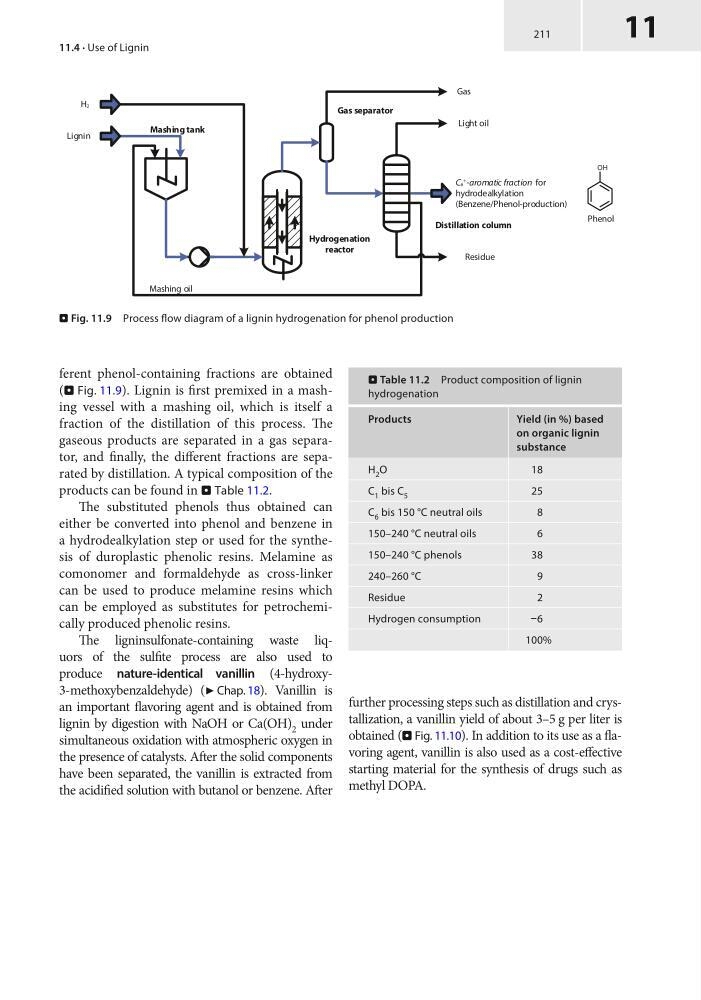
ferent phenol-containing fractions are obtained
(. Fig. 11.9). Lignin is first premixed in a mashing vessel with a mashing oil, which is itself a
fraction of the distillation of this process. The
gaseous products are separated in a gas separator, and finally, the different fractions are separated by distillation. A typical composition of the
products can be found in . Table 11.2.
The substituted phenols thus obtained can
either be converted into phenol and benzene in
a hydrodealkylation step or used for the synthesis of duroplastic phenolic resins. Melamine as
comonomer and formaldehyde as cross-linker
can be used to produce melamine resins which
can be employed as substitutes for petrochemically produced phenolic resins.
The ligninsulfonate-containing waste liquors of the sulfite process are also used to
produce nature-identical vanillin (4-hydroxy3-methoxybenzaldehyde) (7 Chap. 18). Vanillin is
an important flavoring agent and is obtained from
lignin by digestion with NaOH or Ca(OH) 2 under
simultaneous oxidation with atmospheric oxygen in
the presence of catalysts. After the solid components
have been separated, the vanillin is extracted from
the acidified solution with butanol or benzene. After
Mashing tank
H2
Lignin
Hydrogenation
reactor
Gas separator
Distillation column
Gas
Light oil
Mashing oil
Residue
C6
+ -aromatic fraction for
hydrodealkylation
(Benzene/Phenol-production)
Phenol
. Fig. 11.9 Process flow diagram of a lignin hydrogenation for phenol production
. Table 11.2 Product composition of lignin
hydrogenation
Products
Yield (in %) based
on organic lignin
substance
H 2 O
18
C 1 bis C 5
25
C 6 bis 150 °C neutral oils
8
150–240 °C neutral oils
6
150–240 °C phenols
38
240–260 °C
9
Residue
2
Hydrogen consumption
−6
100%
11.4 · Use of Lignin
11
further processing steps such as distillation and crystallization, a vanillin yield of about 3–5 g per liter is
obtained (. Fig. 11.10). In addition to its use as a flavoring agent, vanillin is also used as a cost-effective
starting material for the synthesis of drugs such as
methyl DOPA.
ferent phenol-containing fractions are obtained
(. Fig. 11.9). Lignin is first premixed in a mashing vessel with a mashing oil, which is itself a
fraction of the distillation of this process. The
gaseous products are separated in a gas separator, and finally, the different fractions are separated by distillation. A typical composition of the
products can be found in . Table 11.2.
The substituted phenols thus obtained can
either be converted into phenol and benzene in
a hydrodealkylation step or used for the synthesis of duroplastic phenolic resins. Melamine as
comonomer and formaldehyde as cross-linker
can be used to produce melamine resins which
can be employed as substitutes for petrochemically produced phenolic resins.
The ligninsulfonate-containing waste liquors of the sulfite process are also used to
produce nature-identical vanillin (4-hydroxy3-methoxybenzaldehyde) (7 Chap. 18). Vanillin is
an important flavoring agent and is obtained from
lignin by digestion with NaOH or Ca(OH) 2 under
simultaneous oxidation with atmospheric oxygen in
the presence of catalysts. After the solid components
have been separated, the vanillin is extracted from
the acidified solution with butanol or benzene. After
Mashing tank
H2
Lignin
Hydrogenation
reactor
Gas separator
Distillation column
Gas
Light oil
Mashing oil
Residue
C6
+ -aromatic fraction for
hydrodealkylation
(Benzene/Phenol-production)
Phenol
. Fig. 11.9 Process flow diagram of a lignin hydrogenation for phenol production
. Table 11.2 Product composition of lignin
hydrogenation
Products
Yield (in %) based
on organic lignin
substance
H 2 O
18
C 1 bis C 5
25
C 6 bis 150 °C neutral oils
8
150–240 °C neutral oils
6
150–240 °C phenols
38
240–260 °C
9
Residue
2
Hydrogen consumption
−6
100%
11.4 · Use of Lignin