

210
Chapter 11 · The “Wood-Stuff” - Lignin
11
similar to those of wood, which is interesting, for
example, for the construction of musical instruments.
11.4.3 Use of Lignin for the
Production of Chemicals
There are many different approaches to making
lignin, which is often referred to in a negative
way as waste material, usable for the chemical
industry. The driving force behind this is that
more valuable products lead to an increased
added value of lignin. One possibility is the gasification of lignin to synthesis gas. From this
mixture of carbon monoxide and hydrogen,
intermediates and end products can then be
obtained using already established technology.
Another possibility is the pyrolysis of lignin,
in which a mixture of various hydrocarbons is
obtained, which in turn have to be separated
from each other before they can be used.
By hydrogenation of lignin, it is possible to
produce substituted phenols, which are interesting monomers for the production of special polymers, so-called duroplasts. Here, too, a mixture
of different components is formed, which in turn
is separated by distillation. In this process, difproduced. Lignosulfonates as binders have the
advantage that they are physiologically safe and
environmentally harmless compared to petrochemically based binders.
In a similar way, ligninsulfonates can also
partially replace phenolic resin-based binders in
the manufacture of, e.g., chipboards and be used
for gluing corrugated board. An almost complete
substitution can be achieved if lignin is modified
with phenol, melamine or urea resin.
A particularly interesting application of
lignin was presented by Tecnaro GmbH in
1998. It has developed a lignin-based biomaterial called Arboform® (from Latin arbor = tree),
which can be processed with forming processes
established for the polymer industry such as
injection molding, extrusion or pressing. This
plastic, known as “liquid wood”, is made from
lignin mixed with natural fibers such as cellulose,
flax or hemp. At about 1000 bar and 110–180 °C,
the mixture is first liquefied, granulated and
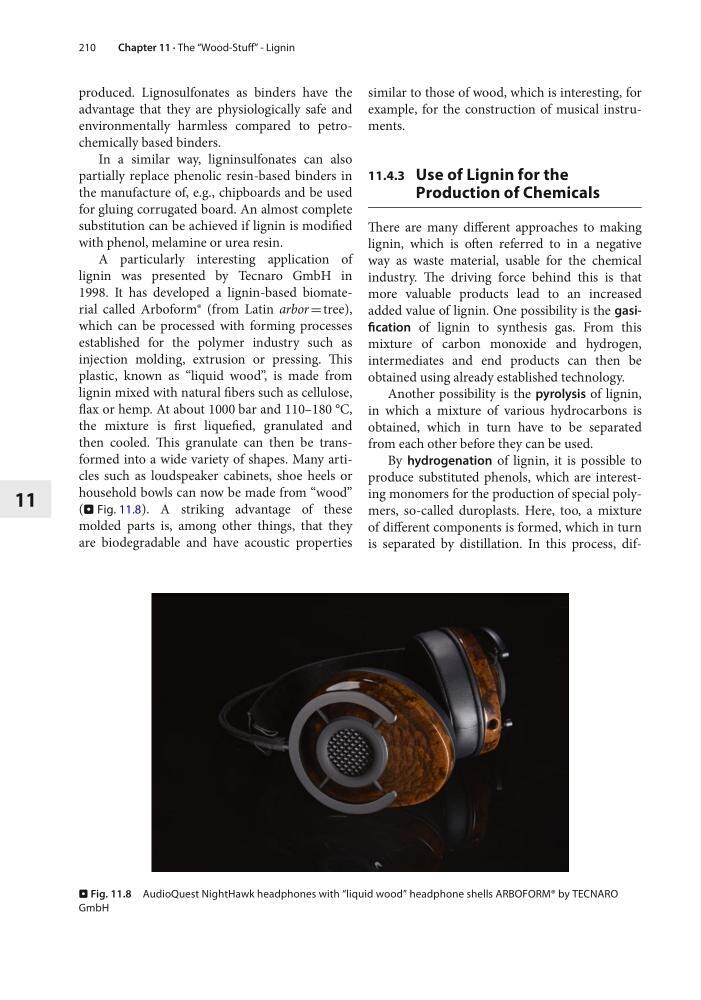
then cooled. This granulate can then be transformed into a wide variety of shapes. Many articles such as loudspeaker cabinets, shoe heels or
household bowls can now be made from “wood”
(. Fig. 11.8). A striking advantage of these
molded parts is, among other things, that they
are biodegradable and have acoustic properties
. Fig. 11.8 AudioQuest NightHawk headphones with “liquid wood” headphone shells ARBOFORM® by TECNARO
GmbH
Chapter 11 · The “Wood-Stuff” - Lignin
11
similar to those of wood, which is interesting, for
example, for the construction of musical instruments.
11.4.3 Use of Lignin for the
Production of Chemicals
There are many different approaches to making
lignin, which is often referred to in a negative
way as waste material, usable for the chemical
industry. The driving force behind this is that
more valuable products lead to an increased
added value of lignin. One possibility is the gasification of lignin to synthesis gas. From this
mixture of carbon monoxide and hydrogen,
intermediates and end products can then be
obtained using already established technology.
Another possibility is the pyrolysis of lignin,
in which a mixture of various hydrocarbons is
obtained, which in turn have to be separated
from each other before they can be used.
By hydrogenation of lignin, it is possible to
produce substituted phenols, which are interesting monomers for the production of special polymers, so-called duroplasts. Here, too, a mixture
of different components is formed, which in turn
is separated by distillation. In this process, difproduced. Lignosulfonates as binders have the
advantage that they are physiologically safe and
environmentally harmless compared to petrochemically based binders.
In a similar way, ligninsulfonates can also
partially replace phenolic resin-based binders in
the manufacture of, e.g., chipboards and be used
for gluing corrugated board. An almost complete
substitution can be achieved if lignin is modified
with phenol, melamine or urea resin.
A particularly interesting application of
lignin was presented by Tecnaro GmbH in
1998. It has developed a lignin-based biomaterial called Arboform® (from Latin arbor = tree),
which can be processed with forming processes
established for the polymer industry such as
injection molding, extrusion or pressing. This
plastic, known as “liquid wood”, is made from
lignin mixed with natural fibers such as cellulose,
flax or hemp. At about 1000 bar and 110–180 °C,
the mixture is first liquefied, granulated and
then cooled. This granulate can then be transformed into a wide variety of shapes. Many articles such as loudspeaker cabinets, shoe heels or
household bowls can now be made from “wood”
(. Fig. 11.8). A striking advantage of these
molded parts is, among other things, that they
are biodegradable and have acoustic properties
. Fig. 11.8 AudioQuest NightHawk headphones with “liquid wood” headphone shells ARBOFORM® by TECNARO
GmbH