

212
Chapter 11 · The “Wood-Stuff” - Lignin
11
manner and thus allow access to aromatic
compounds under mild conditions. In most
cases, either oxidative or reductive systems
have been investigated. However, since there is
a large number of different binding patterns in
lignin, development has so far been limited to
special model molecules with only one binding type. First promising results have already
been achieved with these model systems, but
they are generally not compatible with natural
lignin. Another challenge is that a particularly
pure lignin must be used in order not to poison the catalysts with sulfur, for example. Most
catalytic reactions have been carried out with
lignins from Organosolv processes, of which,
as already discussed, so far no large amounts
exist.
BOX: Whisky and Lignin
The definition of whisky
(‘whiskey’ in Ireland and the
USA) requires that the spirit
drink obtained from mash of
cereals must be stored in a
wooden barrel for at least three
years. But why?
The storage of
ethanol-containing spirits,
especially in oak barrels,
preserves and significantly
influences the taste of the
whisky. On the one hand,
substances are extracted from
the wood. However, there are
also numerous reactions that
lead to the formation of flavor
substances that give the product
its characteristic taste. One of
the most important of these
groups are phenols, which
are formed by the hydrolytic
degradation of the lignin
contained in the wood. These
are responsible for the taste of
various whiskies, often described
as phenolic and woody. But
vanillin, which we already
know, is also produced during
the aging process of whiskies
in wooden barrels: The wood
structure allows oxygen to enter
the barrel from the outside
and oxidative decomposition
of lignin takes place. Vanillin is
produced and is extracted into
the liquid by ethanol. A process
that is very similar to the process
used to produce vanillin from
sulfite liquors, but much slower
and more gentle.
6XOILWH
OLTXRU
1LWUREHQ]HQH
1D2+
3UHVVXUH
UHDFWRU
1HXWUDOL]DWLRQ
WDQN
([WUDFWLRQ
FROXPQ
'LVWLOODWLRQ
FROXPQ
6ROYHQW
UHFRYHU\
&U\VWDOOL]DWLRQ
&2
([KDXVW
JDV
6RGLXP
FDUERQDWH
VROXWLRQ
$]REHQ]HQH
5HVLGXH
%HQ]HQH
9DQLOOLQ
+\GUR[\
PHWKR[\EHQ]DOGHK\GH
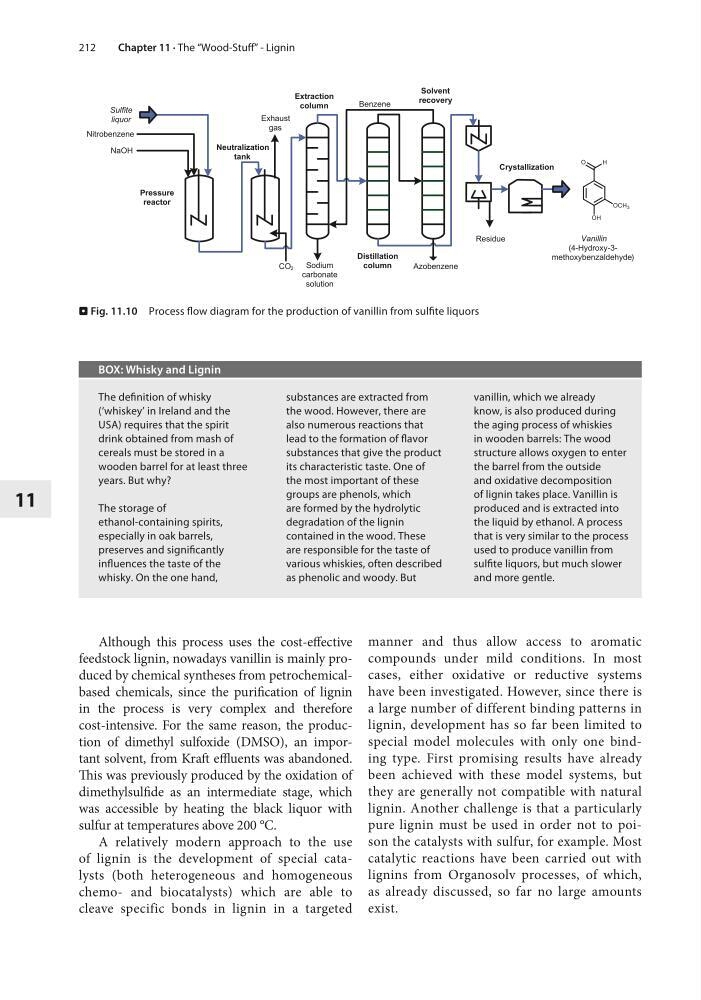
. Fig. 11.10 Process flow diagram for the production of vanillin from sulfite liquors
Although this process uses the cost-effective
feedstock lignin, nowadays vanillin is mainly produced by chemical syntheses from petrochemicalbased chemicals, since the purification of lignin
in the process is very complex and therefore
cost-intensive. For the same reason, the production of dimethyl sulfoxide (DMSO), an important solvent, from Kraft effluents was abandoned.
This was previously produced by the oxidation of
dimethylsulfide as an intermediate stage, which
was accessible by heating the black liquor with
sulfur at temperatures above 200 °C.
A relatively modern approach to the use
of lignin is the development of special catalysts (both heterogeneous and homogeneous
chemo- and biocatalysts) which are able to
cleave specific bonds in lignin in a targeted
Chapter 11 · The “Wood-Stuff” - Lignin
11
manner and thus allow access to aromatic
compounds under mild conditions. In most
cases, either oxidative or reductive systems
have been investigated. However, since there is
a large number of different binding patterns in
lignin, development has so far been limited to
special model molecules with only one binding type. First promising results have already
been achieved with these model systems, but
they are generally not compatible with natural
lignin. Another challenge is that a particularly
pure lignin must be used in order not to poison the catalysts with sulfur, for example. Most
catalytic reactions have been carried out with
lignins from Organosolv processes, of which,
as already discussed, so far no large amounts
exist.
BOX: Whisky and Lignin
The definition of whisky
(‘whiskey’ in Ireland and the
USA) requires that the spirit
drink obtained from mash of
cereals must be stored in a
wooden barrel for at least three
years. But why?
The storage of
ethanol-containing spirits,
especially in oak barrels,
preserves and significantly
influences the taste of the
whisky. On the one hand,
substances are extracted from
the wood. However, there are
also numerous reactions that
lead to the formation of flavor
substances that give the product
its characteristic taste. One of
the most important of these
groups are phenols, which
are formed by the hydrolytic
degradation of the lignin
contained in the wood. These
are responsible for the taste of
various whiskies, often described
as phenolic and woody. But
vanillin, which we already
know, is also produced during
the aging process of whiskies
in wooden barrels: The wood
structure allows oxygen to enter
the barrel from the outside
and oxidative decomposition
of lignin takes place. Vanillin is
produced and is extracted into
the liquid by ethanol. A process
that is very similar to the process
used to produce vanillin from
sulfite liquors, but much slower
and more gentle.
6XOILWH
OLTXRU
1LWUREHQ]HQH
1D2+
3UHVVXUH
UHDFWRU
1HXWUDOL]DWLRQ
WDQN
([WUDFWLRQ
FROXPQ
'LVWLOODWLRQ
FROXPQ
6ROYHQW
UHFRYHU\
&U\VWDOOL]DWLRQ
&2
([KDXVW
JDV
6RGLXP
FDUERQDWH
VROXWLRQ
$]REHQ]HQH
5HVLGXH
%HQ]HQH
9DQLOOLQ
+\GUR[\
PHWKR[\EHQ]DOGHK\GH
. Fig. 11.10 Process flow diagram for the production of vanillin from sulfite liquors
Although this process uses the cost-effective
feedstock lignin, nowadays vanillin is mainly produced by chemical syntheses from petrochemicalbased chemicals, since the purification of lignin
in the process is very complex and therefore
cost-intensive. For the same reason, the production of dimethyl sulfoxide (DMSO), an important solvent, from Kraft effluents was abandoned.
This was previously produced by the oxidation of
dimethylsulfide as an intermediate stage, which
was accessible by heating the black liquor with
sulfur at temperatures above 200 °C.
A relatively modern approach to the use
of lignin is the development of special catalysts (both heterogeneous and homogeneous
chemo- and biocatalysts) which are able to
cleave specific bonds in lignin in a targeted