

195
10
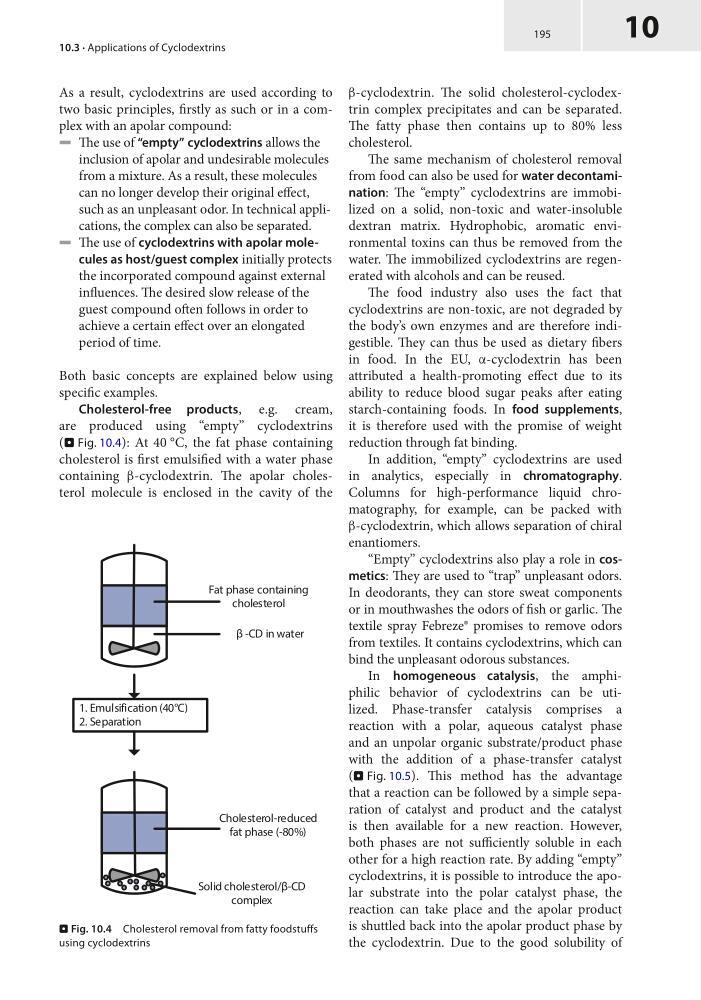
β-cyclodextrin. The solid cholesterol-cyclodextrin complex precipitates and can be separated.
The fatty phase then contains up to 80% less
cholesterol.
The same mechanism of cholesterol removal
from food can also be used for water decontamination: The “empty” cyclodextrins are immobilized on a solid, non-toxic and water-insoluble
dextran matrix. Hydrophobic, aromatic environmental toxins can thus be removed from the
water. The immobilized cyclodextrins are regenerated with alcohols and can be reused.
The food industry also uses the fact that
cyclodextrins are non-toxic, are not degraded by
the body’s own enzymes and are therefore indigestible. They can thus be used as dietary fibers
in food. In the EU, α-cyclodextrin has been
attributed a health-promoting effect due to its
ability to reduce blood sugar peaks after eating
starch-containing foods. In food supplements,
it is therefore used with the promise of weight
reduction through fat binding.
In addition, “empty” cyclodextrins are used
in analytics, especially in chromatography.
Columns for high-performance liquid chromatography, for example, can be packed with
β-cyclodextrin, which allows separation of chiral
enantiomers.
“Empty” cyclodextrins also play a role in cosmetics: They are used to “trap” unpleasant odors.
In deodorants, they can store sweat components
or in mouthwashes the odors of fish or garlic. The
textile spray Febreze® promises to remove odors
from textiles. It contains cyclodextrins, which can
bind the unpleasant odorous substances.
In homogeneous catalysis, the amphiphilic behavior of cyclodextrins can be utilized. Phase-transfer catalysis comprises a
reaction with a polar, aqueous catalyst phase
and an unpolar organic substrate/product phase
with the addition of a phase-transfer catalyst
(. Fig. 10.5). This method has the advantage
that a reaction can be followed by a simple separation of catalyst and product and the catalyst
is then available for a new reaction. However,
both phases are not sufficiently soluble in each
other for a high reaction rate. By adding “empty”
cyclodextrins, it is possible to introduce the apolar substrate into the polar catalyst phase, the
reaction can take place and the apolar product
is shuttled back into the apolar product phase by
the cyclodextrin. Due to the good solubility of
As a result, cyclodextrins are used according to
two basic principles, firstly as such or in a complex with an apolar compound:
5 The use of “empty” cyclodextrins allows the
inclusion of apolar and undesirable molecules
from a mixture. As a result, these molecules
can no longer develop their original effect,
such as an unpleasant odor. In technical applications, the complex can also be separated.
5 The use of cyclodextrins with apolar molecules as host/guest complex initially protects
the incorporated compound against external
influences. The desired slow release of the
guest compound often follows in order to
achieve a certain effect over an elongated
period of time.
Both basic concepts are explained below using
specific examples.
Cholesterol-free products, e.g. cream,
are produced using “empty” cyclodextrins
(. Fig. 10.4): At 40 °C, the fat phase containing
cholesterol is first emulsified with a water phase
containing β-cyclodextrin. The apolar cholesterol molecule is enclosed in the cavity of the
1. Emulsification (40°C)
2. Separation
Fat phase containing
cholesterol
β -CD in water
Cholesterol-reduced
fat phase (-80%)
Solid cholesterol/β-CD
complex
. Fig. 10.4 Cholesterol removal from fatty foodstuffs
using cyclodextrins
10.3 · Applications of Cyclodextrins
10
β-cyclodextrin. The solid cholesterol-cyclodextrin complex precipitates and can be separated.
The fatty phase then contains up to 80% less
cholesterol.
The same mechanism of cholesterol removal
from food can also be used for water decontamination: The “empty” cyclodextrins are immobilized on a solid, non-toxic and water-insoluble
dextran matrix. Hydrophobic, aromatic environmental toxins can thus be removed from the
water. The immobilized cyclodextrins are regenerated with alcohols and can be reused.
The food industry also uses the fact that
cyclodextrins are non-toxic, are not degraded by
the body’s own enzymes and are therefore indigestible. They can thus be used as dietary fibers
in food. In the EU, α-cyclodextrin has been
attributed a health-promoting effect due to its
ability to reduce blood sugar peaks after eating
starch-containing foods. In food supplements,
it is therefore used with the promise of weight
reduction through fat binding.
In addition, “empty” cyclodextrins are used
in analytics, especially in chromatography.
Columns for high-performance liquid chromatography, for example, can be packed with
β-cyclodextrin, which allows separation of chiral
enantiomers.
“Empty” cyclodextrins also play a role in cosmetics: They are used to “trap” unpleasant odors.
In deodorants, they can store sweat components
or in mouthwashes the odors of fish or garlic. The
textile spray Febreze® promises to remove odors
from textiles. It contains cyclodextrins, which can
bind the unpleasant odorous substances.
In homogeneous catalysis, the amphiphilic behavior of cyclodextrins can be utilized. Phase-transfer catalysis comprises a
reaction with a polar, aqueous catalyst phase
and an unpolar organic substrate/product phase
with the addition of a phase-transfer catalyst
(. Fig. 10.5). This method has the advantage
that a reaction can be followed by a simple separation of catalyst and product and the catalyst
is then available for a new reaction. However,
both phases are not sufficiently soluble in each
other for a high reaction rate. By adding “empty”
cyclodextrins, it is possible to introduce the apolar substrate into the polar catalyst phase, the
reaction can take place and the apolar product
is shuttled back into the apolar product phase by
the cyclodextrin. Due to the good solubility of
As a result, cyclodextrins are used according to
two basic principles, firstly as such or in a complex with an apolar compound:
5 The use of “empty” cyclodextrins allows the
inclusion of apolar and undesirable molecules
from a mixture. As a result, these molecules
can no longer develop their original effect,
such as an unpleasant odor. In technical applications, the complex can also be separated.
5 The use of cyclodextrins with apolar molecules as host/guest complex initially protects
the incorporated compound against external
influences. The desired slow release of the
guest compound often follows in order to
achieve a certain effect over an elongated
period of time.
Both basic concepts are explained below using
specific examples.
Cholesterol-free products, e.g. cream,
are produced using “empty” cyclodextrins
(. Fig. 10.4): At 40 °C, the fat phase containing
cholesterol is first emulsified with a water phase
containing β-cyclodextrin. The apolar cholesterol molecule is enclosed in the cavity of the
1. Emulsification (40°C)
2. Separation
Fat phase containing
cholesterol
β -CD in water
Cholesterol-reduced
fat phase (-80%)
Solid cholesterol/β-CD
complex
. Fig. 10.4 Cholesterol removal from fatty foodstuffs
using cyclodextrins
10.3 · Applications of Cyclodextrins