

194
Chapter 10 · Cyclic Carbohydrates - Cyclodextrins
10
BOX: The Winding Discovery of Cyclodextrins
Cyclodextrins were first
mentioned in 1891 by A.
Villier. At first they were called
“cellulosins”. F. Schardinger
was the first to describe a
more detailed production and
isolation of α- and β-cyclodextrin
in 1903. He also discovered that
they were oligosaccharides.
Therefore, cyclodextrins are
often referred to as “Schardinger
dextrins” in older publications.
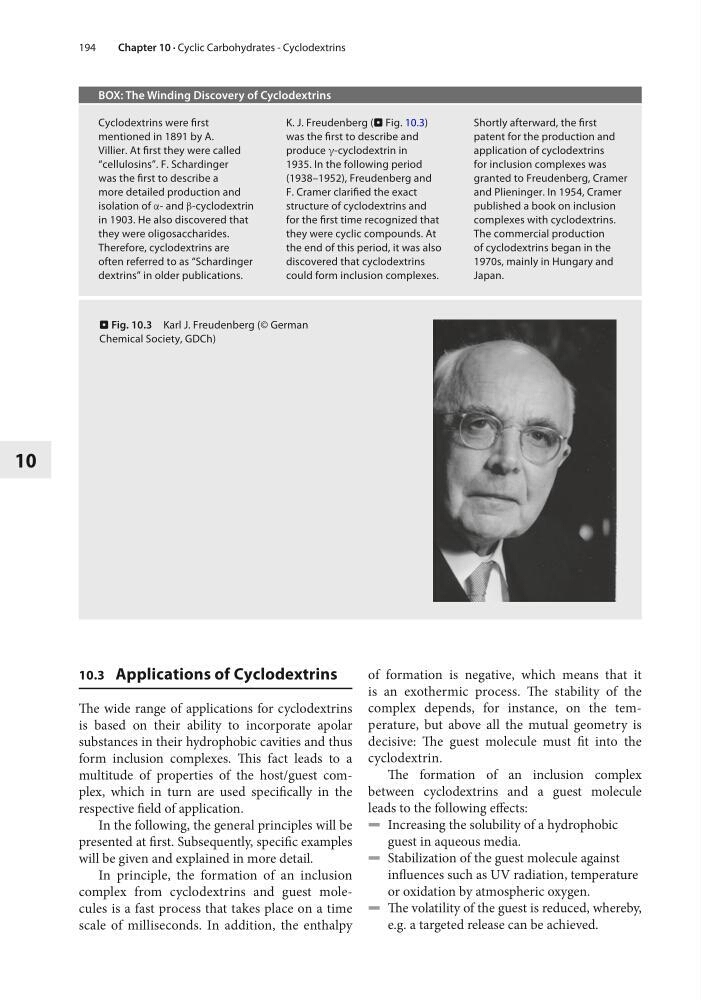
K. J. Freudenberg (. Fig. 10.3)
was the first to describe and
produce γ-cyclodextrin in
1935. In the following period
(1938–1952), Freudenberg and
F. Cramer clarified the exact
structure of cyclodextrins and
for the first time recognized that
they were cyclic compounds. At
the end of this period, it was also
discovered that cyclodextrins
could form inclusion complexes.
Shortly afterward, the first
patent for the production and
application of cyclodextrins
for inclusion complexes was
granted to Freudenberg, Cramer
and Plieninger. In 1954, Cramer
published a book on inclusion
complexes with cyclodextrins.
The commercial production
of cyclodextrins began in the
1970s, mainly in Hungary and
Japan.
. Fig. 10.3 Karl J. Freudenberg (© German
Chemical Society, GDCh)
10.3 Applications of Cyclodextrins
The wide range of applications for cyclodextrins
is based on their ability to incorporate apolar
substances in their hydrophobic cavities and thus
form inclusion complexes. This fact leads to a
multitude of properties of the host/guest complex, which in turn are used specifically in the
respective field of application.
In the following, the general principles will be
presented at first. Subsequently, specific examples
will be given and explained in more detail.
In principle, the formation of an inclusion
complex from cyclodextrins and guest molecules is a fast process that takes place on a time
scale of milliseconds. In addition, the enthalpy
of formation is negative, which means that it
is an exothermic process. The stability of the
complex depends, for instance, on the temperature, but above all the mutual geometry is
decisive: The guest molecule must fit into the
cyclodextrin.
The formation of an inclusion complex
between cyclodextrins and a guest molecule
leads to the following effects:
5 Increasing the solubility of a hydrophobic
guest in aqueous media.
5 Stabilization of the guest molecule against
influences such as UV radiation, temperature
or oxidation by atmospheric oxygen.
5 The volatility of the guest is reduced, whereby,
e.g. a targeted release can be achieved.
Chapter 10 · Cyclic Carbohydrates - Cyclodextrins
10
BOX: The Winding Discovery of Cyclodextrins
Cyclodextrins were first
mentioned in 1891 by A.
Villier. At first they were called
“cellulosins”. F. Schardinger
was the first to describe a
more detailed production and
isolation of α- and β-cyclodextrin
in 1903. He also discovered that
they were oligosaccharides.
Therefore, cyclodextrins are
often referred to as “Schardinger
dextrins” in older publications.
K. J. Freudenberg (. Fig. 10.3)
was the first to describe and
produce γ-cyclodextrin in
1935. In the following period
(1938–1952), Freudenberg and
F. Cramer clarified the exact
structure of cyclodextrins and
for the first time recognized that
they were cyclic compounds. At
the end of this period, it was also
discovered that cyclodextrins
could form inclusion complexes.
Shortly afterward, the first
patent for the production and
application of cyclodextrins
for inclusion complexes was
granted to Freudenberg, Cramer
and Plieninger. In 1954, Cramer
published a book on inclusion
complexes with cyclodextrins.
The commercial production
of cyclodextrins began in the
1970s, mainly in Hungary and
Japan.
. Fig. 10.3 Karl J. Freudenberg (© German
Chemical Society, GDCh)
10.3 Applications of Cyclodextrins
The wide range of applications for cyclodextrins
is based on their ability to incorporate apolar
substances in their hydrophobic cavities and thus
form inclusion complexes. This fact leads to a
multitude of properties of the host/guest complex, which in turn are used specifically in the
respective field of application.
In the following, the general principles will be
presented at first. Subsequently, specific examples
will be given and explained in more detail.
In principle, the formation of an inclusion
complex from cyclodextrins and guest molecules is a fast process that takes place on a time
scale of milliseconds. In addition, the enthalpy
of formation is negative, which means that it
is an exothermic process. The stability of the
complex depends, for instance, on the temperature, but above all the mutual geometry is
decisive: The guest molecule must fit into the
cyclodextrin.
The formation of an inclusion complex
between cyclodextrins and a guest molecule
leads to the following effects:
5 Increasing the solubility of a hydrophobic
guest in aqueous media.
5 Stabilization of the guest molecule against
influences such as UV radiation, temperature
or oxidation by atmospheric oxygen.
5 The volatility of the guest is reduced, whereby,
e.g. a targeted release can be achieved.