

193
10
purified. In a first step, the starch used is partially degraded with amylases (7 Sect. 8.4) before
being converted with the isolated CGTase. Once
the reaction is complete, the enzyme is inactivated by heat and the cyclodextrins formed are
separated from the reaction solution. The cyclodextrins are subsequently purified by crystallization from water.
Of particular interest is the type-specific production of only one type of cyclodextrin, since
cyclodextrins of different sizes have different
applications. In addition, special additives can be
added in the manufacturing step to form a hardly
soluble inclusion complex with the desired cyclodextrin (e.g. toluene for β-cyclodextrin). This
constantly shifts the equilibrium in the direction
of the desired cyclodextrin. The complex can
then be separated from the reaction solution. To
isolate the cyclodextrin, the inclusion compound
is split either by steam distillation or by extraction with an organic solvent. Nowadays, specially
tailored enzymes are available for the targeted
synthesis of a cyclodextrin that meet the necessary requirements.
10.2 Manufacture of Cyclodextrins
Cyclodextrins do not occur in nature and therefore need to be synthetically produced. This is
achieved by enzymatic degradation of amylose,
the unbranched component of starch (7 Chap. 8).
Corn or potato starch is used most frequently.
The so-called cyclodextrin glycosyltransferases
“cut” pieces out of the helical structure of the
amylose and combine these again to cyclic oligosaccharides - the cyclodextrins. As we have
already learned in 7 Chap. 8 about starch, a single winding within the amlyose consists of about
six glucose monomers. As a result, cyclodextrins
often consist of about six to eight glucose building blocks. The enzymes used are to be distinguished from the amylases, since the formation
of cyclodextrins does not involve hydrolysis of
the glycosidic bond; rather, the amylose is cut
and reunited (i.e. transferred).
To produce cyclodextrin glycosyltransferases
(CGTase), certain microorganisms (e.g. Bacillus
macerans) are first cultivated to form these special enzymes. The enzyme is then separated and
c
a
α-CD
β -CD
γ -CD
a [pm]
c [pm]
b [pm]
1370
1530
1690
500
650
850
780
780
780
b
Primary
OH-groups
Secondary
OH-groups
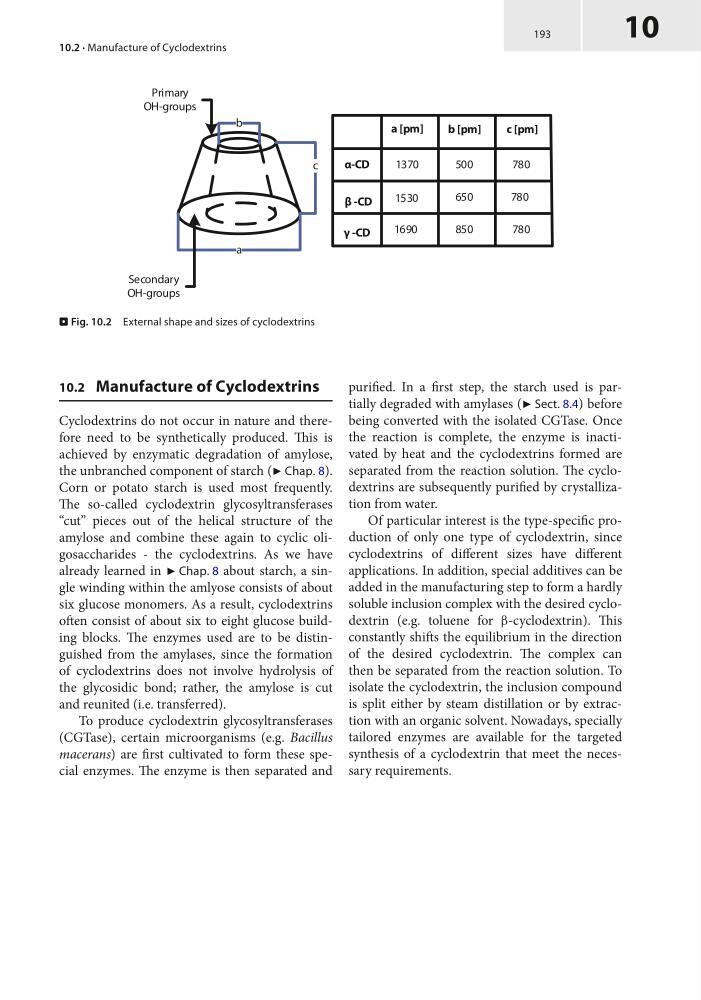
. Fig. 10.2 External shape and sizes of cyclodextrins
10.2 · Manufacture of Cyclodextrins
10
purified. In a first step, the starch used is partially degraded with amylases (7 Sect. 8.4) before
being converted with the isolated CGTase. Once
the reaction is complete, the enzyme is inactivated by heat and the cyclodextrins formed are
separated from the reaction solution. The cyclodextrins are subsequently purified by crystallization from water.
Of particular interest is the type-specific production of only one type of cyclodextrin, since
cyclodextrins of different sizes have different
applications. In addition, special additives can be
added in the manufacturing step to form a hardly
soluble inclusion complex with the desired cyclodextrin (e.g. toluene for β-cyclodextrin). This
constantly shifts the equilibrium in the direction
of the desired cyclodextrin. The complex can
then be separated from the reaction solution. To
isolate the cyclodextrin, the inclusion compound
is split either by steam distillation or by extraction with an organic solvent. Nowadays, specially
tailored enzymes are available for the targeted
synthesis of a cyclodextrin that meet the necessary requirements.
10.2 Manufacture of Cyclodextrins
Cyclodextrins do not occur in nature and therefore need to be synthetically produced. This is
achieved by enzymatic degradation of amylose,
the unbranched component of starch (7 Chap. 8).
Corn or potato starch is used most frequently.
The so-called cyclodextrin glycosyltransferases
“cut” pieces out of the helical structure of the
amylose and combine these again to cyclic oligosaccharides - the cyclodextrins. As we have
already learned in 7 Chap. 8 about starch, a single winding within the amlyose consists of about
six glucose monomers. As a result, cyclodextrins
often consist of about six to eight glucose building blocks. The enzymes used are to be distinguished from the amylases, since the formation
of cyclodextrins does not involve hydrolysis of
the glycosidic bond; rather, the amylose is cut
and reunited (i.e. transferred).
To produce cyclodextrin glycosyltransferases
(CGTase), certain microorganisms (e.g. Bacillus
macerans) are first cultivated to form these special enzymes. The enzyme is then separated and
c
a
α-CD
β -CD
γ -CD
a [pm]
c [pm]
b [pm]
1370
1530
1690
500
650
850
780
780
780
b
Primary
OH-groups
Secondary
OH-groups
. Fig. 10.2 External shape and sizes of cyclodextrins
10.2 · Manufacture of Cyclodextrins