

196
Chapter 10 · Cyclic Carbohydrates - Cyclodextrins
10
of time in the body, as it only gradually leaves the
complex.
The first drug to come onto the market with
cyclodextrins was “Prostarmon E TM ”, which
was marketed in 1976 in Japan by the company
Ono Pharmaceutical Co. It is a prostaglandin
E2/β-cyclodextrin complex.
The effect of cyclodextrin inclusion complexes can also be used to protect the medication
or to avoid interactions with other substances.
For example, glycerin trinitrate (“nitroglycerin”,
7 Sect. 5.2) becomes crystalline in a complex
with cyclodextrin and is no longer explosive. It
can thus be dosed much more easily.
A similar effect can be exploited by complexing fragrances in cyclodextrins. As a result, the
release of these fragrances is more controlled and
takes place over a longer period of time. This is
exploited, for example, in dryer towels: These are
added to the laundry during drying and transfer the cyclodextrin/fragrance complex to the
moist laundry. The fragrance is protected by the
cyclodextrin during the drying process and is
only released slowly during wearing, resulting in
a long-lasting odor. A similar effect can also be
achieved with sprays during ironing.
10.4 Derivatives of Cyclodextrins
As we have already learned in the previous chapters, oligo- and polysaccharides can be derivatized in different ways, e.g. by esterification,
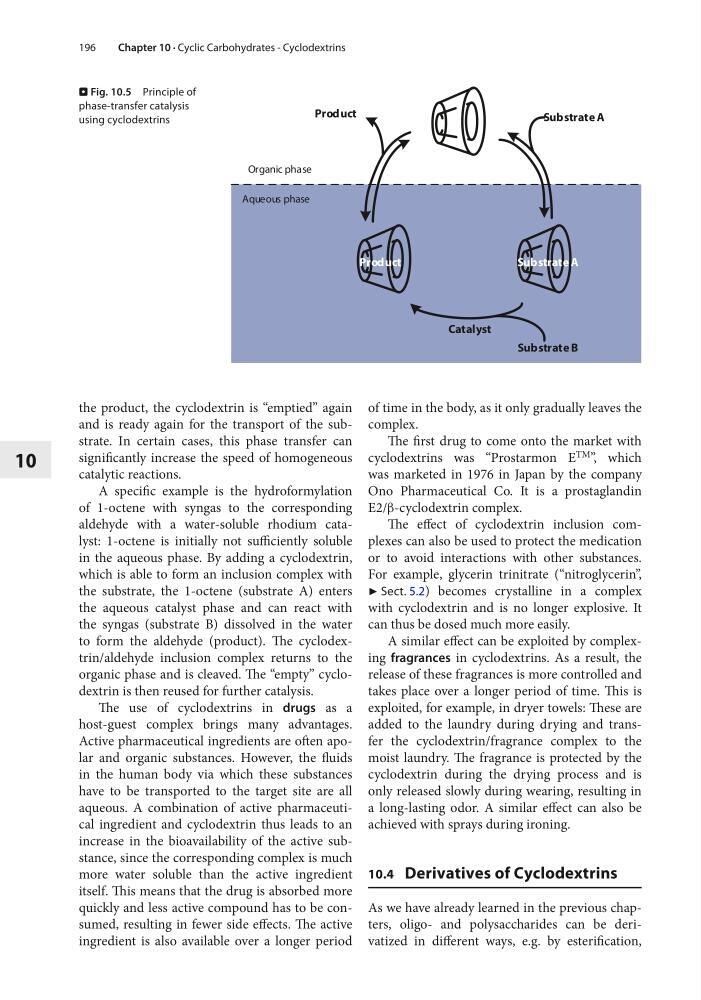
the product, the cyclodextrin is “emptied” again
and is ready again for the transport of the substrate. In certain cases, this phase transfer can
significantly increase the speed of homogeneous
catalytic reactions.
A specific example is the hydroformylation
of 1-octene with syngas to the corresponding
aldehyde with a water-soluble rhodium catalyst: 1-octene is initially not sufficiently soluble
in the aqueous phase. By adding a cyclodextrin,
which is able to form an inclusion complex with
the substrate, the 1-octene (substrate A) enters
the aqueous catalyst phase and can react with
the syngas (substrate B) dissolved in the water
to form the aldehyde (product). The cyclodextrin/aldehyde inclusion complex returns to the
organic phase and is cleaved. The “empty” cyclodextrin is then reused for further catalysis.
The use of cyclodextrins in drugs as a
host-guest complex brings many advantages.
Active pharmaceutical ingredients are often apolar and organic substances. However, the fluids
in the human body via which these substances
have to be transported to the target site are all
aqueous. A combination of active pharmaceutical ingredient and cyclodextrin thus leads to an
increase in the bioavailability of the active substance, since the corresponding complex is much
more water soluble than the active ingredient
itself. This means that the drug is absorbed more
quickly and less active compound has to be consumed, resulting in fewer side effects. The active
ingredient is also available over a longer period
. Fig. 10.5 Principle of
phase-transfer catalysis
using cyclodextrins
Organic phase
Aqueous phase
Substrate A
Catalyst
Product
Substrate B
Substrate A
Product
Chapter 10 · Cyclic Carbohydrates - Cyclodextrins
10
of time in the body, as it only gradually leaves the
complex.
The first drug to come onto the market with
cyclodextrins was “Prostarmon E TM ”, which
was marketed in 1976 in Japan by the company
Ono Pharmaceutical Co. It is a prostaglandin
E2/β-cyclodextrin complex.
The effect of cyclodextrin inclusion complexes can also be used to protect the medication
or to avoid interactions with other substances.
For example, glycerin trinitrate (“nitroglycerin”,
7 Sect. 5.2) becomes crystalline in a complex
with cyclodextrin and is no longer explosive. It
can thus be dosed much more easily.
A similar effect can be exploited by complexing fragrances in cyclodextrins. As a result, the
release of these fragrances is more controlled and
takes place over a longer period of time. This is
exploited, for example, in dryer towels: These are
added to the laundry during drying and transfer the cyclodextrin/fragrance complex to the
moist laundry. The fragrance is protected by the
cyclodextrin during the drying process and is
only released slowly during wearing, resulting in
a long-lasting odor. A similar effect can also be
achieved with sprays during ironing.
10.4 Derivatives of Cyclodextrins
As we have already learned in the previous chapters, oligo- and polysaccharides can be derivatized in different ways, e.g. by esterification,
the product, the cyclodextrin is “emptied” again
and is ready again for the transport of the substrate. In certain cases, this phase transfer can
significantly increase the speed of homogeneous
catalytic reactions.
A specific example is the hydroformylation
of 1-octene with syngas to the corresponding
aldehyde with a water-soluble rhodium catalyst: 1-octene is initially not sufficiently soluble
in the aqueous phase. By adding a cyclodextrin,
which is able to form an inclusion complex with
the substrate, the 1-octene (substrate A) enters
the aqueous catalyst phase and can react with
the syngas (substrate B) dissolved in the water
to form the aldehyde (product). The cyclodextrin/aldehyde inclusion complex returns to the
organic phase and is cleaved. The “empty” cyclodextrin is then reused for further catalysis.
The use of cyclodextrins in drugs as a
host-guest complex brings many advantages.
Active pharmaceutical ingredients are often apolar and organic substances. However, the fluids
in the human body via which these substances
have to be transported to the target site are all
aqueous. A combination of active pharmaceutical ingredient and cyclodextrin thus leads to an
increase in the bioavailability of the active substance, since the corresponding complex is much
more water soluble than the active ingredient
itself. This means that the drug is absorbed more
quickly and less active compound has to be consumed, resulting in fewer side effects. The active
ingredient is also available over a longer period
. Fig. 10.5 Principle of
phase-transfer catalysis
using cyclodextrins
Organic phase
Aqueous phase
Substrate A
Catalyst
Product
Substrate B
Substrate A
Product