

188
Chapter 9 · Carbohydrates from the Sea - Chitin, Chitosan and Algae
9
deacetylation is >50%. Chitosan has thus
free amino groups in its structure, which
gives it very special properties.
5 Chitin and chitosan are both non-toxic,
biodegradable and biocompatible
antibacterial polymers of natural origin.
Among the polysaccharides, they find
the most diverse applications, whereby
these are limited almost exclusively to
the direct application without further
derivatization.
5 Chitin is insoluble in most common
solvents including water. This makes
processing more difficult. Chitin has
only limited applications, for example, in
wastewater treatment and in medicine
for the manufacture of wound dressings.
5 Chitosan is soluble in organic acids due to
its high content of free amino groups. In
these, chitosan forms a polycation at pH
values < 6. In this way, it can be processed
into films.
5 Chitosan can form so-called chelate
complexes with metal cations. These
inclusion compounds are very stable and
can be used to remove dissolved heavy
metals from wastewater.
Summary (Take-Home Messages)
5 After cellulose, chitin is the second
most abundant organic molecule on
earth. It has some things in common
with cellulose: It also consists of a
single monomer, which is linked via a
β-1,4-glycosidic bond. The monomer of
chitin is N-acetylglucosamine.
5 Chitin is naturally found mainly in the
exoskeletons of invertebrates, i.e. insects
and crustaceans. It is also found in
the cell walls of some fungi and other
microorganisms.
5 For the industrial production of chitin,
the waste from shrimp fishing is used,
as it is available in large quantities. In
these wastes, chitin occurs together with
proteins and minerals in a composite
structure. The raw material must therefore
be both deproteinized and demineralized
for its isolation.
5 The most important derivative of chitin
is chitosan, which occurs naturally in
the cell walls of some fungi; industrially,
however, it is produced from chitin by
deacetylation. The polysaccharide is
referred to as chitosan, if the degree of
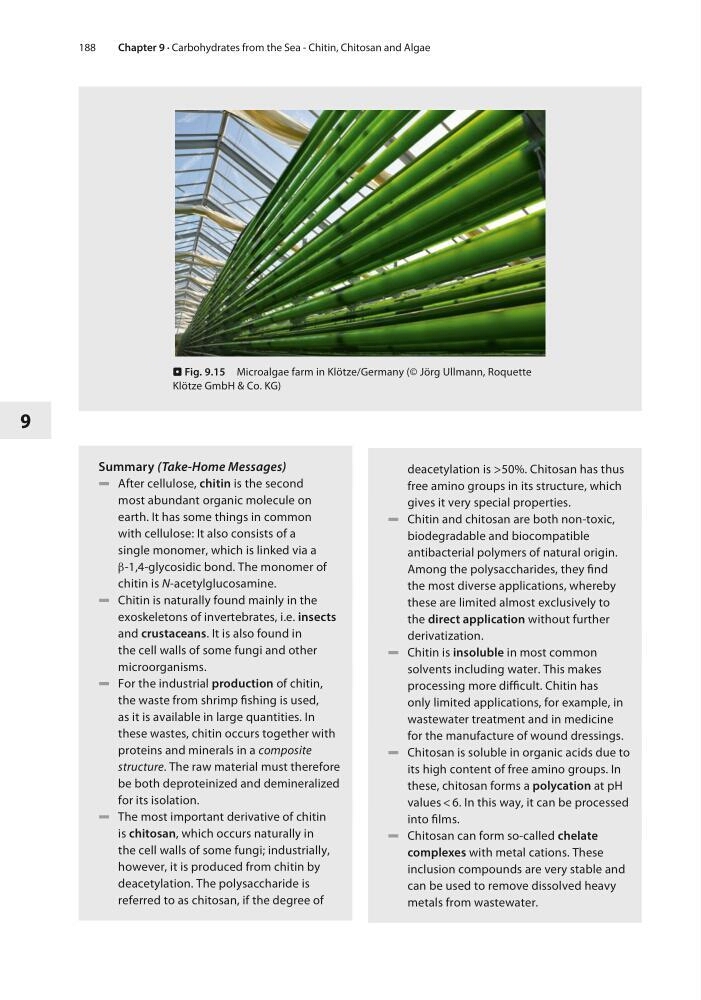
. Fig. 9.15 Microalgae farm in Klötze/Germany (© Jörg Ullmann, Roquette
Klötze GmbH & Co. KG)
Chapter 9 · Carbohydrates from the Sea - Chitin, Chitosan and Algae
9
deacetylation is >50%. Chitosan has thus
free amino groups in its structure, which
gives it very special properties.
5 Chitin and chitosan are both non-toxic,
biodegradable and biocompatible
antibacterial polymers of natural origin.
Among the polysaccharides, they find
the most diverse applications, whereby
these are limited almost exclusively to
the direct application without further
derivatization.
5 Chitin is insoluble in most common
solvents including water. This makes
processing more difficult. Chitin has
only limited applications, for example, in
wastewater treatment and in medicine
for the manufacture of wound dressings.
5 Chitosan is soluble in organic acids due to
its high content of free amino groups. In
these, chitosan forms a polycation at pH
values < 6. In this way, it can be processed
into films.
5 Chitosan can form so-called chelate
complexes with metal cations. These
inclusion compounds are very stable and
can be used to remove dissolved heavy
metals from wastewater.
Summary (Take-Home Messages)
5 After cellulose, chitin is the second
most abundant organic molecule on
earth. It has some things in common
with cellulose: It also consists of a
single monomer, which is linked via a
β-1,4-glycosidic bond. The monomer of
chitin is N-acetylglucosamine.
5 Chitin is naturally found mainly in the
exoskeletons of invertebrates, i.e. insects
and crustaceans. It is also found in
the cell walls of some fungi and other
microorganisms.
5 For the industrial production of chitin,
the waste from shrimp fishing is used,
as it is available in large quantities. In
these wastes, chitin occurs together with
proteins and minerals in a composite
structure. The raw material must therefore
be both deproteinized and demineralized
for its isolation.
5 The most important derivative of chitin
is chitosan, which occurs naturally in
the cell walls of some fungi; industrially,
however, it is produced from chitin by
deacetylation. The polysaccharide is
referred to as chitosan, if the degree of
. Fig. 9.15 Microalgae farm in Klötze/Germany (© Jörg Ullmann, Roquette
Klötze GmbH & Co. KG)