

187
9
BOX: The Harvesting and Production of Algae
Depending on their size, algae
can be divided into two groups:
5 Macroalgae are a few
millimeters to many meters
long. They usually live as
seaweed in seawater. Typical
examples are brown and red
algae.
5 Microalgae have a diameter
of a few micrometers and
are therefore only visible
under the microscope. They
also live in fresh or brackish
water. One example is the
green alga Chlorella.
Macroalgae have been used
as food in Asia for 2500 years
and are now cultivated in large
aquacultures, e.g. in open
concrete basins. The largest
producers of macroalgae are
China and Indonesia, followed
by the Philippines, South Korea
and Japan. In the USA, they are
harvested from water on the
Pacific coast of California using
“mowing machines”. In Norway
and France, especially on the
western tip of Brittany, they are
collected by boats carrying special
harvesting cranes. In Germany,
there is the “Sylt Algae Farm”
in List in the north of the island
of Sylt, which breeds red and
brown algae in large seawater
tanks. Global algae production is
estimated of 21 Mio t a −1 .
Microalgae are microscopically
small organisms. One of them is
the unicellular freshwater alga
Chlorella vulgaris, which owes its
name to the Greek terms chronos
(green) and -ella (small). This
green alga is spherical shaped
with a diameter of 4–10 μm
and is found all over the
world. Its cell wall consists of a
multilayered cellulose structure.
It was discovered in 1889 by
the Dutchman Martinus Willem
Beijerinck (1851–1931), the first
professor of microbiology at
Delft University of Technology
(. Fig. 9.14).
The cultivation of Chlorella vulgaris
began in the 1950s. Its dried
biomass contains approx. 50%
protein, but also polyunsaturated
fatty acids such as linoleic and
linolenic acid, carotenoids and
vitamin B12. It is therefore
marketed as a dietary supplement
or used in the manufacture
of cosmetics. In Germany, a
production plant was built in
Klötze (Saxony-Anhalt) in 1999
in which the algae are cultivated
in a 500 km long system of glass
tubes (. Fig. 9.15). In this “tubular
aquarium”, the algae are optimally
exposed to sunlight and no
impurities can penetrate from the
outside. The algae are separated
by centrifugation followed by
gentle drying.
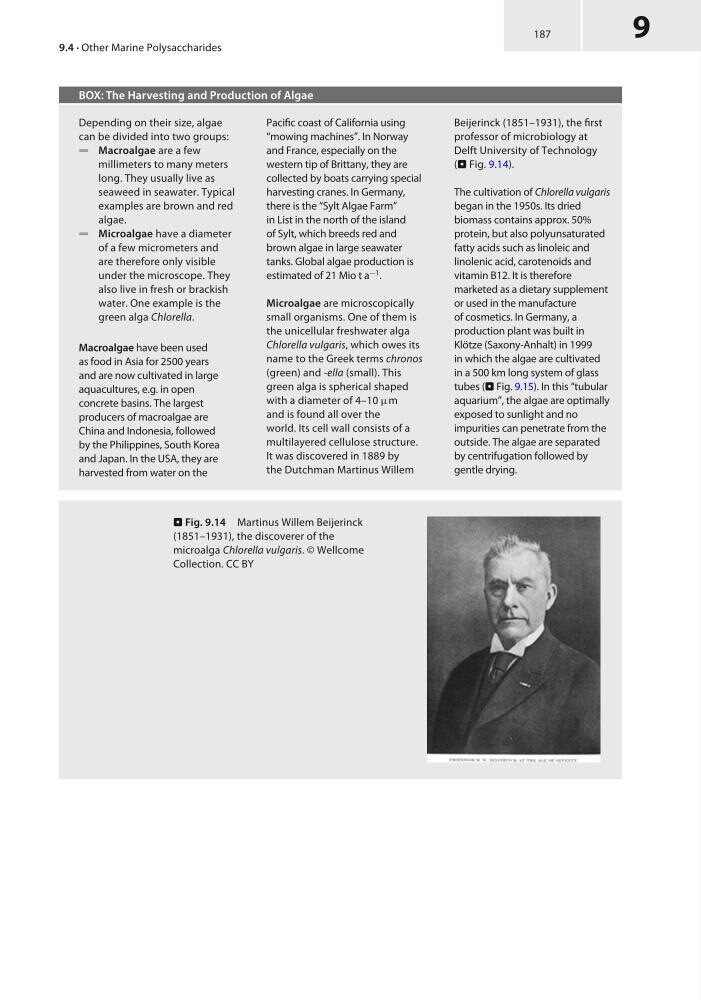
. Fig. 9.14 Martinus Willem Beijerinck
(1851–1931), the discoverer of the
microalga Chlorella vulgaris. © Wellcome
Collection. CC BY
9.4 · Other Marine Polysaccharides
9
BOX: The Harvesting and Production of Algae
Depending on their size, algae
can be divided into two groups:
5 Macroalgae are a few
millimeters to many meters
long. They usually live as
seaweed in seawater. Typical
examples are brown and red
algae.
5 Microalgae have a diameter
of a few micrometers and
are therefore only visible
under the microscope. They
also live in fresh or brackish
water. One example is the
green alga Chlorella.
Macroalgae have been used
as food in Asia for 2500 years
and are now cultivated in large
aquacultures, e.g. in open
concrete basins. The largest
producers of macroalgae are
China and Indonesia, followed
by the Philippines, South Korea
and Japan. In the USA, they are
harvested from water on the
Pacific coast of California using
“mowing machines”. In Norway
and France, especially on the
western tip of Brittany, they are
collected by boats carrying special
harvesting cranes. In Germany,
there is the “Sylt Algae Farm”
in List in the north of the island
of Sylt, which breeds red and
brown algae in large seawater
tanks. Global algae production is
estimated of 21 Mio t a −1 .
Microalgae are microscopically
small organisms. One of them is
the unicellular freshwater alga
Chlorella vulgaris, which owes its
name to the Greek terms chronos
(green) and -ella (small). This
green alga is spherical shaped
with a diameter of 4–10 μm
and is found all over the
world. Its cell wall consists of a
multilayered cellulose structure.
It was discovered in 1889 by
the Dutchman Martinus Willem
Beijerinck (1851–1931), the first
professor of microbiology at
Delft University of Technology
(. Fig. 9.14).
The cultivation of Chlorella vulgaris
began in the 1950s. Its dried
biomass contains approx. 50%
protein, but also polyunsaturated
fatty acids such as linoleic and
linolenic acid, carotenoids and
vitamin B12. It is therefore
marketed as a dietary supplement
or used in the manufacture
of cosmetics. In Germany, a
production plant was built in
Klötze (Saxony-Anhalt) in 1999
in which the algae are cultivated
in a 500 km long system of glass
tubes (. Fig. 9.15). In this “tubular
aquarium”, the algae are optimally
exposed to sunlight and no
impurities can penetrate from the
outside. The algae are separated
by centrifugation followed by
gentle drying.
. Fig. 9.14 Martinus Willem Beijerinck
(1851–1931), the discoverer of the
microalga Chlorella vulgaris. © Wellcome
Collection. CC BY
9.4 · Other Marine Polysaccharides