

186
Chapter 9 · Carbohydrates from the Sea - Chitin, Chitosan and Algae
9
Carrageenans are mainly used in food as gelling
and thickening agents as well as in toothpastes.
9.4.3 Agar-Agar
Agar-agar is a complex-structured polysaccharide made from algae. As with the carrageenans,
the main structural feature is galactose, whereby
agar-agar is divided into two structurally different components: Agarose and agaropectin.
5 In agarose, 1,4-glycosidically linked
3,6-anhydrogalactose occurs together with
1,3-linked β-d-galactose (. Fig. 9.13). This
makes it an uncharged polysaccharide.
5 In principle, the same building blocks occur in
agaropectin, but these are partially replaced
by other sugars or also substituted with sulfate
groups, making it a charged polymer.
Agarose is the main component of agar-agar and is
responsible for its gelling properties. Just 1% agaragar in hot water results in a stable gel. It is tasteless and indigestible and can therefore be used as
a gelatine substitute or thickening agent, e.g. for
desserts. In microbiology, it is used as a culture
medium for microorganisms in Petri dishes.
nium and calcium alginates, which are permitted
as food additives, are important.
The most important property of alginic acid
is its tendency to gel. Especially with calcium cations three-dimensional structures are formed in
a very fast process. This property is used in the
food industry for emulsifying, gelling or coating
applications. Further applications are in medicine, dentistry and textile printing.
9.4.2 Carrageenans
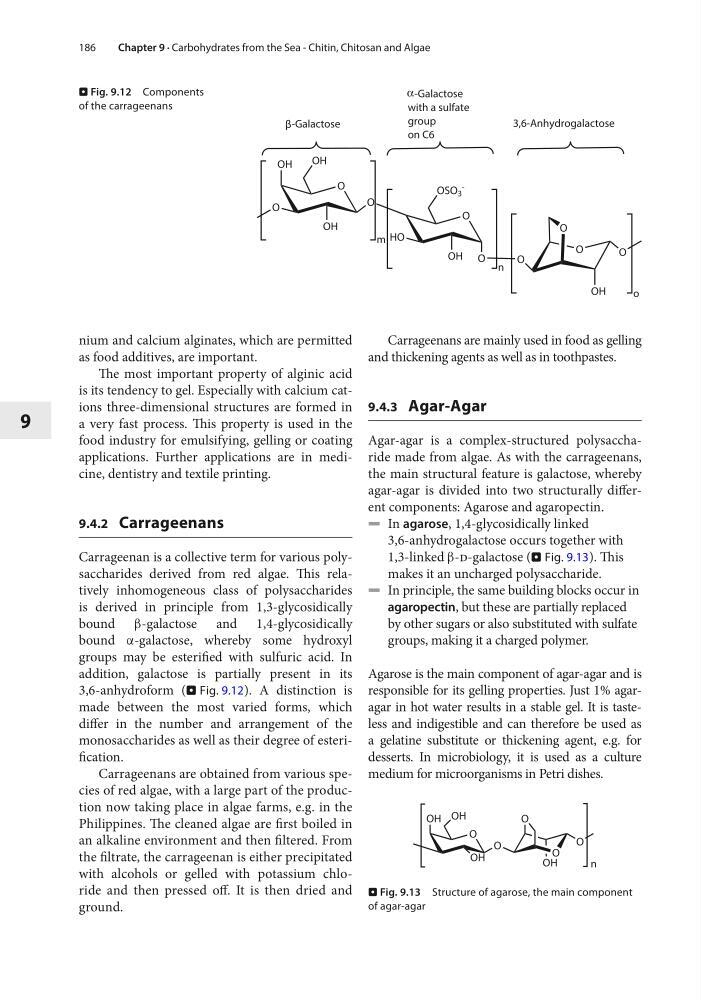
Carrageenan is a collective term for various polysaccharides derived from red algae. This relatively inhomogeneous class of polysaccharides
is derived in principle from 1,3-glycosidically
bound β-galactose and 1,4-glycosidically
bound α-galactose, whereby some hydroxyl
groups may be esterified with sulfuric acid. In
addition, galactose is partially present in its
3,6-anhydroform (. Fig. 9.12). A distinction is
made between the most varied forms, which
differ in the number and arrangement of the
monosaccharides as well as their degree of esterification.
Carrageenans are obtained from various species of red algae, with a large part of the production now taking place in algae farms, e.g. in the
Philippines. The cleaned algae are first boiled in
an alkaline environment and then filtered. From
the filtrate, the carrageenan is either precipitated
with alcohols or gelled with potassium chloride and then pressed off. It is then dried and
ground.
. Fig. 9.12 Components
of the carrageenans
O
O
OH
m
OH
OH
O
HO
OH O n
OSO 3
-
O
O
o
O
O
O
OH
-Galactose
-Galactose
with a sulfate
group
on C6
3,6-Anhydrogalactose
β
α
O
OH
O
OH
OH
O
O
OH
O
n
. Fig. 9.13 Structure of agarose, the main component
of agar-agar
Chapter 9 · Carbohydrates from the Sea - Chitin, Chitosan and Algae
9
Carrageenans are mainly used in food as gelling
and thickening agents as well as in toothpastes.
9.4.3 Agar-Agar
Agar-agar is a complex-structured polysaccharide made from algae. As with the carrageenans,
the main structural feature is galactose, whereby
agar-agar is divided into two structurally different components: Agarose and agaropectin.
5 In agarose, 1,4-glycosidically linked
3,6-anhydrogalactose occurs together with
1,3-linked β-d-galactose (. Fig. 9.13). This
makes it an uncharged polysaccharide.
5 In principle, the same building blocks occur in
agaropectin, but these are partially replaced
by other sugars or also substituted with sulfate
groups, making it a charged polymer.
Agarose is the main component of agar-agar and is
responsible for its gelling properties. Just 1% agaragar in hot water results in a stable gel. It is tasteless and indigestible and can therefore be used as
a gelatine substitute or thickening agent, e.g. for
desserts. In microbiology, it is used as a culture
medium for microorganisms in Petri dishes.
nium and calcium alginates, which are permitted
as food additives, are important.
The most important property of alginic acid
is its tendency to gel. Especially with calcium cations three-dimensional structures are formed in
a very fast process. This property is used in the
food industry for emulsifying, gelling or coating
applications. Further applications are in medicine, dentistry and textile printing.
9.4.2 Carrageenans
Carrageenan is a collective term for various polysaccharides derived from red algae. This relatively inhomogeneous class of polysaccharides
is derived in principle from 1,3-glycosidically
bound β-galactose and 1,4-glycosidically
bound α-galactose, whereby some hydroxyl
groups may be esterified with sulfuric acid. In
addition, galactose is partially present in its
3,6-anhydroform (. Fig. 9.12). A distinction is
made between the most varied forms, which
differ in the number and arrangement of the
monosaccharides as well as their degree of esterification.
Carrageenans are obtained from various species of red algae, with a large part of the production now taking place in algae farms, e.g. in the
Philippines. The cleaned algae are first boiled in
an alkaline environment and then filtered. From
the filtrate, the carrageenan is either precipitated
with alcohols or gelled with potassium chloride and then pressed off. It is then dried and
ground.
. Fig. 9.12 Components
of the carrageenans
O
O
OH
m
OH
OH
O
HO
OH O n
OSO 3
-
O
O
o
O
O
O
OH
-Galactose
-Galactose
with a sulfate
group
on C6
3,6-Anhydrogalactose
β
α
O
OH
O
OH
OH
O
O
OH
O
n
. Fig. 9.13 Structure of agarose, the main component
of agar-agar