

4
Chapter 1 · The Overview - Introduction
1
occurrence of about 100 million tons per year.
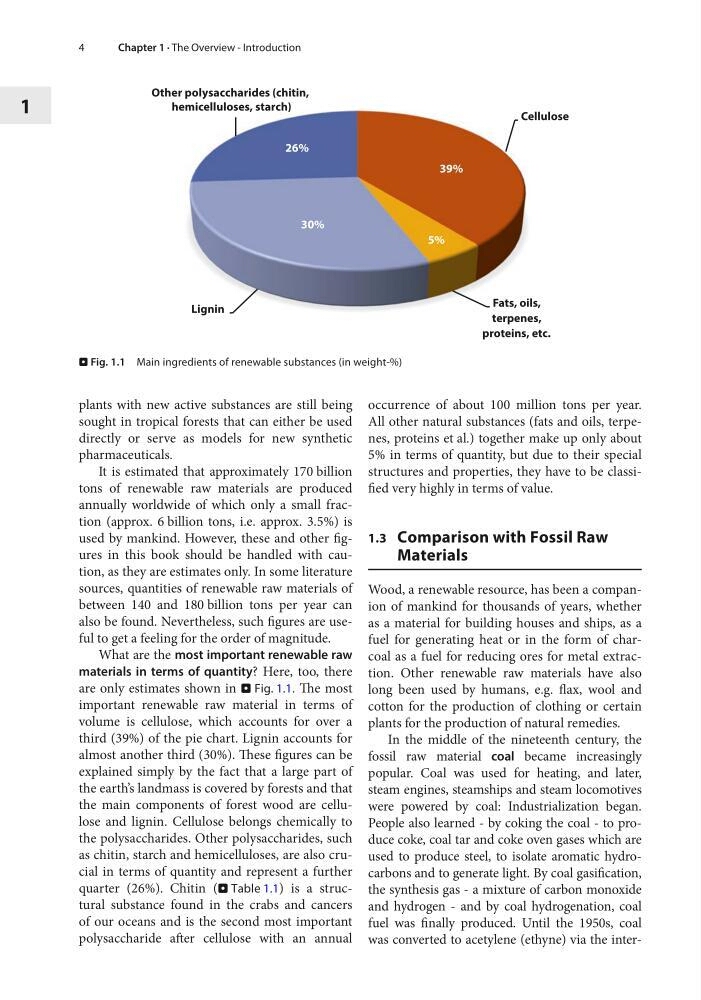
All other natural substances (fats and oils, terpenes, proteins et al.) together make up only about
5% in terms of quantity, but due to their special
structures and properties, they have to be classified very highly in terms of value.
1.3 Comparison with Fossil Raw
Materials
Wood, a renewable resource, has been a companion of mankind for thousands of years, whether
as a material for building houses and ships, as a
fuel for generating heat or in the form of charcoal as a fuel for reducing ores for metal extraction. Other renewable raw materials have also
long been used by humans, e.g. flax, wool and
cotton for the production of clothing or certain
plants for the production of natural remedies.
In the middle of the nineteenth century, the
fossil raw material coal became increasingly
popular. Coal was used for heating, and later,
steam engines, steamships and steam locomotives
were powered by coal: Industrialization began.
People also learned - by coking the coal - to produce coke, coal tar and coke oven gases which are
used to produce steel, to isolate aromatic hydrocarbons and to generate light. By coal gasification,
the synthesis gas - a mixture of carbon monoxide
and hydrogen - and by coal hydrogenation, coal
fuel was finally produced. Until the 1950s, coal
was converted to acetylene (ethyne) via the interplants with new active substances are still being
sought in tropical forests that can either be used
directly or serve as models for new synthetic
pharmaceuticals.
It is estimated that approximately 170 billion
tons of renewable raw materials are produced
annually worldwide of which only a small fraction (approx. 6 billion tons, i.e. approx. 3.5%) is
used by mankind. However, these and other figures in this book should be handled with caution, as they are estimates only. In some literature
sources, quantities of renewable raw materials of
between 140 and 180 billion tons per year can
also be found. Nevertheless, such figures are useful to get a feeling for the order of magnitude.
What are the most important renewable raw
materials in terms of quantity? Here, too, there
are only estimates shown in . Fig. 1.1. The most
important renewable raw material in terms of
volume is cellulose, which accounts for over a
third (39%) of the pie chart. Lignin accounts for
almost another third (30%). These figures can be
explained simply by the fact that a large part of
the earth’s landmass is covered by forests and that
the main components of forest wood are cellulose and lignin. Cellulose belongs chemically to
the polysaccharides. Other polysaccharides, such
as chitin, starch and hemicelluloses, are also crucial in terms of quantity and represent a further
quarter (26%). Chitin (. Table 1.1) is a structural substance found in the crabs and cancers
of our oceans and is the second most important
polysaccharide after cellulose with an annual
Cellulose
Fats, oils,
terpenes,
proteins, etc.
Lignin
Other polysaccharides (chitin,
hemicelluloses, starch)
26%
30%
5%
39%
. Fig. 1.1 Main ingredients of renewable substances (in weight-%)
Chapter 1 · The Overview - Introduction
1
occurrence of about 100 million tons per year.
All other natural substances (fats and oils, terpenes, proteins et al.) together make up only about
5% in terms of quantity, but due to their special
structures and properties, they have to be classified very highly in terms of value.
1.3 Comparison with Fossil Raw
Materials
Wood, a renewable resource, has been a companion of mankind for thousands of years, whether
as a material for building houses and ships, as a
fuel for generating heat or in the form of charcoal as a fuel for reducing ores for metal extraction. Other renewable raw materials have also
long been used by humans, e.g. flax, wool and
cotton for the production of clothing or certain
plants for the production of natural remedies.
In the middle of the nineteenth century, the
fossil raw material coal became increasingly
popular. Coal was used for heating, and later,
steam engines, steamships and steam locomotives
were powered by coal: Industrialization began.
People also learned - by coking the coal - to produce coke, coal tar and coke oven gases which are
used to produce steel, to isolate aromatic hydrocarbons and to generate light. By coal gasification,
the synthesis gas - a mixture of carbon monoxide
and hydrogen - and by coal hydrogenation, coal
fuel was finally produced. Until the 1950s, coal
was converted to acetylene (ethyne) via the interplants with new active substances are still being
sought in tropical forests that can either be used
directly or serve as models for new synthetic
pharmaceuticals.
It is estimated that approximately 170 billion
tons of renewable raw materials are produced
annually worldwide of which only a small fraction (approx. 6 billion tons, i.e. approx. 3.5%) is
used by mankind. However, these and other figures in this book should be handled with caution, as they are estimates only. In some literature
sources, quantities of renewable raw materials of
between 140 and 180 billion tons per year can
also be found. Nevertheless, such figures are useful to get a feeling for the order of magnitude.
What are the most important renewable raw
materials in terms of quantity? Here, too, there
are only estimates shown in . Fig. 1.1. The most
important renewable raw material in terms of
volume is cellulose, which accounts for over a
third (39%) of the pie chart. Lignin accounts for
almost another third (30%). These figures can be
explained simply by the fact that a large part of
the earth’s landmass is covered by forests and that
the main components of forest wood are cellulose and lignin. Cellulose belongs chemically to
the polysaccharides. Other polysaccharides, such
as chitin, starch and hemicelluloses, are also crucial in terms of quantity and represent a further
quarter (26%). Chitin (. Table 1.1) is a structural substance found in the crabs and cancers
of our oceans and is the second most important
polysaccharide after cellulose with an annual
Cellulose
Fats, oils,
terpenes,
proteins, etc.
Lignin
Other polysaccharides (chitin,
hemicelluloses, starch)
26%
30%
5%
39%
. Fig. 1.1 Main ingredients of renewable substances (in weight-%)