

3
1
1.2 The Different Types of Renewable Raw Materials
in the major task of separating these substances
from each other and isolating them in sufficient
quality.
The primary ingredients are found in particularly large quantities in nature. In addition to
the primary ingredients, there are also the secondary ingredients, which occur in the plant in
much smaller amounts, often only in traces. They
were gradually trained in the course of a plant’s
development in order to pursue specific strategies, e.g. fending off predators or attracting pollinating insects. These include certain fragrances
and dyes as well as substances that we now use as
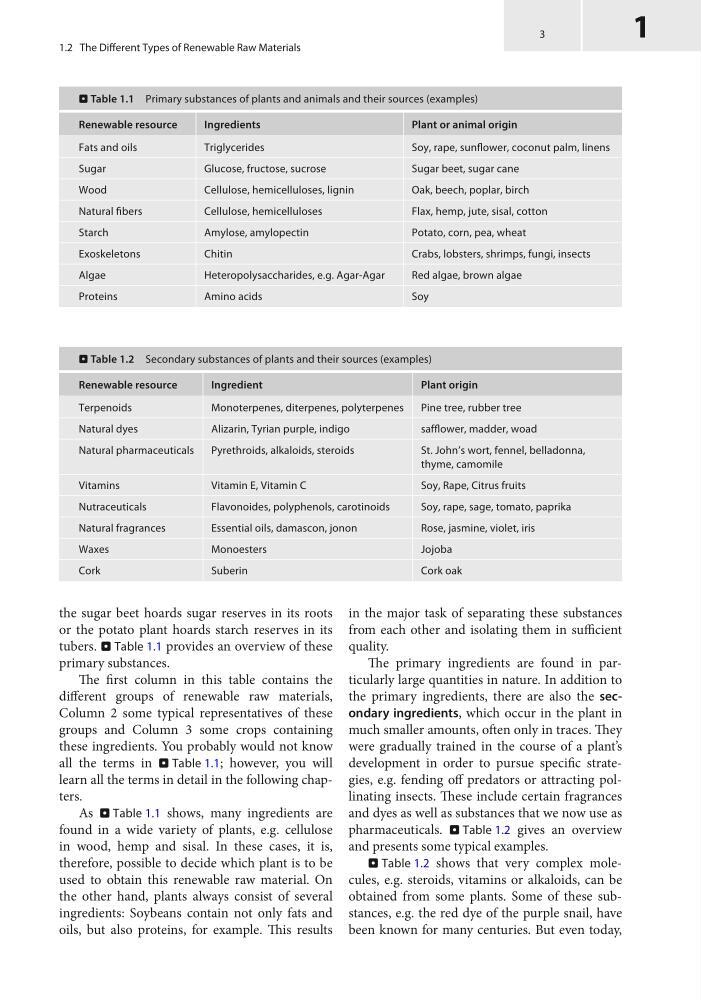
pharmaceuticals. . Table 1.2 gives an overview
and presents some typical examples.
. Table 1.2 shows that very complex molecules, e.g. steroids, vitamins or alkaloids, can be
obtained from some plants. Some of these substances, e.g. the red dye of the purple snail, have
been known for many centuries. But even today,
the sugar beet hoards sugar reserves in its roots
or the potato plant hoards starch reserves in its
tubers. . Table 1.1 provides an overview of these
primary substances.
The first column in this table contains the
different groups of renewable raw materials,
Column 2 some typical representatives of these
groups and Column 3 some crops containing
these ingredients. You probably would not know
all the terms in . Table 1.1; however, you will
learn all the terms in detail in the following chapters.
As . Table 1.1 shows, many ingredients are
found in a wide variety of plants, e.g. cellulose
in wood, hemp and sisal. In these cases, it is,
therefore, possible to decide which plant is to be
used to obtain this renewable raw material. On
the other hand, plants always consist of several
ingredients: Soybeans contain not only fats and
oils, but also proteins, for example. This results
. Table 1.1 Primary substances of plants and animals and their sources (examples)
Renewable resource
Ingredients
Plant or animal origin
Fats and oils
Triglycerides
Soy, rape, sunflower, coconut palm, linens
Sugar
Glucose, fructose, sucrose
Sugar beet, sugar cane
Wood
Cellulose, hemicelluloses, lignin
Oak, beech, poplar, birch
Natural fibers
Cellulose, hemicelluloses
Flax, hemp, jute, sisal, cotton
Starch
Amylose, amylopectin
Potato, corn, pea, wheat
Exoskeletons
Chitin
Crabs, lobsters, shrimps, fungi, insects
Algae
Heteropolysaccharides, e.g. Agar-Agar
Red algae, brown algae
Proteins
Amino acids
Soy
. Table 1.2 Secondary substances of plants and their sources (examples)
Renewable resource
Ingredient
Plant origin
Terpenoids
Monoterpenes, diterpenes, polyterpenes
Pine tree, rubber tree
Natural dyes
Alizarin, Tyrian purple, indigo
safflower, madder, woad
Natural pharmaceuticals
Pyrethroids, alkaloids, steroids
St. John’s wort, fennel, belladonna,
thyme, camomile
Vitamins
Vitamin E, Vitamin C
Soy, Rape, Citrus fruits
Nutraceuticals
Flavonoides, polyphenols, carotinoids
Soy, rape, sage, tomato, paprika
Natural fragrances
Essential oils, damascon, jonon
Rose, jasmine, violet, iris
Waxes
Monoesters
Jojoba
Cork
Suberin
Cork oak
1
1.2 The Different Types of Renewable Raw Materials
in the major task of separating these substances
from each other and isolating them in sufficient
quality.
The primary ingredients are found in particularly large quantities in nature. In addition to
the primary ingredients, there are also the secondary ingredients, which occur in the plant in
much smaller amounts, often only in traces. They
were gradually trained in the course of a plant’s
development in order to pursue specific strategies, e.g. fending off predators or attracting pollinating insects. These include certain fragrances
and dyes as well as substances that we now use as
pharmaceuticals. . Table 1.2 gives an overview
and presents some typical examples.
. Table 1.2 shows that very complex molecules, e.g. steroids, vitamins or alkaloids, can be
obtained from some plants. Some of these substances, e.g. the red dye of the purple snail, have
been known for many centuries. But even today,
the sugar beet hoards sugar reserves in its roots
or the potato plant hoards starch reserves in its
tubers. . Table 1.1 provides an overview of these
primary substances.
The first column in this table contains the
different groups of renewable raw materials,
Column 2 some typical representatives of these
groups and Column 3 some crops containing
these ingredients. You probably would not know
all the terms in . Table 1.1; however, you will
learn all the terms in detail in the following chapters.
As . Table 1.1 shows, many ingredients are
found in a wide variety of plants, e.g. cellulose
in wood, hemp and sisal. In these cases, it is,
therefore, possible to decide which plant is to be
used to obtain this renewable raw material. On
the other hand, plants always consist of several
ingredients: Soybeans contain not only fats and
oils, but also proteins, for example. This results
. Table 1.1 Primary substances of plants and animals and their sources (examples)
Renewable resource
Ingredients
Plant or animal origin
Fats and oils
Triglycerides
Soy, rape, sunflower, coconut palm, linens
Sugar
Glucose, fructose, sucrose
Sugar beet, sugar cane
Wood
Cellulose, hemicelluloses, lignin
Oak, beech, poplar, birch
Natural fibers
Cellulose, hemicelluloses
Flax, hemp, jute, sisal, cotton
Starch
Amylose, amylopectin
Potato, corn, pea, wheat
Exoskeletons
Chitin
Crabs, lobsters, shrimps, fungi, insects
Algae
Heteropolysaccharides, e.g. Agar-Agar
Red algae, brown algae
Proteins
Amino acids
Soy
. Table 1.2 Secondary substances of plants and their sources (examples)
Renewable resource
Ingredient
Plant origin
Terpenoids
Monoterpenes, diterpenes, polyterpenes
Pine tree, rubber tree
Natural dyes
Alizarin, Tyrian purple, indigo
safflower, madder, woad
Natural pharmaceuticals
Pyrethroids, alkaloids, steroids
St. John’s wort, fennel, belladonna,
thyme, camomile
Vitamins
Vitamin E, Vitamin C
Soy, Rape, Citrus fruits
Nutraceuticals
Flavonoides, polyphenols, carotinoids
Soy, rape, sage, tomato, paprika
Natural fragrances
Essential oils, damascon, jonon
Rose, jasmine, violet, iris
Waxes
Monoesters
Jojoba
Cork
Suberin
Cork oak