

5
1
1.3 Comparison with Fossil Raw Materials
thesis of important chemicals will continue to be
preserved for even longer. Similar considerations
apply to natural gas: The current estimated world
reserves of approx. 181 × 10 12 m 3 will last - also
statistically speaking - for another 63 years.
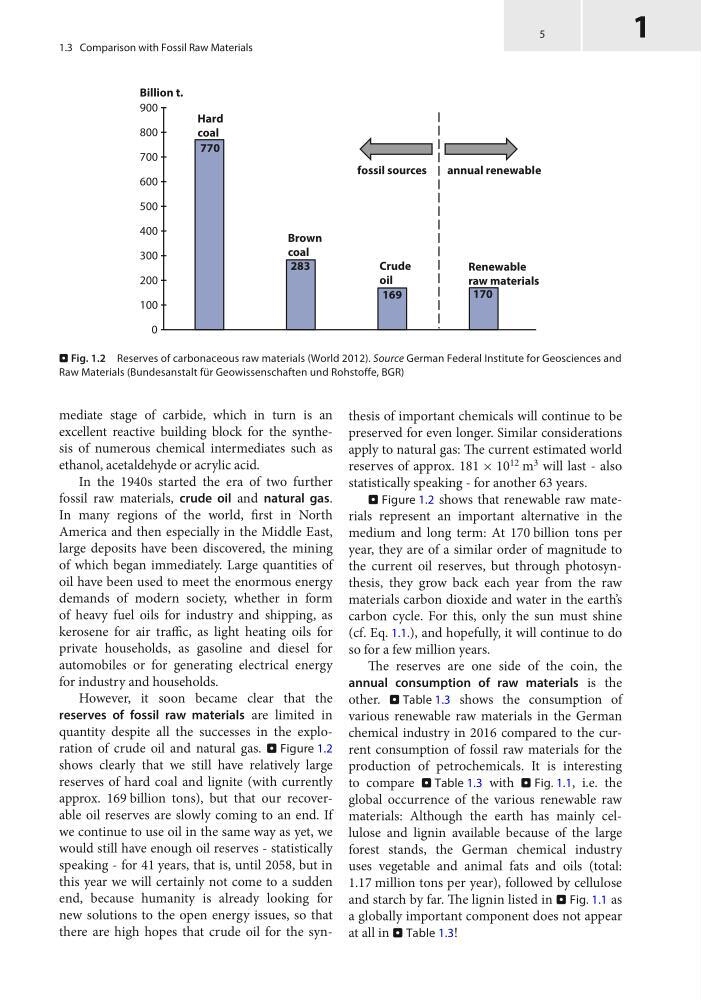
. Figure 1.2 shows that renewable raw materials represent an important alternative in the
medium and long term: At 170 billion tons per
year, they are of a similar order of magnitude to
the current oil reserves, but through photosynthesis, they grow back each year from the raw
materials carbon dioxide and water in the earth’s
carbon cycle. For this, only the sun must shine
(cf. Eq. 1.1.), and hopefully, it will continue to do
so for a few million years.
The reserves are one side of the coin, the
annual consumption of raw materials is the
other. . Table 1.3 shows the consumption of
various renewable raw materials in the German
chemical industry in 2016 compared to the current consumption of fossil raw materials for the
production of petrochemicals. It is interesting
to compare . Table 1.3 with . Fig. 1.1, i.e. the
global occurrence of the various renewable raw
materials: Although the earth has mainly cellulose and lignin available because of the large
forest stands, the German chemical industry
uses vegetable and animal fats and oils (total:
1.17 million tons per year), followed by cellulose
and starch by far. The lignin listed in . Fig. 1.1 as
a globally important component does not appear
at all in . Table 1.3!
mediate stage of carbide, which in turn is an
excellent reactive building block for the synthesis of numerous chemical intermediates such as
ethanol, acetaldehyde or acrylic acid.
In the 1940s started the era of two further
fossil raw materials, crude oil and natural gas.
In many regions of the world, first in North
America and then especially in the Middle East,
large deposits have been discovered, the mining
of which began immediately. Large quantities of
oil have been used to meet the enormous energy
demands of modern society, whether in form
of heavy fuel oils for industry and shipping, as
kerosene for air traffic, as light heating oils for
private households, as gasoline and diesel for
automobiles or for generating electrical energy
for industry and households.
However, it soon became clear that the
reserves of fossil raw materials are limited in
quantity despite all the successes in the exploration of crude oil and natural gas. . Figure 1.2
shows clearly that we still have relatively large
reserves of hard coal and lignite (with currently
approx. 169 billion tons), but that our recoverable oil reserves are slowly coming to an end. If
we continue to use oil in the same way as yet, we
would still have enough oil reserves - statistically
speaking - for 41 years, that is, until 2058, but in
this year we will certainly not come to a sudden
end, because humanity is already looking for
new solutions to the open energy issues, so that
there are high hopes that crude oil for the syn. Fig. 1.2 Reserves of carbonaceous raw materials (World 2012). Source German Federal Institute for Geosciences and
Raw Materials (Bundesanstalt für Geowissenschaften und Rohstoffe, BGR)
0
100
200
300
400
500
600
700
800
900
770
283
169
170
Hard
coal
Brown
coal
Crude
oil
Renewable
raw materials
annual renewable
fossil sources
Billion t.
1
1.3 Comparison with Fossil Raw Materials
thesis of important chemicals will continue to be
preserved for even longer. Similar considerations
apply to natural gas: The current estimated world
reserves of approx. 181 × 10 12 m 3 will last - also
statistically speaking - for another 63 years.
. Figure 1.2 shows that renewable raw materials represent an important alternative in the
medium and long term: At 170 billion tons per
year, they are of a similar order of magnitude to
the current oil reserves, but through photosynthesis, they grow back each year from the raw
materials carbon dioxide and water in the earth’s
carbon cycle. For this, only the sun must shine
(cf. Eq. 1.1.), and hopefully, it will continue to do
so for a few million years.
The reserves are one side of the coin, the
annual consumption of raw materials is the
other. . Table 1.3 shows the consumption of
various renewable raw materials in the German
chemical industry in 2016 compared to the current consumption of fossil raw materials for the
production of petrochemicals. It is interesting
to compare . Table 1.3 with . Fig. 1.1, i.e. the
global occurrence of the various renewable raw
materials: Although the earth has mainly cellulose and lignin available because of the large
forest stands, the German chemical industry
uses vegetable and animal fats and oils (total:
1.17 million tons per year), followed by cellulose
and starch by far. The lignin listed in . Fig. 1.1 as
a globally important component does not appear
at all in . Table 1.3!
mediate stage of carbide, which in turn is an
excellent reactive building block for the synthesis of numerous chemical intermediates such as
ethanol, acetaldehyde or acrylic acid.
In the 1940s started the era of two further
fossil raw materials, crude oil and natural gas.
In many regions of the world, first in North
America and then especially in the Middle East,
large deposits have been discovered, the mining
of which began immediately. Large quantities of
oil have been used to meet the enormous energy
demands of modern society, whether in form
of heavy fuel oils for industry and shipping, as
kerosene for air traffic, as light heating oils for
private households, as gasoline and diesel for
automobiles or for generating electrical energy
for industry and households.
However, it soon became clear that the
reserves of fossil raw materials are limited in
quantity despite all the successes in the exploration of crude oil and natural gas. . Figure 1.2
shows clearly that we still have relatively large
reserves of hard coal and lignite (with currently
approx. 169 billion tons), but that our recoverable oil reserves are slowly coming to an end. If
we continue to use oil in the same way as yet, we
would still have enough oil reserves - statistically
speaking - for 41 years, that is, until 2058, but in
this year we will certainly not come to a sudden
end, because humanity is already looking for
new solutions to the open energy issues, so that
there are high hopes that crude oil for the syn. Fig. 1.2 Reserves of carbonaceous raw materials (World 2012). Source German Federal Institute for Geosciences and
Raw Materials (Bundesanstalt für Geowissenschaften und Rohstoffe, BGR)
0
100
200
300
400
500
600
700
800
900
770
283
169
170
Hard
coal
Brown
coal
Crude
oil
Renewable
raw materials
annual renewable
fossil sources
Billion t.