

149
7
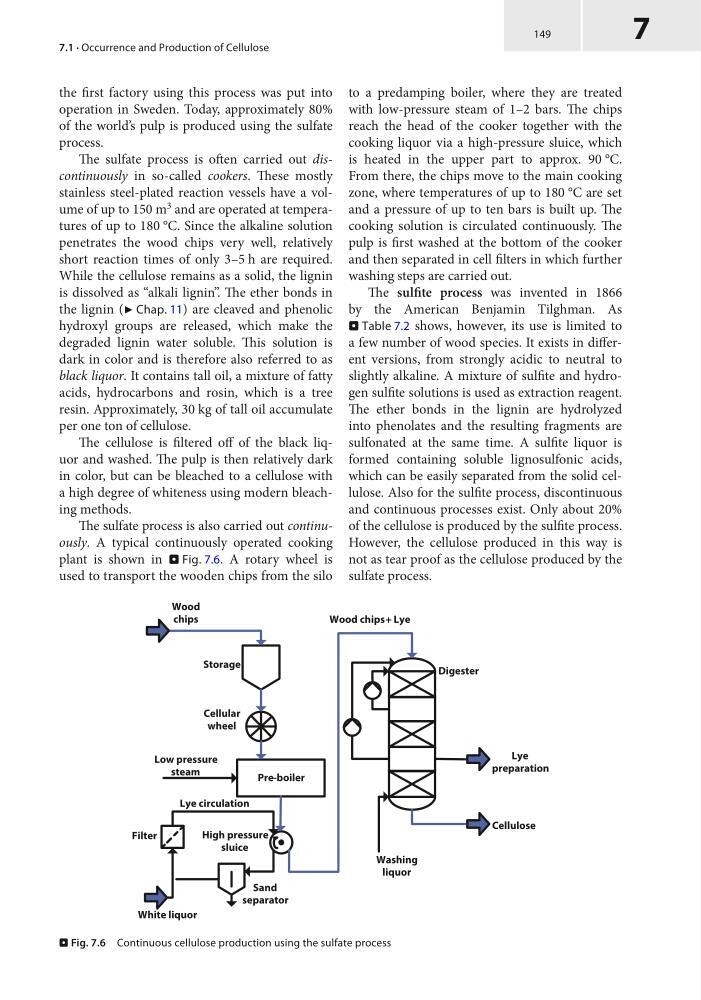
to a predamping boiler, where they are treated
with low-pressure steam of 1–2 bars. The chips
reach the head of the cooker together with the
cooking liquor via a high-pressure sluice, which
is heated in the upper part to approx. 90 °C.
From there, the chips move to the main cooking
zone, where temperatures of up to 180 °C are set
and a pressure of up to ten bars is built up. The
cooking solution is circulated continuously. The
pulp is first washed at the bottom of the cooker
and then separated in cell filters in which further
washing steps are carried out.
The sulfite process was invented in 1866
by the American Benjamin Tilghman. As
. Table 7.2 shows, however, its use is limited to
a few number of wood species. It exists in different versions, from strongly acidic to neutral to
slightly alkaline. A mixture of sulfite and hydrogen sulfite solutions is used as extraction reagent.
The ether bonds in the lignin are hydrolyzed
into phenolates and the resulting fragments are
sulfonated at the same time. A sulfite liquor is
formed containing soluble lignosulfonic acids,
which can be easily separated from the solid cellulose. Also for the sulfite process, discontinuous
and continuous processes exist. Only about 20%
of the cellulose is produced by the sulfite process.
However, the cellulose produced in this way is
not as tear proof as the cellulose produced by the
sulfate process.
the first factory using this process was put into
operation in Sweden. Today, approximately 80%
of the world’s pulp is produced using the sulfate
process.
The sulfate process is often carried out discontinuously in so-called cookers. These mostly
stainless steel-plated reaction vessels have a volume of up to 150 m 3 and are operated at temperatures of up to 180 °C. Since the alkaline solution
penetrates the wood chips very well, relatively
short reaction times of only 3–5 h are required.
While the cellulose remains as a solid, the lignin
is dissolved as “alkali lignin”. The ether bonds in
the lignin (7 Chap. 11) are cleaved and phenolic
hydroxyl groups are released, which make the
degraded lignin water soluble. This solution is
dark in color and is therefore also referred to as
black liquor. It contains tall oil, a mixture of fatty
acids, hydrocarbons and rosin, which is a tree
resin. Approximately, 30 kg of tall oil accumulate
per one ton of cellulose.
The cellulose is filtered off of the black liquor and washed. The pulp is then relatively dark
in color, but can be bleached to a cellulose with
a high degree of whiteness using modern bleaching methods.
The sulfate process is also carried out continuously. A typical continuously operated cooking
plant is shown in . Fig. 7.6. A rotary wheel is
used to transport the wooden chips from the silo
Pre-boiler
Wood
chips
Storage
Cellular
wheel
Low pressure
steam
Lye circulation
High pressure
sluice
Filter
Sand
separator
White liquor
Wood chips + Lye
Digester
Lye
preparation
Cellulose
Washing
liquor
. Fig. 7.6 Continuous cellulose production using the sulfate process
7.1 · Occurrence and Production of Cellulose
7
to a predamping boiler, where they are treated
with low-pressure steam of 1–2 bars. The chips
reach the head of the cooker together with the
cooking liquor via a high-pressure sluice, which
is heated in the upper part to approx. 90 °C.
From there, the chips move to the main cooking
zone, where temperatures of up to 180 °C are set
and a pressure of up to ten bars is built up. The
cooking solution is circulated continuously. The
pulp is first washed at the bottom of the cooker
and then separated in cell filters in which further
washing steps are carried out.
The sulfite process was invented in 1866
by the American Benjamin Tilghman. As
. Table 7.2 shows, however, its use is limited to
a few number of wood species. It exists in different versions, from strongly acidic to neutral to
slightly alkaline. A mixture of sulfite and hydrogen sulfite solutions is used as extraction reagent.
The ether bonds in the lignin are hydrolyzed
into phenolates and the resulting fragments are
sulfonated at the same time. A sulfite liquor is
formed containing soluble lignosulfonic acids,
which can be easily separated from the solid cellulose. Also for the sulfite process, discontinuous
and continuous processes exist. Only about 20%
of the cellulose is produced by the sulfite process.
However, the cellulose produced in this way is
not as tear proof as the cellulose produced by the
sulfate process.
the first factory using this process was put into
operation in Sweden. Today, approximately 80%
of the world’s pulp is produced using the sulfate
process.
The sulfate process is often carried out discontinuously in so-called cookers. These mostly
stainless steel-plated reaction vessels have a volume of up to 150 m 3 and are operated at temperatures of up to 180 °C. Since the alkaline solution
penetrates the wood chips very well, relatively
short reaction times of only 3–5 h are required.
While the cellulose remains as a solid, the lignin
is dissolved as “alkali lignin”. The ether bonds in
the lignin (7 Chap. 11) are cleaved and phenolic
hydroxyl groups are released, which make the
degraded lignin water soluble. This solution is
dark in color and is therefore also referred to as
black liquor. It contains tall oil, a mixture of fatty
acids, hydrocarbons and rosin, which is a tree
resin. Approximately, 30 kg of tall oil accumulate
per one ton of cellulose.
The cellulose is filtered off of the black liquor and washed. The pulp is then relatively dark
in color, but can be bleached to a cellulose with
a high degree of whiteness using modern bleaching methods.
The sulfate process is also carried out continuously. A typical continuously operated cooking
plant is shown in . Fig. 7.6. A rotary wheel is
used to transport the wooden chips from the silo
Pre-boiler
Wood
chips
Storage
Cellular
wheel
Low pressure
steam
Lye circulation
High pressure
sluice
Filter
Sand
separator
White liquor
Wood chips + Lye
Digester
Lye
preparation
Cellulose
Washing
liquor
. Fig. 7.6 Continuous cellulose production using the sulfate process
7.1 · Occurrence and Production of Cellulose