

148
Chapter 7 · From Wood to Pulp - Cellulose
7
To produce cellulose, wood is mechanically debarked and shredded in special cutting
machines with rotating knives. Wood chips
with a length of approx. 2 cm and a thickness of
approx. 5 mm are formed. This size guarantees
that, on the one hand, the digestion solutions can
penetrate well into the chips and, on the other
hand, that sufficiently long fibers are available for
paper production.
Cellulose can be obtained by various methods. The two currently most important extraction processes for cellulose are the sulfate
process (also known as the “Kraft process”) and
the sulfite process. Both are compared with each
other in . Table 7.2.
The sulfate process is carried out with the
extraction agents caustic soda solution and
sodium sulfide. This solution results in a basic
pH value of pH 10–14. The process-related sulfur losses are compensated by the addition of
sodium sulfate. This sulfate additive has given the
process its name. It is also known as the “Kraft
process” because the paper produced in this way
has a particularly high strength (German: “Kraftpapier”). The residual lignin content is 4–5%.
The sulfate process was invented as early as
1879 by Carl Ferdinand Dahl. As early as 1890,
In wood, the tensile fibers of cellulose are combined with lignin and hemicelluloses in a
biogenic composite material. Lignin, a three-dimensional macromolecule of aromatic building
blocks (7 Chap. 11), forms a pressure-resistant
matrix in wood that protects cellulose from
enzymatic degradation. Hemicelluloses (or
“polyoses”) also belong to this matrix. Hemicelluloses usually have a lower degree of polymerization than cellulose, are branched and often
consist of several monosaccharide building
blocks. Due to the branches, hemicelluloses do
not form crystalline segments and are therefore
amorphous.
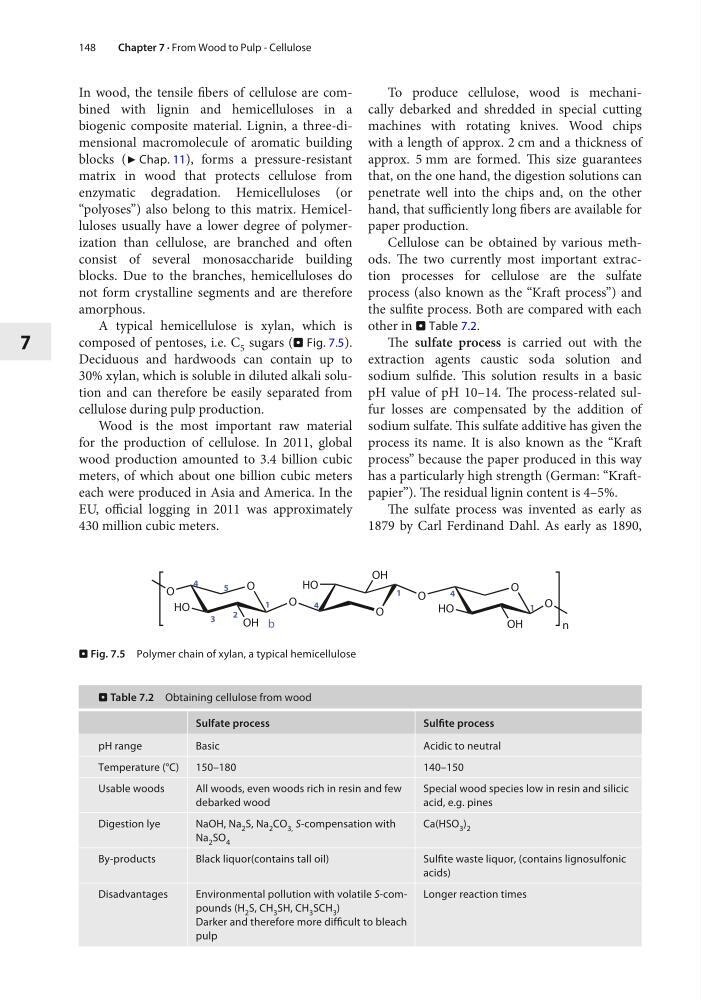
A typical hemicellulose is xylan, which is
composed of pentoses, i.e. C 5 sugars (. Fig. 7.5).
Deciduous and hardwoods can contain up to
30% xylan, which is soluble in diluted alkali solution and can therefore be easily separated from
cellulose during pulp production.
Wood is the most important raw material
for the production of cellulose. In 2011, global
wood production amounted to 3.4 billion cubic
meters, of which about one billion cubic meters
each were produced in Asia and America. In the
EU, official logging in 2011 was approximately
430 million cubic meters.
O
O
OH
O
O
OH
O
HO
OH
O
HO
O
HO
1
2
1
4
4
5
3
1
4
b
n
. Fig. 7.5 Polymer chain of xylan, a typical hemicellulose
. Table 7.2 Obtaining cellulose from wood
Sulfate process
Sulfite process
pH range
Basic
Acidic to neutral
Temperature (°C)
150–180
140–150
Usable woods
All woods, even woods rich in resin and few
debarked wood
Special wood species low in resin and silicic
acid, e.g. pines
Digestion lye
NaOH, Na 2 S, Na 2 CO 3, S-compensation with
Na 2 SO 4
Ca(HSO 3 ) 2
By-products
Black liquor(contains tall oil)
Sulfite waste liquor, (contains lignosulfonic
acids)
Disadvantages
Environmental pollution with volatile S-compounds (H 2 S, CH 3 SH, CH 3 SCH 3 )
Darker and therefore more difficult to bleach
pulp
Longer reaction times
Chapter 7 · From Wood to Pulp - Cellulose
7
To produce cellulose, wood is mechanically debarked and shredded in special cutting
machines with rotating knives. Wood chips
with a length of approx. 2 cm and a thickness of
approx. 5 mm are formed. This size guarantees
that, on the one hand, the digestion solutions can
penetrate well into the chips and, on the other
hand, that sufficiently long fibers are available for
paper production.
Cellulose can be obtained by various methods. The two currently most important extraction processes for cellulose are the sulfate
process (also known as the “Kraft process”) and
the sulfite process. Both are compared with each
other in . Table 7.2.
The sulfate process is carried out with the
extraction agents caustic soda solution and
sodium sulfide. This solution results in a basic
pH value of pH 10–14. The process-related sulfur losses are compensated by the addition of
sodium sulfate. This sulfate additive has given the
process its name. It is also known as the “Kraft
process” because the paper produced in this way
has a particularly high strength (German: “Kraftpapier”). The residual lignin content is 4–5%.
The sulfate process was invented as early as
1879 by Carl Ferdinand Dahl. As early as 1890,
In wood, the tensile fibers of cellulose are combined with lignin and hemicelluloses in a
biogenic composite material. Lignin, a three-dimensional macromolecule of aromatic building
blocks (7 Chap. 11), forms a pressure-resistant
matrix in wood that protects cellulose from
enzymatic degradation. Hemicelluloses (or
“polyoses”) also belong to this matrix. Hemicelluloses usually have a lower degree of polymerization than cellulose, are branched and often
consist of several monosaccharide building
blocks. Due to the branches, hemicelluloses do
not form crystalline segments and are therefore
amorphous.
A typical hemicellulose is xylan, which is
composed of pentoses, i.e. C 5 sugars (. Fig. 7.5).
Deciduous and hardwoods can contain up to
30% xylan, which is soluble in diluted alkali solution and can therefore be easily separated from
cellulose during pulp production.
Wood is the most important raw material
for the production of cellulose. In 2011, global
wood production amounted to 3.4 billion cubic
meters, of which about one billion cubic meters
each were produced in Asia and America. In the
EU, official logging in 2011 was approximately
430 million cubic meters.
O
O
OH
O
O
OH
O
HO
OH
O
HO
O
HO
1
2
1
4
4
5
3
1
4
b
n
. Fig. 7.5 Polymer chain of xylan, a typical hemicellulose
. Table 7.2 Obtaining cellulose from wood
Sulfate process
Sulfite process
pH range
Basic
Acidic to neutral
Temperature (°C)
150–180
140–150
Usable woods
All woods, even woods rich in resin and few
debarked wood
Special wood species low in resin and silicic
acid, e.g. pines
Digestion lye
NaOH, Na 2 S, Na 2 CO 3, S-compensation with
Na 2 SO 4
Ca(HSO 3 ) 2
By-products
Black liquor(contains tall oil)
Sulfite waste liquor, (contains lignosulfonic
acids)
Disadvantages
Environmental pollution with volatile S-compounds (H 2 S, CH 3 SH, CH 3 SCH 3 )
Darker and therefore more difficult to bleach
pulp
Longer reaction times