

150
Chapter 7 · From Wood to Pulp - Cellulose
7
Today, paper is produced on a large industrial scale in paper mills. For this purpose, various
fiber suspensions are mixed together in the pulp
center and the desired fillers (kaolin, talc, calcium
carbonate, starch etc.), dyes (titanium dioxide or
colored pigments) and glues (tree resins or synthetic
resins) are added. The mixture obtained in this way
usually contains only 4% solids; the rest is water.
This mixture is fed onto a fully automatic
paper machine, the setup of which is shown in
. Fig. 7.8. In the front of the paper machine is
the so-called forming section, which consists of
an endless sieve. In this section, the water content is reduced approx. 80%. In the subsequent
press section, the paper web is pressed between
large rolls and the water content thus reduced to
approx. 50% under high pressure. In the drying
section, further water removal is carried out by
steam-heated drying cylinders and supporting
dry webs to a residual water content of approx.
5%. The warm paper band is then cooled down
to room temperature by cooling cylinders and
passed through a calander to the reel.
Modern paper machines are up to 10 m
wide and up to 200 m long. Paper production
in these machines takes place at a speed of up to
1900 m min −1 . Paper rolls with a paper length of
60 km and a weight of up to 25 t are produced. A
photo of a paper machine is shown in . Fig. 7.9.
The machine “PM7” shown here is supplied by
Voith and has an annual capacity of 360,000 tons.
The paper is subsequently refined and finished:
5 An important step in the finishing process
is the coating of the paper. The surface of
the paper is coated with pigments, binders
and additives. Paper coated in this way has
In addition to the classical sulfate and sulfite
processes, further wood pulping processes have
recently been developed with the aim not only of
isolating a pure pulp but also of obtaining lignin
in a usable form at the same time. So far, in many
cases, the lignin-containing solutions have been
evaporated and then the remaining solids were
burned in order to maintain the operating temperature required for the cellulose production.
The new alternative processes are presented in
more detail in 7 Chap. 11.
7.2 Manufacture of Paper
One of the main applications of pulp is the
production of paper or board. According to
the European ISO 216, paper is used for surface weights up to 160 g m −2 and cardboard for
higher weights. The name paper comes from the
similar material that the Egyptians produced
from the papyrus plant at about 3000 BC.
In 2014, approximately 400 million tons of
paper were produced worldwide, of which 92 million tons were consumed in Europe. After China
(106 Mio. t), USA (71 Mio. t) and Japan (27 Mio.
t), Germany is the fourth largest consumer of
paper: with a total of 20 Mio. tons, or 250 kg per
capita and year, Germany consumes just as much
paper as Africa and South America combined.
Paper consists not only of cellulose, but also
contains mechanically crushed wood as well as
fillers and other auxiliary materials. Increasingly, paper is also being recycled, as waste paper
- after the removal of printing inks (deinking) -
to the manufacturing process as a raw material.
A distinction is made between graphical papers
(writing, printing and catalog papers), hygiene
papers, packaging papers, e.g. wrapping papers
and corrugated cardboards, and special papers,
e.g. for banknotes. In total, approx. 3000 different
types of paper do exist.
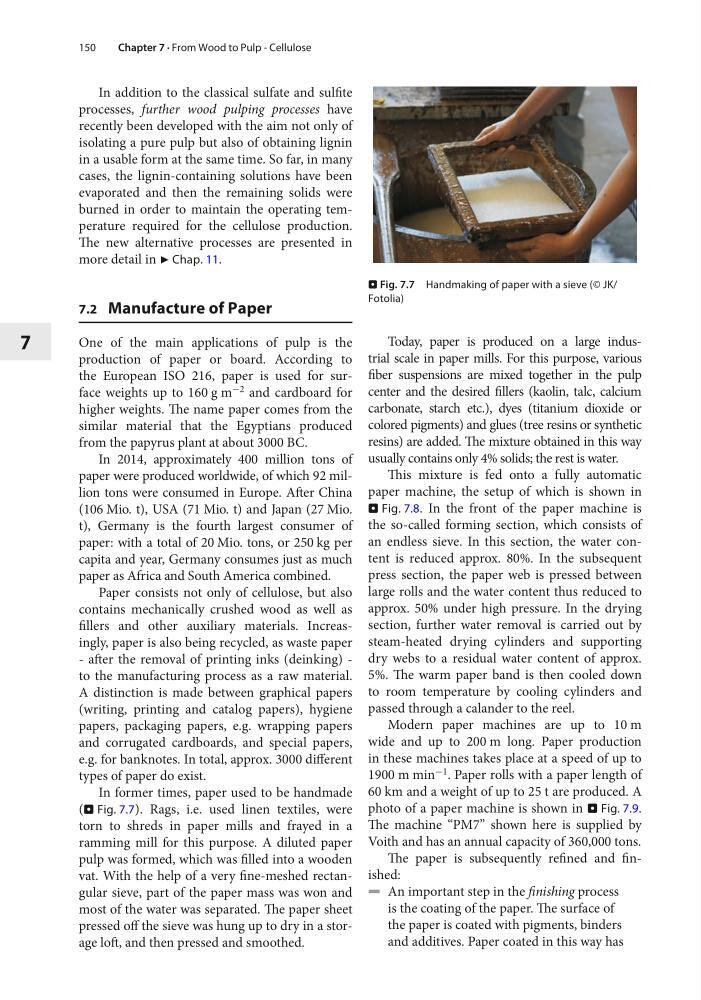
In former times, paper used to be handmade
(. Fig. 7.7). Rags, i.e. used linen textiles, were
torn to shreds in paper mills and frayed in a
ramming mill for this purpose. A diluted paper
pulp was formed, which was filled into a wooden
vat. With the help of a very fine-meshed rectangular sieve, part of the paper mass was won and
most of the water was separated. The paper sheet
pressed off the sieve was hung up to dry in a storage loft, and then pressed and smoothed.
. Fig. 7.7 Handmaking of paper with a sieve (© JK/
Fotolia)
Chapter 7 · From Wood to Pulp - Cellulose
7
Today, paper is produced on a large industrial scale in paper mills. For this purpose, various
fiber suspensions are mixed together in the pulp
center and the desired fillers (kaolin, talc, calcium
carbonate, starch etc.), dyes (titanium dioxide or
colored pigments) and glues (tree resins or synthetic
resins) are added. The mixture obtained in this way
usually contains only 4% solids; the rest is water.
This mixture is fed onto a fully automatic
paper machine, the setup of which is shown in
. Fig. 7.8. In the front of the paper machine is
the so-called forming section, which consists of
an endless sieve. In this section, the water content is reduced approx. 80%. In the subsequent
press section, the paper web is pressed between
large rolls and the water content thus reduced to
approx. 50% under high pressure. In the drying
section, further water removal is carried out by
steam-heated drying cylinders and supporting
dry webs to a residual water content of approx.
5%. The warm paper band is then cooled down
to room temperature by cooling cylinders and
passed through a calander to the reel.
Modern paper machines are up to 10 m
wide and up to 200 m long. Paper production
in these machines takes place at a speed of up to
1900 m min −1 . Paper rolls with a paper length of
60 km and a weight of up to 25 t are produced. A
photo of a paper machine is shown in . Fig. 7.9.
The machine “PM7” shown here is supplied by
Voith and has an annual capacity of 360,000 tons.
The paper is subsequently refined and finished:
5 An important step in the finishing process
is the coating of the paper. The surface of
the paper is coated with pigments, binders
and additives. Paper coated in this way has
In addition to the classical sulfate and sulfite
processes, further wood pulping processes have
recently been developed with the aim not only of
isolating a pure pulp but also of obtaining lignin
in a usable form at the same time. So far, in many
cases, the lignin-containing solutions have been
evaporated and then the remaining solids were
burned in order to maintain the operating temperature required for the cellulose production.
The new alternative processes are presented in
more detail in 7 Chap. 11.
7.2 Manufacture of Paper
One of the main applications of pulp is the
production of paper or board. According to
the European ISO 216, paper is used for surface weights up to 160 g m −2 and cardboard for
higher weights. The name paper comes from the
similar material that the Egyptians produced
from the papyrus plant at about 3000 BC.
In 2014, approximately 400 million tons of
paper were produced worldwide, of which 92 million tons were consumed in Europe. After China
(106 Mio. t), USA (71 Mio. t) and Japan (27 Mio.
t), Germany is the fourth largest consumer of
paper: with a total of 20 Mio. tons, or 250 kg per
capita and year, Germany consumes just as much
paper as Africa and South America combined.
Paper consists not only of cellulose, but also
contains mechanically crushed wood as well as
fillers and other auxiliary materials. Increasingly, paper is also being recycled, as waste paper
- after the removal of printing inks (deinking) -
to the manufacturing process as a raw material.
A distinction is made between graphical papers
(writing, printing and catalog papers), hygiene
papers, packaging papers, e.g. wrapping papers
and corrugated cardboards, and special papers,
e.g. for banknotes. In total, approx. 3000 different
types of paper do exist.
In former times, paper used to be handmade
(. Fig. 7.7). Rags, i.e. used linen textiles, were
torn to shreds in paper mills and frayed in a
ramming mill for this purpose. A diluted paper
pulp was formed, which was filled into a wooden
vat. With the help of a very fine-meshed rectangular sieve, part of the paper mass was won and
most of the water was separated. The paper sheet
pressed off the sieve was hung up to dry in a storage loft, and then pressed and smoothed.
. Fig. 7.7 Handmaking of paper with a sieve (© JK/
Fotolia)