

131
6
6.3.1 Sucrose Production
The extraction of sucrose is associated with
numerous process steps. Roughly speaking, a distinction can be made between the following process steps:
5 Production of raw sugar juice (A)
5 Sugar juice purification (B)
5 Juice thickening in the evaporator station (C)
5 Crystallization of the sugar in the “cooking
station” (D).
These steps are explained in more detail in
the (very simplified) process flow diagram of
. Fig. 6.21 using the example of sugar beets.
Production of the raw sugar juice (A):
From the end of September, the mechanically harvested beets, cleaned from leaves, are
delivered to the sugar factories. Until they are
processed, they are stored - mostly outdoors - on
large concreted areas. They are fed into a large
water washing system via channels and stone
separators. The washing water is separated in
the decanter into “beet soil” (which is returned
to the field) and wastewater, which is treated
in a biological treatment plant. The beets are
fed into cutting machines, which produce beet
flakes as thick as pencils. These pass through a
heat exchanger, in which they are preheated to
70 °C in countercurrent flow by the raw juice
(. Fig. 6.21). They are then fed from below into
an extraction tower where the sugar is continuously extracted with 70 °C hot water. At this
temperature, the walls of the plant cells become
permeable enabling very effective extraction:
Approx. 99% of the sugar is extracted from the
tons) and India (2017/18: 34 Mio. tons), followed
by Thailand and the People’s Republic of China.
These countries can produce more than 70 tons
of sugar per hectare per year. In Europe, there is
little sugar cane cultivation in Spain and Portugal, but with significantly lower yields per hectare.
The grass-like sugar cane has stalks with a
diameter of 2–4 cm and a length of up to 6 m.
The pulp of the stalk contains 10–20% sucrose.
After harvesting the stalks, the sugar juice is
pressed out, leaving behind the bagasse, which
consists of lignocellulose (7 Chap. 11) and is
mainly burnt for energy supply.
As already mentioned at the beginning, the
chemist Marggraf discovered in the eighteenth
century that the sugar beet (Beta vulgaris),
which is native in Europe, also contains sucrose
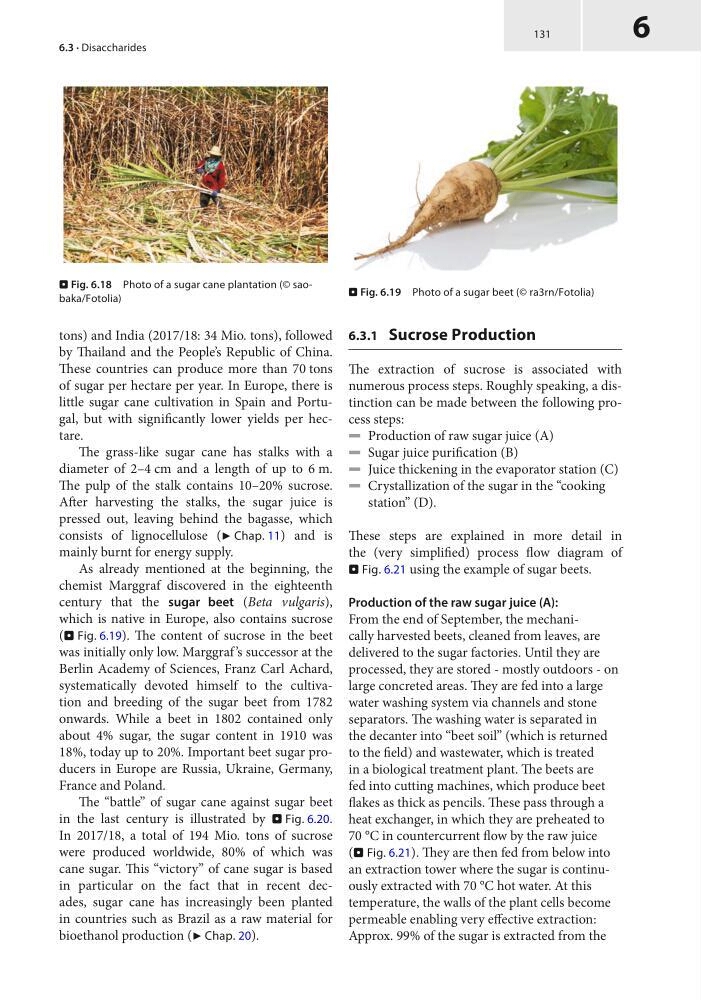
(. Fig. 6.19). The content of sucrose in the beet
was initially only low. Marggraf ’s successor at the
Berlin Academy of Sciences, Franz Carl Achard,
systematically devoted himself to the cultivation and breeding of the sugar beet from 1782
onwards. While a beet in 1802 contained only
about 4% sugar, the sugar content in 1910 was
18%, today up to 20%. Important beet sugar producers in Europe are Russia, Ukraine, Germany,
France and Poland.
The “battle” of sugar cane against sugar beet
in the last century is illustrated by . Fig. 6.20.
In 2017/18, a total of 194 Mio. tons of sucrose
were produced worldwide, 80% of which was
cane sugar. This “victory” of cane sugar is based
in particular on the fact that in recent decades, sugar cane has increasingly been planted
in countries such as Brazil as a raw material for
bioethanol production (7 Chap. 20).
. Fig. 6.18 Photo of a sugar cane plantation (© saobaka/Fotolia)
. Fig. 6.19 Photo of a sugar beet (© ra3rn/Fotolia)
6.3 · Disaccharides
6
6.3.1 Sucrose Production
The extraction of sucrose is associated with
numerous process steps. Roughly speaking, a distinction can be made between the following process steps:
5 Production of raw sugar juice (A)
5 Sugar juice purification (B)
5 Juice thickening in the evaporator station (C)
5 Crystallization of the sugar in the “cooking
station” (D).
These steps are explained in more detail in
the (very simplified) process flow diagram of
. Fig. 6.21 using the example of sugar beets.
Production of the raw sugar juice (A):
From the end of September, the mechanically harvested beets, cleaned from leaves, are
delivered to the sugar factories. Until they are
processed, they are stored - mostly outdoors - on
large concreted areas. They are fed into a large
water washing system via channels and stone
separators. The washing water is separated in
the decanter into “beet soil” (which is returned
to the field) and wastewater, which is treated
in a biological treatment plant. The beets are
fed into cutting machines, which produce beet
flakes as thick as pencils. These pass through a
heat exchanger, in which they are preheated to
70 °C in countercurrent flow by the raw juice
(. Fig. 6.21). They are then fed from below into
an extraction tower where the sugar is continuously extracted with 70 °C hot water. At this
temperature, the walls of the plant cells become
permeable enabling very effective extraction:
Approx. 99% of the sugar is extracted from the
tons) and India (2017/18: 34 Mio. tons), followed
by Thailand and the People’s Republic of China.
These countries can produce more than 70 tons
of sugar per hectare per year. In Europe, there is
little sugar cane cultivation in Spain and Portugal, but with significantly lower yields per hectare.
The grass-like sugar cane has stalks with a
diameter of 2–4 cm and a length of up to 6 m.
The pulp of the stalk contains 10–20% sucrose.
After harvesting the stalks, the sugar juice is
pressed out, leaving behind the bagasse, which
consists of lignocellulose (7 Chap. 11) and is
mainly burnt for energy supply.
As already mentioned at the beginning, the
chemist Marggraf discovered in the eighteenth
century that the sugar beet (Beta vulgaris),
which is native in Europe, also contains sucrose
(. Fig. 6.19). The content of sucrose in the beet
was initially only low. Marggraf ’s successor at the
Berlin Academy of Sciences, Franz Carl Achard,
systematically devoted himself to the cultivation and breeding of the sugar beet from 1782
onwards. While a beet in 1802 contained only
about 4% sugar, the sugar content in 1910 was
18%, today up to 20%. Important beet sugar producers in Europe are Russia, Ukraine, Germany,
France and Poland.
The “battle” of sugar cane against sugar beet
in the last century is illustrated by . Fig. 6.20.
In 2017/18, a total of 194 Mio. tons of sucrose
were produced worldwide, 80% of which was
cane sugar. This “victory” of cane sugar is based
in particular on the fact that in recent decades, sugar cane has increasingly been planted
in countries such as Brazil as a raw material for
bioethanol production (7 Chap. 20).
. Fig. 6.18 Photo of a sugar cane plantation (© saobaka/Fotolia)
. Fig. 6.19 Photo of a sugar beet (© ra3rn/Fotolia)
6.3 · Disaccharides