

132
Chapter 6 · Sweet Chemistry - Mono- and Disaccharides
6
filter press, this carbonation lime is separated; it
can partly be used as fertilizer for acid soils. The
“dilute juice” containing approx. 16% sugar is
removed from the filter press.
Juice thickening in the evaporator station (C):
The dilute juice is converted in a multistage
(usually four-stage) evaporator station into a
thick juice. This light brown, viscous solution
has a sugar content of approx. 67%. The vapors
are collected from the evaporators, which can be
used in the sugar factory as a source of energy.
Approximately, one cubic meter of water must
be gently removed in the evaporator station for
one ton of processed sugar beet. Approximately,
300 kg thick juice remain per ton of beet, which
is again filtered before further processing.
Crystallization of the sugar in the “cooking
station” (D):
The last step of the preparation is the “cooking
station”, in which more water is removed so that
the sugar crystallises. This “evaporation crystallization” is carried out discontinuously in several
stages under a slight vacuum. By the addition
of seed crystals, a highly viscous crystal–syrup
flakes. The flakes, which are almost completely
de-sugared, are predehydrated in a press and
finally converted into dry pellets in a drum dryer
for use as animal feed. The sugary juice is collected at the bottom of the extraction tower and
returned to the heat exchanger.
Sugar juice purification (B):
The sugar juice thus formed is dark in color
and contains a number of impurities such as
invert sugar (a mixture of glucose and fructose),
pectins and amino acids such as glutamine. It is
therefore absolutely necessary to purify the juice
in order to obtain “thermostable juices”. This is
done using lime milk (calcium hydroxide) and
carbon dioxide. For this purpose, every sugar
factory site has a limekiln in which calcium carbonate (“limestone”) is split into calcium oxide
(CaO) and carbon dioxide (CO 2 ). The lime milk
containing Ca(OH) 2 is produced by reacting
calcium oxide with water. This lime milk leads
to the flocculation of suspended and non-sugar
compounds. In the carbonation step, excess lime
milk is subsequently reacted with carbon dioxide
from the limekiln into solid calcium carbonate,
which contains all undesirable precipitates. In a
0
50
100
150
200
250
Cane sugar
Beet sugar
Total
Mio. t/a
Year
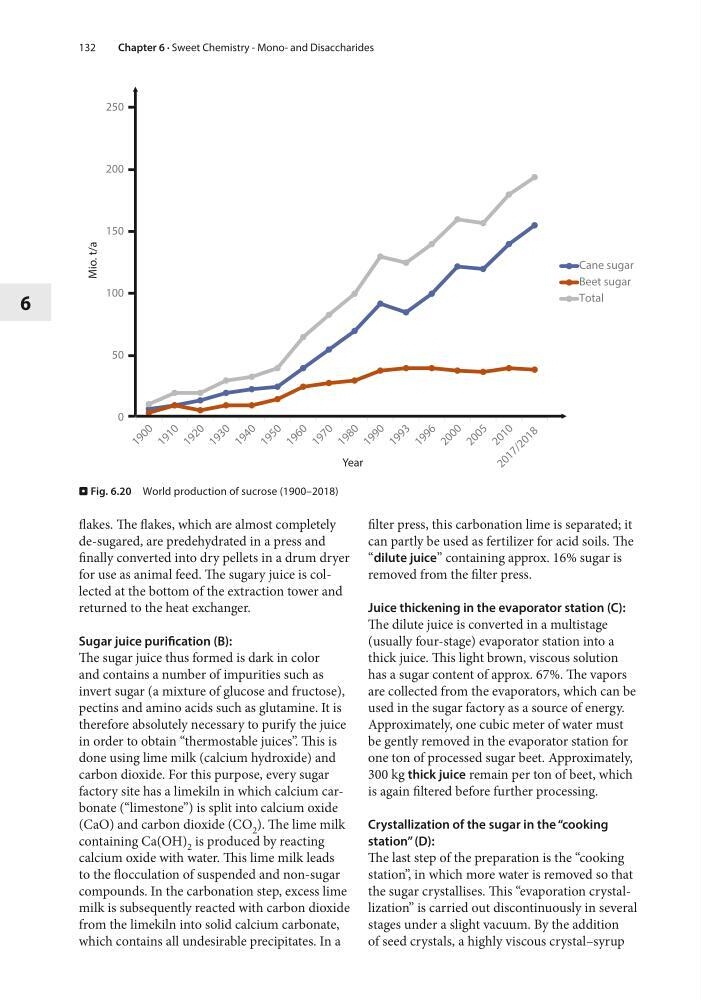
. Fig. 6.20 World production of sucrose (1900–2018)
Chapter 6 · Sweet Chemistry - Mono- and Disaccharides
6
filter press, this carbonation lime is separated; it
can partly be used as fertilizer for acid soils. The
“dilute juice” containing approx. 16% sugar is
removed from the filter press.
Juice thickening in the evaporator station (C):
The dilute juice is converted in a multistage
(usually four-stage) evaporator station into a
thick juice. This light brown, viscous solution
has a sugar content of approx. 67%. The vapors
are collected from the evaporators, which can be
used in the sugar factory as a source of energy.
Approximately, one cubic meter of water must
be gently removed in the evaporator station for
one ton of processed sugar beet. Approximately,
300 kg thick juice remain per ton of beet, which
is again filtered before further processing.
Crystallization of the sugar in the “cooking
station” (D):
The last step of the preparation is the “cooking
station”, in which more water is removed so that
the sugar crystallises. This “evaporation crystallization” is carried out discontinuously in several
stages under a slight vacuum. By the addition
of seed crystals, a highly viscous crystal–syrup
flakes. The flakes, which are almost completely
de-sugared, are predehydrated in a press and
finally converted into dry pellets in a drum dryer
for use as animal feed. The sugary juice is collected at the bottom of the extraction tower and
returned to the heat exchanger.
Sugar juice purification (B):
The sugar juice thus formed is dark in color
and contains a number of impurities such as
invert sugar (a mixture of glucose and fructose),
pectins and amino acids such as glutamine. It is
therefore absolutely necessary to purify the juice
in order to obtain “thermostable juices”. This is
done using lime milk (calcium hydroxide) and
carbon dioxide. For this purpose, every sugar
factory site has a limekiln in which calcium carbonate (“limestone”) is split into calcium oxide
(CaO) and carbon dioxide (CO 2 ). The lime milk
containing Ca(OH) 2 is produced by reacting
calcium oxide with water. This lime milk leads
to the flocculation of suspended and non-sugar
compounds. In the carbonation step, excess lime
milk is subsequently reacted with carbon dioxide
from the limekiln into solid calcium carbonate,
which contains all undesirable precipitates. In a
0
50
100
150
200
250
Cane sugar
Beet sugar
Total
Mio. t/a
Year
. Fig. 6.20 World production of sucrose (1900–2018)