

130
Chapter 6 · Sweet Chemistry - Mono- and Disaccharides
6
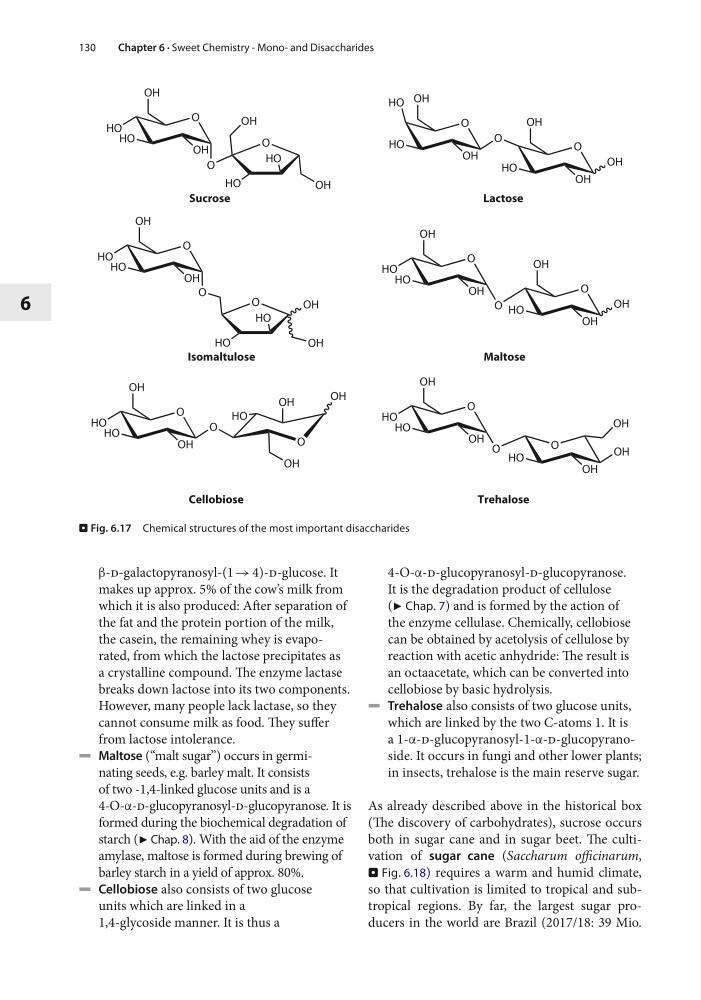
4-O-α-d-glucopyranosyl-d-glucopyranose.
It is the degradation product of cellulose
(7 Chap. 7) and is formed by the action of
the enzyme cellulase. Chemically, cellobiose
can be obtained by acetolysis of cellulose by
reaction with acetic anhydride: The result is
an octaacetate, which can be converted into
cellobiose by basic hydrolysis.
5 Trehalose also consists of two glucose units,
which are linked by the two C-atoms 1. It is
a 1-α-d-glucopyranosyl-1-α-d-glucopyranoside. It occurs in fungi and other lower plants;
in insects, trehalose is the main reserve sugar.
As already described above in the historical box
(The discovery of carbohydrates), sucrose occurs
both in sugar cane and in sugar beet. The cultivation of sugar cane (Saccharum officinarum,
. Fig. 6.18) requires a warm and humid climate,
so that cultivation is limited to tropical and subtropical regions. By far, the largest sugar producers in the world are Brazil (2017/18: 39 Mio.
β-d-galactopyranosyl-(1 → 4)-d-glucose. It
makes up approx. 5% of the cow’s milk from
which it is also produced: After separation of
the fat and the protein portion of the milk,
the casein, the remaining whey is evaporated, from which the lactose precipitates as
a crystalline compound. The enzyme lactase
breaks down lactose into its two components.
However, many people lack lactase, so they
cannot consume milk as food. They suffer
from lactose intolerance.
5 Maltose (“malt sugar”) occurs in germinating seeds, e.g. barley malt. It consists
of two -1,4-linked glucose units and is a
4-O-α-d-glucopyranosyl-d-glucopyranose. It is
formed during the biochemical degradation of
starch (7 Chap. 8). With the aid of the enzyme
amylase, maltose is formed during brewing of
barley starch in a yield of approx. 80%.
5 Cellobiose also consists of two glucose
units which are linked in a
1,4-glycoside manner. It is thus a
O
HO
HO
O
OH
OH
O
HO
HO
OH
OH
Sucrose
O
HO
HO
OH
OH
O
HO
HO
OH
OH
Isomaltulose
O
HO
HO
O
OH
OH
O
HO
OH
OH
OH
Cellobiose
O
HO
HO
O
OH
OH
O
HO
OH
OH
OH
Lactose
O
HO
HO
O
OH
OH
O
HO
OH
OH
OH
Maltose
O
HO
HO
O
OH
OH
O
HO
OH
OH
OH
Trehalose
O
. Fig. 6.17 Chemical structures of the most important disaccharides
Chapter 6 · Sweet Chemistry - Mono- and Disaccharides
6
4-O-α-d-glucopyranosyl-d-glucopyranose.
It is the degradation product of cellulose
(7 Chap. 7) and is formed by the action of
the enzyme cellulase. Chemically, cellobiose
can be obtained by acetolysis of cellulose by
reaction with acetic anhydride: The result is
an octaacetate, which can be converted into
cellobiose by basic hydrolysis.
5 Trehalose also consists of two glucose units,
which are linked by the two C-atoms 1. It is
a 1-α-d-glucopyranosyl-1-α-d-glucopyranoside. It occurs in fungi and other lower plants;
in insects, trehalose is the main reserve sugar.
As already described above in the historical box
(The discovery of carbohydrates), sucrose occurs
both in sugar cane and in sugar beet. The cultivation of sugar cane (Saccharum officinarum,
. Fig. 6.18) requires a warm and humid climate,
so that cultivation is limited to tropical and subtropical regions. By far, the largest sugar producers in the world are Brazil (2017/18: 39 Mio.
β-d-galactopyranosyl-(1 → 4)-d-glucose. It
makes up approx. 5% of the cow’s milk from
which it is also produced: After separation of
the fat and the protein portion of the milk,
the casein, the remaining whey is evaporated, from which the lactose precipitates as
a crystalline compound. The enzyme lactase
breaks down lactose into its two components.
However, many people lack lactase, so they
cannot consume milk as food. They suffer
from lactose intolerance.
5 Maltose (“malt sugar”) occurs in germinating seeds, e.g. barley malt. It consists
of two -1,4-linked glucose units and is a
4-O-α-d-glucopyranosyl-d-glucopyranose. It is
formed during the biochemical degradation of
starch (7 Chap. 8). With the aid of the enzyme
amylase, maltose is formed during brewing of
barley starch in a yield of approx. 80%.
5 Cellobiose also consists of two glucose
units which are linked in a
1,4-glycoside manner. It is thus a
O
HO
HO
O
OH
OH
O
HO
HO
OH
OH
Sucrose
O
HO
HO
OH
OH
O
HO
HO
OH
OH
Isomaltulose
O
HO
HO
O
OH
OH
O
HO
OH
OH
OH
Cellobiose
O
HO
HO
O
OH
OH
O
HO
OH
OH
OH
Lactose
O
HO
HO
O
OH
OH
O
HO
OH
OH
OH
Maltose
O
HO
HO
O
OH
OH
O
HO
OH
OH
OH
Trehalose
O
. Fig. 6.17 Chemical structures of the most important disaccharides