

127
6
and the solid/liquid mixture is fed into a stirred
tank reactor. Alternatively, glucose syrup is used
and a stable liquid/liquid dispersion can be produced by adding small amounts of the product
APG (as emulsifier). The mixture is heated to a
reaction temperature of around 100 °C. Lower
temperatures <100 °C lead to relatively long reaction times; temperatures of 110–120 °C result in
more colored products. The water formed during
reaction is continuously drawn off by means of a
vacuum system at pressures of 20–100 mbar. An
external intensive mixer is installed below the
stirred tank ensuring very fine droplet distribution and thus a large surface area. The mixture is
continuously fed back into the stirred tank via a
heat exchanger until the glucose used is almost
completely converted.
The mixture thus formed consists of 20–50%
APG and 50–80% fatty alcohols. The downstream of this mixture requires a great deal of
effort, as some important criteria have to be met:
5 The excess fatty alcohol must be reduced to
<1% during processing; otherwise, problems
with the solubility of the APG as well as with
the unwanted odour of fatty alcohols occur.
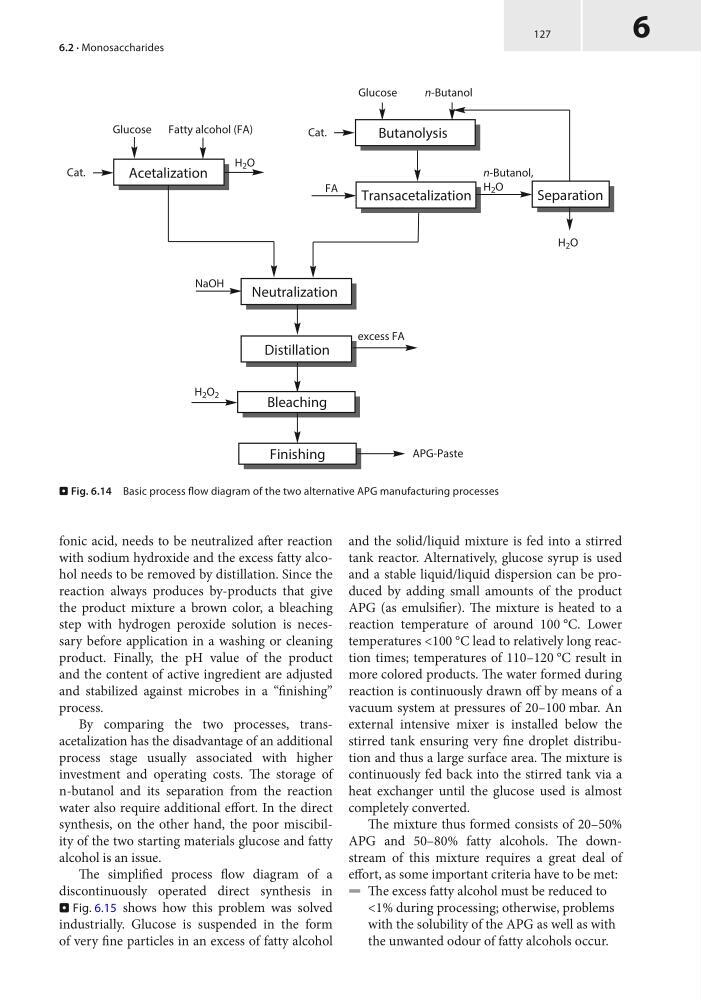
fonic acid, needs to be neutralized after reaction
with sodium hydroxide and the excess fatty alcohol needs to be removed by distillation. Since the
reaction always produces by-products that give
the product mixture a brown color, a bleaching
step with hydrogen peroxide solution is necessary before application in a washing or cleaning
product. Finally, the pH value of the product
and the content of active ingredient are adjusted
and stabilized against microbes in a “finishing”
process.
By comparing the two processes, transacetalization has the disadvantage of an additional
process stage usually associated with higher
investment and operating costs. The storage of
n-butanol and its separation from the reaction
water also require additional effort. In the direct
synthesis, on the other hand, the poor miscibility of the two starting materials glucose and fatty
alcohol is an issue.
The simplified process flow diagram of a
discontinuously operated direct synthesis in
. Fig. 6.15 shows how this problem was solved
industrially. Glucose is suspended in the form
of very fine particles in an excess of fatty alcohol
Neutralization
H 2 O
Distillation
Bleaching
APG-Paste
Transacetalization
n-Butanol,
H 2 O
Butanolysis
Glucose
n-Butanol
H 2 O 2
Glucose Fatty alcohol (FA)
FA
excess FA
Cat.
Cat.
Separation
H 2 O
NaOH
Acetalization
Finishing
. Fig. 6.14 Basic process flow diagram of the two alternative APG manufacturing processes
6.2 · Monosaccharides
6
and the solid/liquid mixture is fed into a stirred
tank reactor. Alternatively, glucose syrup is used
and a stable liquid/liquid dispersion can be produced by adding small amounts of the product
APG (as emulsifier). The mixture is heated to a
reaction temperature of around 100 °C. Lower
temperatures <100 °C lead to relatively long reaction times; temperatures of 110–120 °C result in
more colored products. The water formed during
reaction is continuously drawn off by means of a
vacuum system at pressures of 20–100 mbar. An
external intensive mixer is installed below the
stirred tank ensuring very fine droplet distribution and thus a large surface area. The mixture is
continuously fed back into the stirred tank via a
heat exchanger until the glucose used is almost
completely converted.
The mixture thus formed consists of 20–50%
APG and 50–80% fatty alcohols. The downstream of this mixture requires a great deal of
effort, as some important criteria have to be met:
5 The excess fatty alcohol must be reduced to
<1% during processing; otherwise, problems
with the solubility of the APG as well as with
the unwanted odour of fatty alcohols occur.
fonic acid, needs to be neutralized after reaction
with sodium hydroxide and the excess fatty alcohol needs to be removed by distillation. Since the
reaction always produces by-products that give
the product mixture a brown color, a bleaching
step with hydrogen peroxide solution is necessary before application in a washing or cleaning
product. Finally, the pH value of the product
and the content of active ingredient are adjusted
and stabilized against microbes in a “finishing”
process.
By comparing the two processes, transacetalization has the disadvantage of an additional
process stage usually associated with higher
investment and operating costs. The storage of
n-butanol and its separation from the reaction
water also require additional effort. In the direct
synthesis, on the other hand, the poor miscibility of the two starting materials glucose and fatty
alcohol is an issue.
The simplified process flow diagram of a
discontinuously operated direct synthesis in
. Fig. 6.15 shows how this problem was solved
industrially. Glucose is suspended in the form
of very fine particles in an excess of fatty alcohol
Neutralization
H 2 O
Distillation
Bleaching
APG-Paste
Transacetalization
n-Butanol,
H 2 O
Butanolysis
Glucose
n-Butanol
H 2 O 2
Glucose Fatty alcohol (FA)
FA
excess FA
Cat.
Cat.
Separation
H 2 O
NaOH
Acetalization
Finishing
. Fig. 6.14 Basic process flow diagram of the two alternative APG manufacturing processes
6.2 · Monosaccharides