

128
Chapter 6 · Sweet Chemistry - Mono- and Disaccharides
6
with Cincinnati coming online in 2018 and Jinshan in 2019.
The APGs have very interesting properties:
They are very skin-friendly, have good foaming
properties, do not form gels when sprayed with
water, and are almost non-toxic and completely
biodegradable. Particularly, noteworthy is their
synergistic effect with other traditional surfactants such as fatty alcohol sulfates (FAS) and
fatty alcohol ether sulfates (FAES).
Due to their higher production costs, APG
are rarely used in laundry detergents, but rather
in special products. They are found in cosmetics,
shampoos, shower gels, liquid soaps and dishwashing detergents, but also in industrial cleaners and agrochemical products.
Esterification Reactions
The esterification of monosaccharides leads to
a series of sugar esters. Acetic acid, for example, can be used as a carboxylic acid; however,
the long-chain fatty acids are again of particular
interest - as is the case with APG - because in
this way, washing-active compounds are formed
again. Industrially, predominantly the disaccharide sucrose is esterified, which is discussed in
more detail in 7 Sect. 6.4.
The sugar alcohol sorbitol and its anhydrides,
the sorbitans (see . Fig. 6.12), can also be esteri5 The product must be treated very gently, as
pyrolysis and thus discoloration will occur if
thermal stress is too high or too long.
5 On the other hand, no monoglyceride should
remain in the fatty alcohol fraction because it
is completely returned to the reaction.
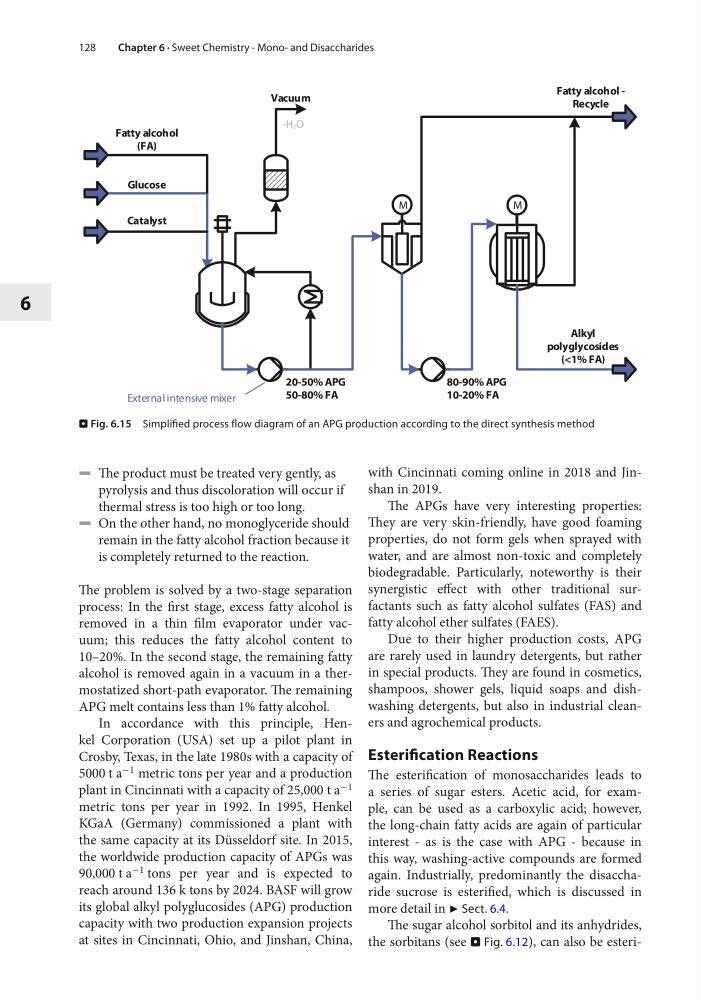
The problem is solved by a two-stage separation
process: In the first stage, excess fatty alcohol is
removed in a thin film evaporator under vacuum; this reduces the fatty alcohol content to
10–20%. In the second stage, the remaining fatty
alcohol is removed again in a vacuum in a thermostatized short-path evaporator. The remaining
APG melt contains less than 1% fatty alcohol.
In accordance with this principle, Henkel Corporation (USA) set up a pilot plant in
Crosby, Texas, in the late 1980s with a capacity of
5000 t a −1 metric tons per year and a production
plant in Cincinnati with a capacity of 25,000 t a −1
metric tons per year in 1992. In 1995, Henkel
KGaA (Germany) commissioned a plant with
the same capacity at its Düsseldorf site. In 2015,
the worldwide production capacity of APGs was
90,000 t a −1 tons per year and is expected to
reach around 136 k tons by 2024. BASF will grow
its global alkyl polyglucosides (APG) production
capacity with two production expansion projects
at sites in Cincinnati, Ohio, and Jinshan, China,
. Fig. 6.15 Simplified process flow diagram of an APG production according to the direct synthesis method
Chapter 6 · Sweet Chemistry - Mono- and Disaccharides
6
with Cincinnati coming online in 2018 and Jinshan in 2019.
The APGs have very interesting properties:
They are very skin-friendly, have good foaming
properties, do not form gels when sprayed with
water, and are almost non-toxic and completely
biodegradable. Particularly, noteworthy is their
synergistic effect with other traditional surfactants such as fatty alcohol sulfates (FAS) and
fatty alcohol ether sulfates (FAES).
Due to their higher production costs, APG
are rarely used in laundry detergents, but rather
in special products. They are found in cosmetics,
shampoos, shower gels, liquid soaps and dishwashing detergents, but also in industrial cleaners and agrochemical products.
Esterification Reactions
The esterification of monosaccharides leads to
a series of sugar esters. Acetic acid, for example, can be used as a carboxylic acid; however,
the long-chain fatty acids are again of particular
interest - as is the case with APG - because in
this way, washing-active compounds are formed
again. Industrially, predominantly the disaccharide sucrose is esterified, which is discussed in
more detail in 7 Sect. 6.4.
The sugar alcohol sorbitol and its anhydrides,
the sorbitans (see . Fig. 6.12), can also be esteri5 The product must be treated very gently, as
pyrolysis and thus discoloration will occur if
thermal stress is too high or too long.
5 On the other hand, no monoglyceride should
remain in the fatty alcohol fraction because it
is completely returned to the reaction.
The problem is solved by a two-stage separation
process: In the first stage, excess fatty alcohol is
removed in a thin film evaporator under vacuum; this reduces the fatty alcohol content to
10–20%. In the second stage, the remaining fatty
alcohol is removed again in a vacuum in a thermostatized short-path evaporator. The remaining
APG melt contains less than 1% fatty alcohol.
In accordance with this principle, Henkel Corporation (USA) set up a pilot plant in
Crosby, Texas, in the late 1980s with a capacity of
5000 t a −1 metric tons per year and a production
plant in Cincinnati with a capacity of 25,000 t a −1
metric tons per year in 1992. In 1995, Henkel
KGaA (Germany) commissioned a plant with
the same capacity at its Düsseldorf site. In 2015,
the worldwide production capacity of APGs was
90,000 t a −1 tons per year and is expected to
reach around 136 k tons by 2024. BASF will grow
its global alkyl polyglucosides (APG) production
capacity with two production expansion projects
at sites in Cincinnati, Ohio, and Jinshan, China,
. Fig. 6.15 Simplified process flow diagram of an APG production according to the direct synthesis method