

126
Chapter 6 · Sweet Chemistry - Mono- and Disaccharides
6
glycosidation of glucose with n-butanol in the
first step followed by the conversion of this
“medium-polar” butyl glucoside with a fatty
alcohol to the desired APG incorporating the
desired long alkyl chain in a second step. During
this “trans-acetalization”, the n-butanol employed
is released again and can be reused in step one.
These two variants are shown in . Fig. 6.14 as
a basic process flow diagram. In both processes,
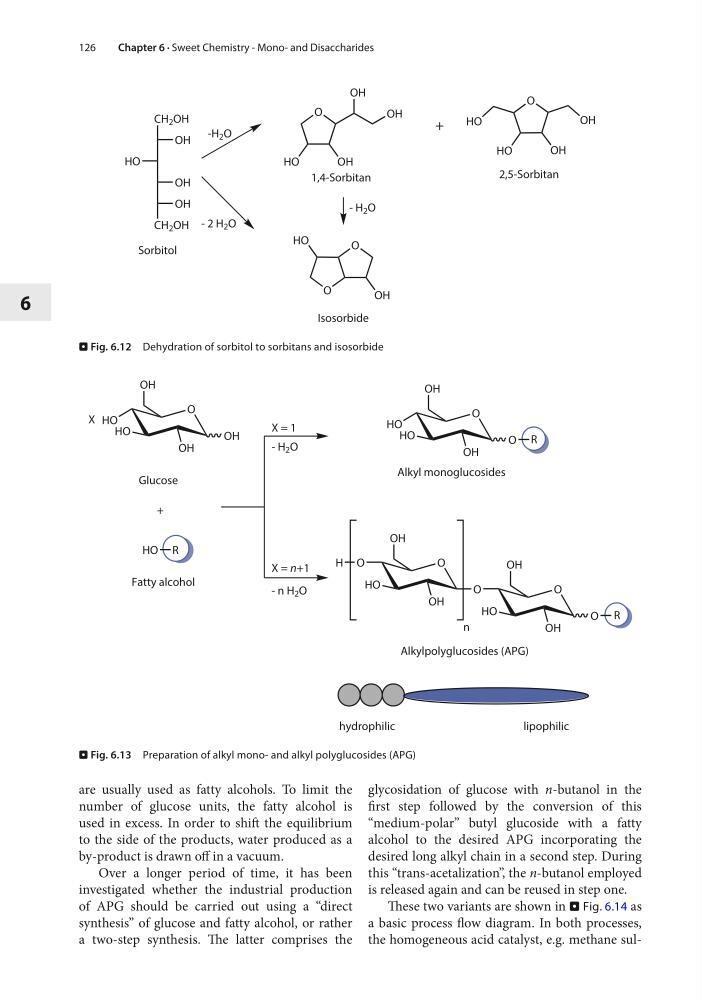
the homogeneous acid catalyst, e.g. methane sulare usually used as fatty alcohols. To limit the
number of glucose units, the fatty alcohol is
used in excess. In order to shift the equilibrium
to the side of the products, water produced as a
by-product is drawn off in a vacuum.
Over a longer period of time, it has been
investigated whether the industrial production
of APG should be carried out using a “direct
synthesis” of glucose and fatty alcohol, or rather
a two-step synthesis. The latter comprises the
O
HO
HO
OH
OH
OH
X
Glucose
HO
Fatty alcohol
X = 1
X = n+1
+
O
HO
HO
OH
OH
O R
Alkyl monoglucosides
O
HO
OH
OH
O
O
O
HO
OH
OH
O
H
n
Alkylpolyglucosides (APG)
- n H 2 O
- H 2 O
hydrophilic
lipophilic
R
R
R
. Fig. 6.13 Preparation of alkyl mono- and alkyl polyglucosides (APG)
CH 2 OH
OH
HO
OH
OH
CH 2 OH
Sorbitol
-H 2 O
- 2 H 2 O
O
HO
OH
OH
OH
1,4-Sorbitan
+
- H 2 O
O
O
HO
OH
O
HO
OH
OH
HO
2,5-Sorbitan
Isosorbide
. Fig. 6.12 Dehydration of sorbitol to sorbitans and isosorbide
Chapter 6 · Sweet Chemistry - Mono- and Disaccharides
6
glycosidation of glucose with n-butanol in the
first step followed by the conversion of this
“medium-polar” butyl glucoside with a fatty
alcohol to the desired APG incorporating the
desired long alkyl chain in a second step. During
this “trans-acetalization”, the n-butanol employed
is released again and can be reused in step one.
These two variants are shown in . Fig. 6.14 as
a basic process flow diagram. In both processes,
the homogeneous acid catalyst, e.g. methane sulare usually used as fatty alcohols. To limit the
number of glucose units, the fatty alcohol is
used in excess. In order to shift the equilibrium
to the side of the products, water produced as a
by-product is drawn off in a vacuum.
Over a longer period of time, it has been
investigated whether the industrial production
of APG should be carried out using a “direct
synthesis” of glucose and fatty alcohol, or rather
a two-step synthesis. The latter comprises the
O
HO
HO
OH
OH
OH
X
Glucose
HO
Fatty alcohol
X = 1
X = n+1
+
O
HO
HO
OH
OH
O R
Alkyl monoglucosides
O
HO
OH
OH
O
O
O
HO
OH
OH
O
H
n
Alkylpolyglucosides (APG)
- n H 2 O
- H 2 O
hydrophilic
lipophilic
R
R
R
. Fig. 6.13 Preparation of alkyl mono- and alkyl polyglucosides (APG)
CH 2 OH
OH
HO
OH
OH
CH 2 OH
Sorbitol
-H 2 O
- 2 H 2 O
O
HO
OH
OH
OH
1,4-Sorbitan
+
- H 2 O
O
O
HO
OH
O
HO
OH
OH
HO
2,5-Sorbitan
Isosorbide
. Fig. 6.12 Dehydration of sorbitol to sorbitans and isosorbide