

125
6
the fatty alcohol): These glucosides are non-ionic
surfactants made exclusively from renewable raw
materials. Glycosidation leads to a side reaction,
the oligomerization of several glucose units.
Instead of an alkyl monoglucoside, alkyl polyglucosides (APG) can also form, in which two or
three glucose units are usually linked to one fatty
alcohol (. Fig. 6.13). Dodecanol or tetradecanol
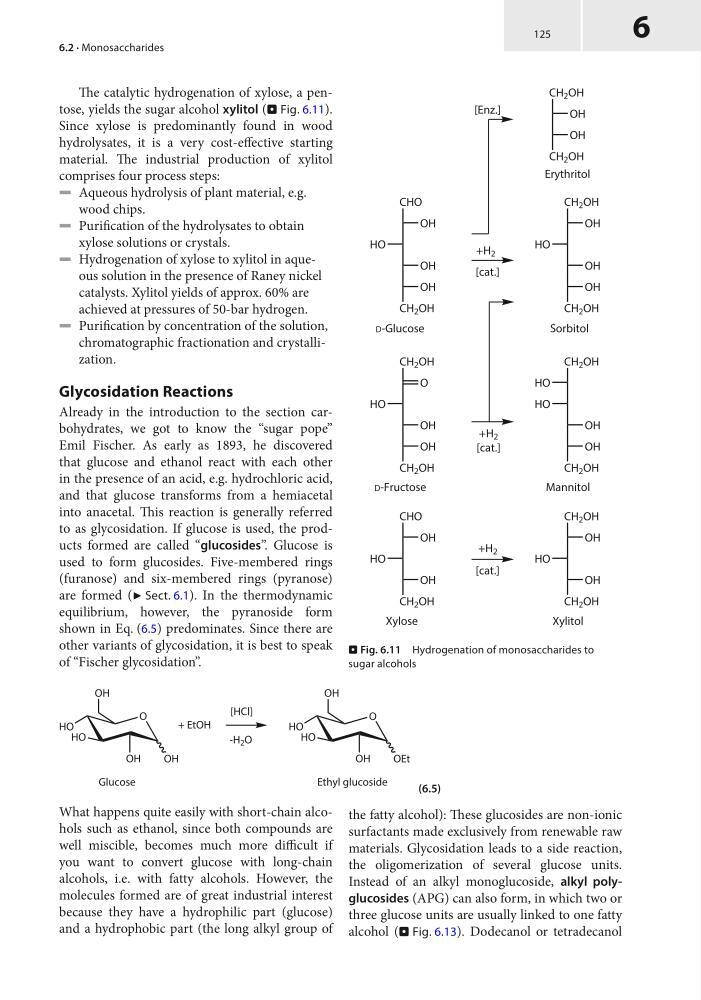
The catalytic hydrogenation of xylose, a pentose, yields the sugar alcohol xylitol (. Fig. 6.11).
Since xylose is predominantly found in wood
hydrolysates, it is a very cost-effective starting
material. The industrial production of xylitol
comprises four process steps:
5 Aqueous hydrolysis of plant material, e.g.
wood chips.
5 Purification of the hydrolysates to obtain
xylose solutions or crystals.
5 Hydrogenation of xylose to xylitol in aqueous solution in the presence of Raney nickel
catalysts. Xylitol yields of approx. 60% are
achieved at pressures of 50-bar hydrogen.
5 Purification by concentration of the solution,
chromatographic fractionation and crystallization.
Glycosidation Reactions
Already in the introduction to the section carbohydrates, we got to know the “sugar pope”
Emil Fischer. As early as 1893, he discovered
that glucose and ethanol react with each other
in the presence of an acid, e.g. hydrochloric acid,
and that glucose transforms from a hemiacetal
into anacetal. This reaction is generally referred
to as glycosidation. If glucose is used, the products formed are called “glucosides”. Glucose is
used to form glucosides. Five-membered rings
(furanose) and six-membered rings (pyranose)
are formed (7 Sect. 6.1). In the thermodynamic
equilibrium, however, the pyranoside form
shown in Eq. (6.5) predominates. Since there are
other variants of glycosidation, it is best to speak
of “Fischer glycosidation”.
What happens quite easily with short-chain alcohols such as ethanol, since both compounds are
well miscible, becomes much more difficult if
you want to convert glucose with long-chain
alcohols, i.e. with fatty alcohols. However, the
molecules formed are of great industrial interest
because they have a hydrophilic part (glucose)
and a hydrophobic part (the long alkyl group of
(6.5)
O
HO
HO
OH
OH
OH
+ EtOH
[HCl]
-H 2 O
Glucose
O
HO
HO
OH
OH
OEt
Ethyl glucoside
CHO
OH
HO
OH
OH
CH 2 OH
CH 2 OH
O
HO
OH
OH
CH 2 OH
CHO
OH
HO
OH
CH 2 OH
CH 2 OH
OH
OH
CH 2 OH
CH 2 OH
OH
HO
OH
OH
CH 2 OH
CH 2 OH
HO
OH
OH
CH 2 OH
HO
CH 2 OH
OH
HO
OH
CH 2 OH
Erythritol
Sorbitol
Mannitol
Xylitol
D-Glucose
D-Fructose
Xylose
[Enz.]
+H 2
[cat.]
+H 2
[cat.]
+H 2
[cat.]
. Fig. 6.11 Hydrogenation of monosaccharides to
sugar alcohols
6.2 · Monosaccharides
6
the fatty alcohol): These glucosides are non-ionic
surfactants made exclusively from renewable raw
materials. Glycosidation leads to a side reaction,
the oligomerization of several glucose units.
Instead of an alkyl monoglucoside, alkyl polyglucosides (APG) can also form, in which two or
three glucose units are usually linked to one fatty
alcohol (. Fig. 6.13). Dodecanol or tetradecanol
The catalytic hydrogenation of xylose, a pentose, yields the sugar alcohol xylitol (. Fig. 6.11).
Since xylose is predominantly found in wood
hydrolysates, it is a very cost-effective starting
material. The industrial production of xylitol
comprises four process steps:
5 Aqueous hydrolysis of plant material, e.g.
wood chips.
5 Purification of the hydrolysates to obtain
xylose solutions or crystals.
5 Hydrogenation of xylose to xylitol in aqueous solution in the presence of Raney nickel
catalysts. Xylitol yields of approx. 60% are
achieved at pressures of 50-bar hydrogen.
5 Purification by concentration of the solution,
chromatographic fractionation and crystallization.
Glycosidation Reactions
Already in the introduction to the section carbohydrates, we got to know the “sugar pope”
Emil Fischer. As early as 1893, he discovered
that glucose and ethanol react with each other
in the presence of an acid, e.g. hydrochloric acid,
and that glucose transforms from a hemiacetal
into anacetal. This reaction is generally referred
to as glycosidation. If glucose is used, the products formed are called “glucosides”. Glucose is
used to form glucosides. Five-membered rings
(furanose) and six-membered rings (pyranose)
are formed (7 Sect. 6.1). In the thermodynamic
equilibrium, however, the pyranoside form
shown in Eq. (6.5) predominates. Since there are
other variants of glycosidation, it is best to speak
of “Fischer glycosidation”.
What happens quite easily with short-chain alcohols such as ethanol, since both compounds are
well miscible, becomes much more difficult if
you want to convert glucose with long-chain
alcohols, i.e. with fatty alcohols. However, the
molecules formed are of great industrial interest
because they have a hydrophilic part (glucose)
and a hydrophobic part (the long alkyl group of
(6.5)
O
HO
HO
OH
OH
OH
+ EtOH
[HCl]
-H 2 O
Glucose
O
HO
HO
OH
OH
OEt
Ethyl glucoside
CHO
OH
HO
OH
OH
CH 2 OH
CH 2 OH
O
HO
OH
OH
CH 2 OH
CHO
OH
HO
OH
CH 2 OH
CH 2 OH
OH
OH
CH 2 OH
CH 2 OH
OH
HO
OH
OH
CH 2 OH
CH 2 OH
HO
OH
OH
CH 2 OH
HO
CH 2 OH
OH
HO
OH
CH 2 OH
Erythritol
Sorbitol
Mannitol
Xylitol
D-Glucose
D-Fructose
Xylose
[Enz.]
+H 2
[cat.]
+H 2
[cat.]
+H 2
[cat.]
. Fig. 6.11 Hydrogenation of monosaccharides to
sugar alcohols
6.2 · Monosaccharides